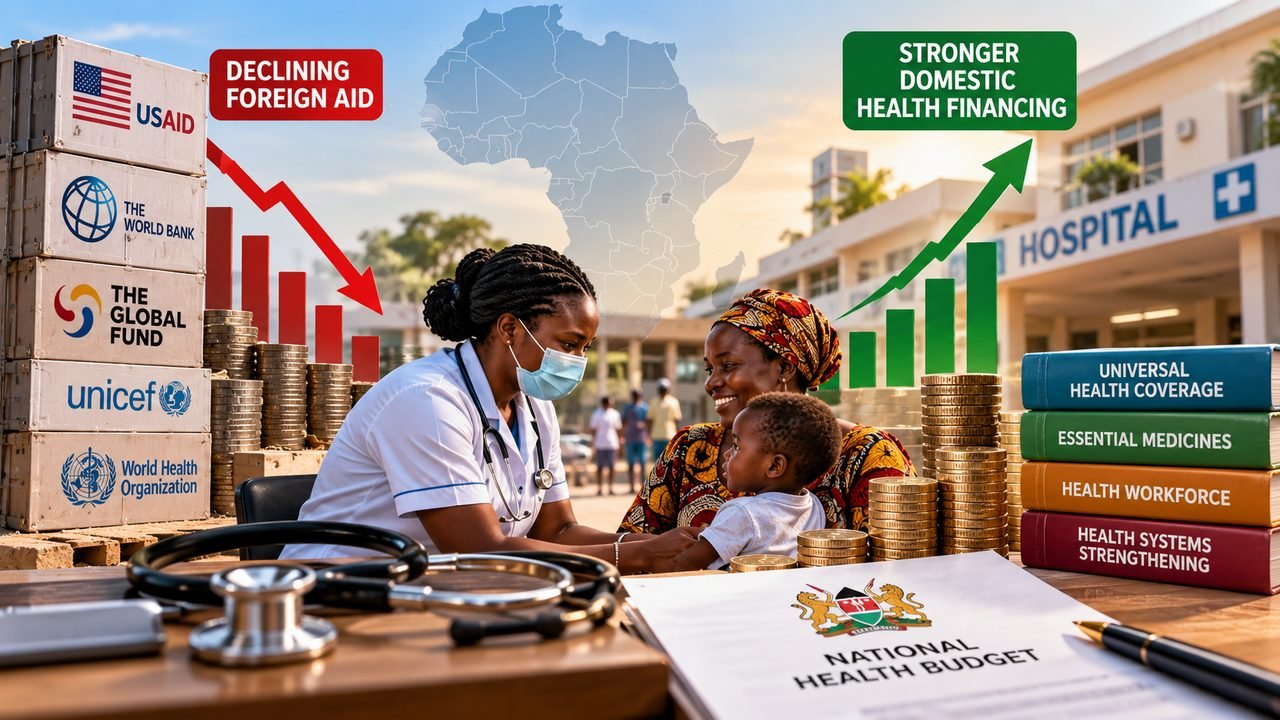
Africa is facing a critical question about the future of healthcare: who will pay for essential health services as international assistance declines and governments struggle with competing financial demands?
For decades, development partners have supported HIV treatment, tuberculosis and malaria programmes, immunisation, maternal and child health, disease surveillance and emergency responses across the continent. That support has helped expand access to services, but dependence on external funding has left some health systems vulnerable when donor priorities and budgets change.
The pressure is becoming more pronounced. According to preliminary estimates published by the Institute for Health Metrics and Evaluation (IHME) in October 2026, global development assistance for health fell by 12% in 2025 and is estimated to have declined by a further 5% in 2026. The figures are estimates of global financing, not a measure of the reduction experienced by every African country. Source: Think Global Health, October 2026
For African governments, the challenge is to maintain essential services, protect households from medical costs and build financing systems that can withstand future shocks without relying excessively on unpredictable external support.
How much does Africa depend on external health funding?
The scale of dependence differs considerably between countries and programmes. Some governments finance a substantial share of their health systems domestically, while others rely heavily on international partners to sustain specific disease-control programmes and essential services.
Africa CDC’s analysis of the continent’s health financing landscape estimates that external assistance accounts for about 23% of total health expenditure across Africa, while government sources account for approximately 35% and out-of-pocket payments another 35%. These continental averages conceal major differences between countries. In some lower-income settings, donor funding accounts for a much larger proportion of health spending.
The consequences of funding reductions can extend beyond individual projects. Where external assistance supports medicines, laboratory services, health workers, community outreach or disease surveillance, a reduction may create pressure on national budgets to fill the gap. If replacement financing is not available, programmes may have to narrow their activities or prioritise the most urgent needs.
The Africa CDC analysis on financing health security and sovereignty identifies declining external assistance, rising public debt and population growth among the pressures reshaping health financing across the continent.
What happens when international assistance falls?
The effects depend on which programmes lose funding, how quickly the reductions occur and whether governments or other partners can replace the money.
HIV, tuberculosis, malaria, immunisation and reproductive health services are among the areas exposed to reductions in international assistance. The Organisation for Economic Co-operation and Development (OECD) projected that official development assistance to sub-Saharan Africa would decline by 11.6% in 2026. Its analysis also projected substantial reductions in development assistance for health between 2024 and 2026, including support for communicable disease control. These are projections rather than final expenditure figures.
For health facilities and communities, the risks may include shortages of essential commodities, fewer outreach activities, pressure on laboratory services and difficulties sustaining staff or other programme costs. The actual effect will vary by country and funding arrangement, and should be established using national budgets, programme reports and facility-level evidence rather than assumed from global estimates alone.
Funding uncertainty can also affect preparedness for epidemics. Surveillance networks, laboratory capacity and rapid-response teams require sustained investment, including between emergencies. If routine financing is inadequate, countries may find it harder to respond quickly when a new outbreak emerges.
The OECD’s projections for official development assistance in 2026 provide further detail on the expected funding pressures.
Can African governments fill the financing gap?
Domestic financing will need to play a larger role, but increasing public spending is not straightforward.
Governments must balance healthcare against education, infrastructure, debt repayment, social protection and other public services. High debt-servicing costs can leave limited room for new spending, while weak revenue collection and economic pressures constrain the resources available to ministries of finance.
Nevertheless, governments have options to strengthen health financing. These include increasing predictable budget allocations, improving tax collection, reviewing inefficient expenditure, strengthening public financial management and ensuring that approved health budgets are actually released and spent.
The objective should not simply be to spend more. Countries also need to improve purchasing arrangements, reduce waste, use health data to identify unmet needs and direct resources towards services with the greatest potential to improve health outcomes.
In August 2026, the World Health Organization’s African regional committee endorsed the Strategy for Financing the Future of Health in the WHO African Region, 2026–2035. The strategy calls for stronger domestic resource mobilisation, improved pooling of funds, more strategic purchasing and better public financial management.
WHO estimates that around 385 million people in its African Region are pushed into or deeper into poverty each year because of out-of-pocket health expenditure. The strategy aims to make health systems more sustainable while reducing the financial hardship families experience when seeking care.
Read WHO’s strategy on sustainable health financing in Africa.
Why health insurance alone will not solve the problem
Health insurance can help pool financial risks and reduce the amount households pay directly when they need care. However, an insurance scheme cannot provide reliable coverage unless it has sufficient, predictable revenue and pays for services effectively.
Countries expanding health insurance must consider who contributes, which services are covered, how vulnerable populations are supported and whether healthcare providers are reimbursed on time. Delays in payments can create cash-flow pressures for hospitals and clinics, even when patients are formally insured.
Insurance reforms therefore need to be linked to realistic benefit packages, sound purchasing arrangements, reliable claims systems and adequate funding for primary healthcare.
For informal workers and low-income households, governments may also need to subsidise contributions or finance essential services through general revenue. Otherwise, people who cannot afford premiums or other required payments may remain excluded from effective access to care.
The measure of success is not simply how many people are registered with a scheme. It is whether they can obtain needed services without facing unaffordable costs.
Can regional cooperation lower the cost of healthcare?
African countries may also reduce costs by working together to negotiate better prices for medicines, diagnostics, vaccines and other health products.
Pooled procurement can combine demand across participating countries, potentially strengthening negotiating power and creating more predictable markets for suppliers. Stronger regional regulation and local manufacturing can complement these efforts, provided that products meet quality standards and procurement systems remain transparent.
Regional cooperation is particularly relevant for diseases that cross borders. Joint investment in surveillance, laboratory networks, emergency supplies and information-sharing can help countries prepare for outbreaks that no single government can manage effectively alone.
However, pooled procurement and local manufacturing are not immediate substitutes for adequate health budgets. They require sustained financing, strong institutions, reliable demand and effective oversight.
Africa CDC has identified sustainable financing, health security and greater continental ownership of health priorities as important parts of the transition away from excessive dependence on external assistance.
Read Africa CDC’s analysis of health financing and sovereignty.
Kenya illustrates the challenge
Kenya is pursuing reforms intended to strengthen domestic health financing, including the Social Health Authority (SHA) and changes to how healthcare services are funded and purchased.
The Ministry of Health has presented Taifa Care and the SHA as part of a broader effort to expand coverage and strengthen domestic financing. But the success of these reforms will depend on more than registration figures. Reliable contributions, timely payments to providers, clear benefit entitlements and transparent financial reporting will all matter.
Kenya also faces pressure to sustain programmes historically supported by international partners. A Kenya News Agency report published earlier in 2026 cited a substantial decline in external health funding between the 2024/25 and 2025/26 financial years, alongside reductions affecting several disease programmes. Those figures relate to the reporting period and should not be treated as a measure of all current health expenditure.
The country’s experience highlights a wider continental question: how can governments replace uncertain external funding without shifting the burden onto patients or weakening essential services?
Kenya’s Ministry of Health has also called for stronger domestic resource mobilisation, local manufacturing and digital transformation as part of efforts to build a more self-reliant health sector.
Read the Ministry of Health’s statement on a self-reliant African health sector.
What solutions can make health financing more sustainable?
There is no single financing model that will work for every African country. A more resilient approach is likely to combine several measures:
1. Protect essential health budgets. Governments should identify high-priority services and ensure that allocations are predictable, released on time and monitored against actual expenditure.
2. Expand domestic revenue fairly. Countries can improve tax collection and assess health-related taxes where appropriate, while protecting low-income households from regressive costs.
3. Pool health risks and protect vulnerable households. Well-designed insurance schemes and publicly financed essential services can reduce dependence on direct payments at the point of care.
4. Improve spending efficiency. Better procurement, stronger claims management, transparent budgeting and evidence-based purchasing can help available funds deliver more services.
5. Coordinate donor transitions. Development partners and governments should agree on realistic timelines, clarify which services require replacement financing and avoid abrupt withdrawals that leave essential programmes without resources.
6. Invest in regional public goods. Joint surveillance, laboratory systems, medicine procurement and emergency preparedness can spread costs and strengthen responses across borders.
7. Make funding results measurable. Governments should publish information on allocations, releases, spending, service coverage and outcomes so that citizens and policymakers can see whether additional financing is making a difference.
Who is helping shape Africa’s next financing model?
Several institutions are contributing to the discussion.
The World Health Organization is promoting stronger domestic financing and improved financial protection through its 2026–2035 regional strategy. Africa CDC is advocating for greater African ownership of health security and more sustainable financing. The United Nations Economic Commission for Africa is working to strengthen coordination between finance and health ministries and develop approaches that can turn financing strategies into funded programmes.
African governments remain central to the process. Development partners, multilateral institutions, philanthropic organisations and private-sector actors can contribute resources and technical support, but external funding should complement rather than replace the long-term responsibility of governments to finance essential public services.
The key challenge is to move from declarations and financing pledges to credible budgets, actual disbursements and measurable improvements in access to healthcare.
The way forward
Africa’s changing health financing landscape is not simply a question of replacing donor money with government money. It is an opportunity to reconsider how health services are funded, how public resources are used and how the financial burden is shared.
Domestic financing will need to increase where fiscal conditions allow, but the transition must be realistic. Countries facing high debt, limited revenue and substantial health needs will continue to require international cooperation. Abruptly withdrawing external assistance without a credible transition plan could undermine services and reverse hard-won progress.
The long-term goal should be a financing system in which governments can sustain essential services, external partners provide predictable and complementary support, and households are protected from catastrophic medical costs.
Ultimately, the test of Africa’s health financing reforms will not be the number of funding announcements or insurance registrations. It will be whether people can obtain the healthcare they need, when they need it, without being pushed further into poverty.
Discussion