Saturday, 14 November 2026 — Africa’s health agenda over the past 48 hours has been shaped by renewed warnings over the Bundibugyo Ebola outbreak in the Democratic Republic of the Congo (DRC), Nigeria’s completion of monitoring for all 62 identified contacts of its imported case, new WHO evidence on tuberculosis financing and a continental agreement to strengthen health information systems. Kenya is also preparing for the peak of the October–December rains, with authorities warning that 1.5 million people could be affected by flooding.
The developments show how health security depends on more than emergency response. Surveillance, trusted community engagement, reliable health data, sustainable financing and resilient primary healthcare are all central to protecting progress.
Central Africa: DRC Ebola response faces insecurity and access constraints
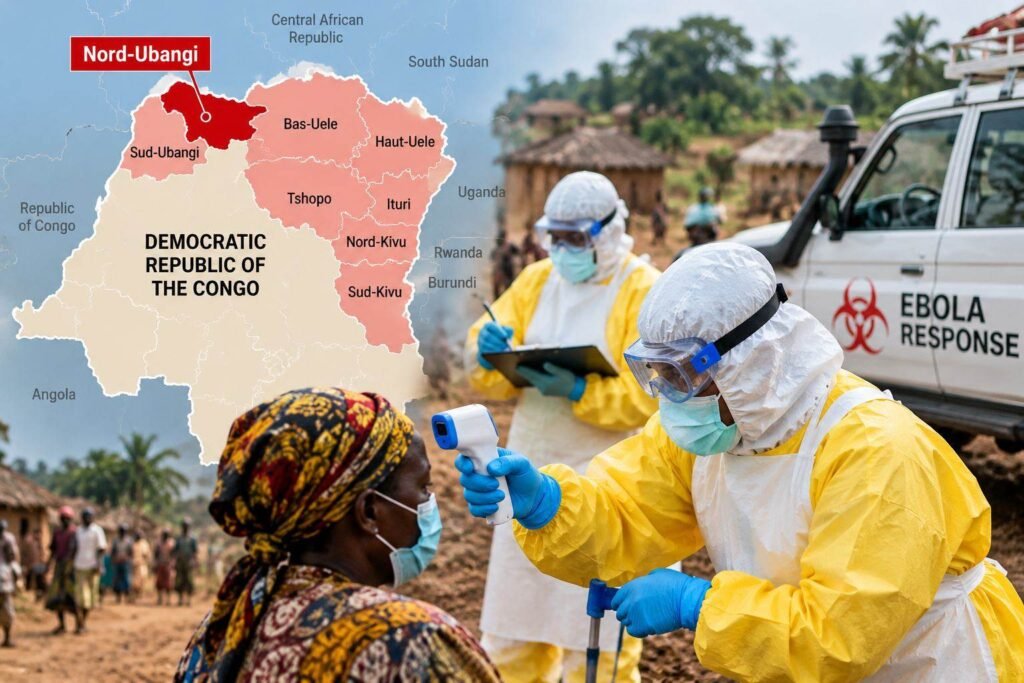
United Nations health officials said on 13 November that the Ebola response in the DRC has made progress in some former hotspots but that the outbreak continues to spread into more remote and difficult-to-reach areas. WHO Health Emergencies Programme chief Chikwe Ihekweazu identified rising insecurity as the response’s biggest challenge and cited 80 attacks on health sites and workers.
The Associated Press reported on 13–14 November that Congolese authorities had recorded 11,042 infections and 5,387 deaths since the outbreak was declared in May. These are reported national figures, not a new WHO case bulletin published on 14 November. The Bundibugyo virus is responsible; there is no approved vaccine or specific treatment for this strain. Candidate countermeasures remain under evaluation and should not be presented as available licensed products.
MSF has raised concerns about missing supplies and continuing transmission. The UN response coordinator has emphasised the scale of the operating area and the difficulty of maintaining access. For further reporting, see Health Signal Africa’s coverage of the DRC Ebola response. For health systems, the immediate priorities remain safe access for response teams, contact investigation, laboratory capacity, infection prevention and control, continuity of essential services and protection of health workers.
Sources: Reuters, 13 November 2026; Associated Press, DRC outbreak update; ECDC outbreak updates.
West Africa: Nigeria completes monitoring of 62 Ebola contacts
Nigeria’s Centre for Disease Control and Prevention (NCDC) said on 13 November that all 62 contacts identified after the country’s imported Bundibugyo Ebola case had completed the 21-day monitoring period without developing the disease. Thirteen contacts reported fever or other non-specific symptoms during follow-up, but all tested negative. Seven additional Ebola alerts investigated across five states during the preceding three weeks also tested negative.
The imported case was confirmed on 20 October in a Swiss woman who had travelled to Uganda before returning to Nigeria. She and her husband were evacuated to Switzerland, where she recovered and was discharged. The NCDC said that completing contact monitoring does not itself mean the outbreak is over. WHO protocol requires a 42-day period from the recovery or departure of the last confirmed patient before a country can make an official end-of-outbreak declaration.
The NCDC’s online dashboard, generated on 13 November, still displays epidemiological data with a cut-off of 11 November and therefore does not yet reflect Friday’s completion of all 62 contacts. It records one confirmed case and no deaths. This reporting lag should be kept in mind when comparing the dashboard with the 13 November NCDC statement reported by Reuters.
Sources: Reuters, 13 November 2026; NCDC Ebola outbreak dashboard; WHO multi-country Bundibugyo disease outbreak report.
East Africa: South Sudan’s Ebola readiness improves, but containment gaps remain
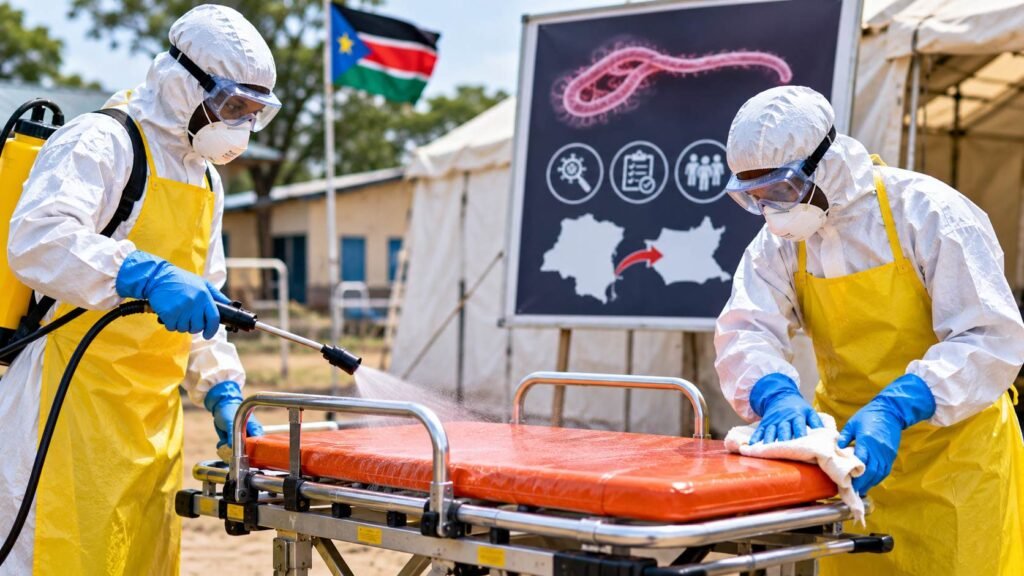
WHO reported on 12 November that South Sudan had not recorded a confirmed Bundibugyo virus disease case, but its estimated risk of virus importation from the DRC had risen to 99% in October. A joint assessment identified 3,450 people who had crossed from the DRC into South Sudan in September amid community concern and cross-border movement.
National readiness stood at 72.5% at the end of October. WHO said 76 alerts had been recorded by 30 October and investigated; 33 tested negative by RT-PCR, with the remainder discarded. A full-scale simulation exercise conducted from 19 to 24 October found that South Sudan could detect a suspected case but could not yet contain it safely. The exercise identified weaknesses in the hand-offs between response pillars, infection prevention supplies, safe referral, specimen handling and patient flow.
The findings underline the need to convert preparedness plans into operational capacity at border facilities and in high-risk counties. WHO said 150 health workers had been trained in Ebola case management across 15 priority counties between May and October, while temporary infectious-disease units had been established in eight counties.
Source: WHO, 12 November 2026.
Pan-African: WHO tuberculosis report highlights financing and diagnostic gaps
The WHO Global Tuberculosis Report 2026, released on 12 November, estimates that 10.6 million people developed TB worldwide in 2025 and 1.13 million died. The incidence rate in the WHO African Region fell by 30% between 2015 and 2025, while TB deaths in the region fell by 50% over the same period. The region continues to carry a substantial share of the global burden. WHO’s regional estimates put 2025 incidence at approximately 2.61 million cases, or one-quarter of the global total, equivalent to 201 cases per 100,000 people. Eleven countries in the region still had incidence rates above 300 per 100,000.
WHO reported that total funding for TB prevention, diagnosis and treatment across 131 low- and middle-income countries reached US$6.6 billion in 2025, an increase of US$550 million from 2024. Domestic sources accounted for 86% of the total, while international donor funding fell by 14%, from US$1.1 billion to US$940 million. However, 54 countries reported insufficient funding to implement their 2026 national TB plans, with a combined reported gap of US$1.7 billion. Among high-burden countries, Kenya reported a US$121 million gap and Nigeria US$85 million. These are planning shortfalls, not proof that the full amounts have been withdrawn or that services have already stopped.
Globally, 59% of newly diagnosed patients received a WHO-recommended rapid diagnostic test as their initial test in 2025. WHO recorded 155,333 people enrolled on treatment for rifampicin-resistant TB, 5.8% fewer than in 2024; the number remained far below the estimated incidence of drug-resistant disease. Among people treated for rifampicin-resistant TB, use of six-month regimens increased from 18% in 2024 to 42% in 2025. In the African Region, bacteriological confirmation of pulmonary TB improved from 65% to 71% between 2020 and 2025. The figures reinforce the need to protect national budgets, expand rapid molecular diagnosis, integrate TB and HIV services and improve access to drug-resistant TB treatment.
Related coverage: WHO’s 2026 TB burden and financing analysis. Sources: WHO Global Tuberculosis Report 2026; WHO diagnostic testing analysis; WHO drug-resistant TB treatment analysis; WHO news release, 12 November 2026; WHO TB financing analysis.
Pan-African: 51 countries adopt Nairobi Health Data Action Agenda
Government representatives and health partners adopted the Nairobi Health Data Action Agenda at the conclusion of the First Africa Health Data Forum in Nairobi on 12 November. WHO said the three-day forum brought together more than 300 participants from 51 countries across the WHO African and Eastern Mediterranean regions. All 51 countries adopted the agenda.
The agenda sets out eight priorities to help countries move from collecting health information to using it to guide policy, investment and service delivery. Priorities described by WHO include stronger national leadership, sustainable domestic financing, better data quality, connected information systems, investment in skilled professionals, responsible use of digital health and artificial intelligence, and routine use of evidence in planning and resource allocation.
Two WHO assessments launched at the forum found continuing weaknesses. An assessment of 40 countries recorded an overall health-information-system maturity score of 59 out of 100. A separate SCORE 2025 assessment of 52 countries found that none had reached the highest level of sustainable capacity for using data and evidence effectively in policy and action. Implementation of the Nairobi agenda will be guided by a continental results and accountability framework through 2030, with annual national reviews.
Related coverage: African health leaders adopt the Nairobi Health Data Action Agenda. Sources: WHO, 12 November 2026; WHO Kenya, 13 November 2026.
East Africa: Kenya prepares for flood-related health risks
Kenya is preparing for heavier-than-usual rainfall during the October–December short-rains season, with November expected to be the peak. The National Disaster Operations Centre has warned that about 1.5 million people could be affected and urged residents in flood-prone areas to move to safer ground. In Nairobi, county officials told the Associated Press that approximately 172 potential shelter venues had been identified to provide food and medicine if evacuations are required, and that mobile-phone alerts were being planned with Safaricom.
WHO’s September assessment said 18 counties and 5,660 health facilities had been identified in at-risk areas, while overall flood preparedness was assessed at 54%. The Ministry of Health has activated a health-sector El Niño contingency plan. Flooding can contaminate water supplies, damage sanitation systems, interrupt access to clinics and disrupt medicine supply chains. WHO has warned that crowded shelters and contaminated water can increase cholera risk. Other waterborne and vector-borne risks depend on local conditions and should be monitored rather than assumed.
The 1.5 million figure is a preparedness estimate, not a count of people already affected by floods. The 172 shelter sites refer to Nairobi County, not the entire country. Health authorities and county governments need to protect water and sanitation services, strengthen disease surveillance, pre-position essential medicines and maintain continuity of maternal, child, TB, HIV and chronic-disease services.
Related coverage: El Niño’s wider food-security and health implications across Africa. Sources: Associated Press, 13 November 2026; WHO Kenya, 8 September 2026; WHO Kenya, 28 September 2026; Kenya Meteorological Department forecasts.
Technology and innovation watch
- Health data interoperability: The Nairobi agenda prioritises connected national information systems, data quality, skilled personnel and responsible use of AI. The next test is whether countries cost and finance implementation through 2030.
- Emergency alerts: Nairobi County plans to work with Safaricom on mobile alerts for flood-related emergencies. The initiative is a plan, not a confirmed operational alert service.
- TB diagnostics: WHO’s finding that 59% of newly diagnosed patients globally received a recommended rapid test highlights the need to expand access to molecular diagnostics and link results to treatment.
- Outbreak surveillance: South Sudan’s alert investigations, border screening and simulation exercises show the importance of specimen transport, referral pathways and infection prevention alongside digital reporting.
Health opportunities watch
- Programme Director – Mozambique, The MENTOR Initiative: Cabo Delgado; 10-month assignment; deadline 17 November 2026. Requires at least five years managing field-level humanitarian and health/vector-control programmes, Portuguese and English fluency, and experience in complex security settings. Official vacancy.
- Mental Health and Psychosocial Support Flying Manager – Nigeria, ALIMA: Six-month contract, renewable subject to funding and performance; deadline 7 December 2026. Requires a professional master’s degree in clinical or health psychology, humanitarian experience, at least three years of psychological practice and fluent English. Salary depends on experience plus per diem; travel, accommodation and medical cover are provided. Official vacancy.
- Supplier Prequalification RFP-2026-EA-007 – MSF Eastern Africa: Companies, firms and consortia may apply for seven goods and service categories. Confirmation of participation is due 18 November and bids by 2 December 2026. Applicants must read the main RFP and the relevant terms of reference. Official tender.
Editorial note and limitations
This briefing covers significant developments published from 12 to 14 November 2026, with earlier WHO preparedness material used only to provide context for current reporting. The DRC case and death totals are attributed to AP reporting of national figures; Reuters provides the latest operational assessment of insecurity. Nigeria’s NCDC dashboard is dated 13 November but contains data only through 11 November, so the 13 November statement reported by Reuters is used for completion of contact monitoring. Forecast and preparedness estimates are not actual impact counts. No new clinical-trial efficacy results were identified in this review, and investigational Bundibugyo countermeasures are not described as approved products.


Discussion