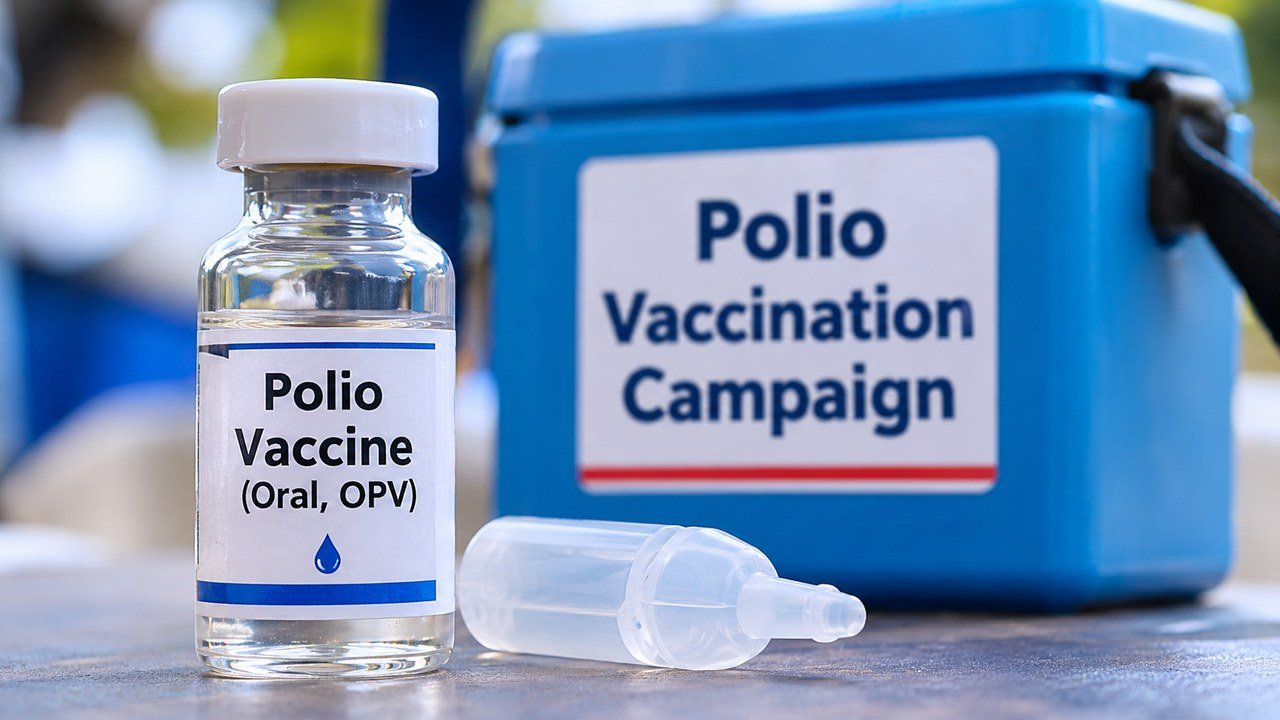
South Sudan is conducting a nationwide polio vaccination campaign targeting approximately 3.9 million children aged 0–59 months as health authorities work to stop transmission of circulating vaccine-derived poliovirus types 1 and 2. The Ministry of Health is leading the campaign with support from the World Health Organization, UNICEF and other partners. Vaccination teams are administering novel oral polio vaccine type 2 (nOPV2) and bivalent oral polio vaccine (bOPV) as part of the response to the two circulating virus types.
Two poliovirus types are being addressed
The campaign responds to concurrent outbreaks of circulating vaccine-derived poliovirus type 1 and type 2. According to WHO, as of 19 October 2026, South Sudan had confirmed 18 cVDPV1 cases and four cVDPV2 cases detected through acute flaccid paralysis surveillance. Environmental surveillance had also identified two isolates of each virus type. These figures are a time-specific update from the WHO report and should not be treated as a current cumulative total beyond that reporting date.
Polio is a highly infectious disease that can cause paralysis, particularly in children. Circulating vaccine-derived polioviruses can emerge when weakened virus contained in oral polio vaccines circulates for an extended period in populations where immunisation coverage is low. The risk is reduced when communities maintain high coverage and children receive the recommended vaccine doses. The presence of two circulating types makes it important for the response to use the appropriate vaccines and maintain surveillance for both.
First-round coverage and missed children
The first nationwide round was scheduled for 13–16 October 2026, although implementation was staggered in some locations because of operational and logistical challenges. By 19 October, 73 counties had completed the round, six were still implementing it and one county had not yet started because of access challenges. WHO reported that more than 3.3 million children under five—about 84% of the reported first-round target of 3.8 million—had received both vaccines by that date.
The national campaign target is approximately 3.9 million children. The difference between the overall target and the reported first-round denominator reflects the figures as presented in the WHO release; coverage should therefore always be quoted with its date and denominator. The 84% figure indicates substantial reach, but it also means that children remained unreached at the time of reporting. In an outbreak response, missed children matter because pockets of low immunity can allow the virus to continue circulating even when national coverage appears relatively high.
Reaching communities facing access barriers
South Sudan faces insecurity, population displacement and communities that are difficult to reach because of distance, poor roads or disrupted services. These conditions can make it challenging for vaccination teams to complete house-to-house visits, maintain cold-chain operations and return to households where children were absent during the first visit. The WHO report describes teams reaching families in Yei and other communities, including households that had not previously been reached by vaccinators. Community engagement is therefore a core part of the response, not an optional communication activity.
Parents and caregivers need clear information about why children should receive the recommended oral vaccine doses, where vaccination teams are operating and how to seek vaccination if a child was missed. Local leaders, community health workers and volunteers can help teams identify mobile households, respond to concerns and plan routes that include remote settlements. Authorities also need reliable vaccine supplies, trained vaccinators, transport and supervision to ensure that doses are delivered safely and that campaign data accurately identify missed children.
Second round and continued surveillance
A second campaign round is planned for November 2026. It will be important for health authorities and partners to review the first round, identify areas where coverage was lower, and direct additional effort to counties and communities that were not reached. Repeated vaccination is a standard part of outbreak response because children may miss a round for many reasons, including illness, travel, displacement or absence from home. The response must make it possible for families to catch up.
Vaccination campaigns need to operate alongside strong surveillance. Acute flaccid paralysis surveillance helps detect suspected polio cases, while environmental surveillance can identify poliovirus in wastewater and provide evidence of circulation. These systems help authorities monitor whether transmission is continuing and where response measures may need to be intensified. The next indicators to watch are second-round coverage, completion in the counties that had not finished the first round by 19 October, and updated surveillance findings for both virus types. The goal is not simply to reach a large number of children once, but to protect every eligible child and interrupt transmission.
Discussion