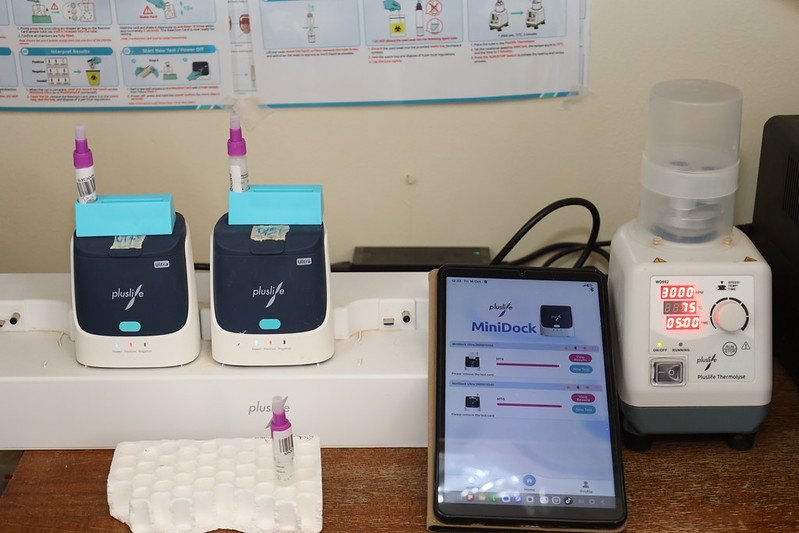
Thika, Kenya — A pilot project in Kiambu County is evaluating whether near-point-of-care tuberculosis (TB) diagnostics and an artificial intelligence (AI)-enabled digital stethoscope can help health workers confirm TB in patients who are unable to produce sputum for testing.
The initiative, known as the Near Point-of-Care TB Diagnostics and Digital AI Stethoscope to Accelerate Case Confirmation, Equity, and Scale-Up (NPOC ACCESS) project, is being implemented in Thika, Juja, Lari and Limuru sub-counties. It is designed to assess diagnostic approaches for people who may be missed or experience delays when conventional sputum-based testing is difficult.
What the pilot is evaluating
The project is assessing a near-point-of-care Mini-Doc MTB assay alongside an AI-enabled digital stethoscope. The approach is intended to support TB case confirmation, particularly among patients who cannot easily provide sputum samples.
The programme uses a two-arm, cluster-based evaluation design. The intervention approach is being assessed against the standard of care, allowing the project team to examine how the new tools perform within routine service settings and whether they can be integrated into existing TB diagnostic pathways.
Training and county and sub-county entry activities have focused on the project’s objectives, implementation timelines, recruitment, sample collection, documentation and the NPOC implementation roadmap. Operational considerations include device uptime, Bluetooth connectivity and consistent recording of study information.
Why alternative sampling approaches matter
Sputum collection can be difficult for some people with presumptive TB, including patients who are unable to produce a sample despite repeated attempts. This can delay diagnostic confirmation and create additional demands on patients and health workers.
Near-point-of-care testing and digital auscultation tools are being explored as ways to support diagnostic assessment closer to where patients receive care. Their value will depend on diagnostic performance, usability, workflow requirements, reliability and the ability of facilities to act on results.
Objectives are not yet results
NPOC ACCESS is a pilot evaluation. Its objectives include assessing the feasibility and performance of the diagnostic tools, understanding how they fit into service delivery and generating evidence to inform decisions about possible scale-up.
Results from the pilot have not yet been published or provided for this report. The project should therefore not be described as having improved TB detection, shortened turnaround times or demonstrated diagnostic accuracy. Those conclusions would require analysed findings from the evaluation.
As implementation proceeds, important questions will include whether the tools can reliably support case confirmation, how well they work for patients unable to produce sputum, what training and maintenance they require, and whether facilities can sustain their use.
What would determine wider use?
Before adoption at scale, evidence will be needed on diagnostic performance compared with the relevant reference standard, patient acceptability, cost, staff workload, equipment reliability and the availability of maintenance and technical support. Implementation findings should also clarify which patients are most likely to benefit and how the tools fit alongside existing molecular testing pathways.
For county health teams, the practical question is not only whether a device can generate a result, but whether it can be used consistently, linked to treatment decisions and supported within routine budgets and workflows.
Source and limitations
Source: NPOC ACCESS project information and implementation details shared with Health Signal Africa. The project is described as an evaluation in Thika, Juja, Lari and Limuru sub-counties of Kiambu County.
No outcome dataset, peer-reviewed publication or final evaluation report was available for this article. The tools’ effectiveness, diagnostic accuracy, impact on turnaround time and readiness for scale-up are therefore not established here. This article reports the project’s objectives and implementation focus, not demonstrated results.




Discussion