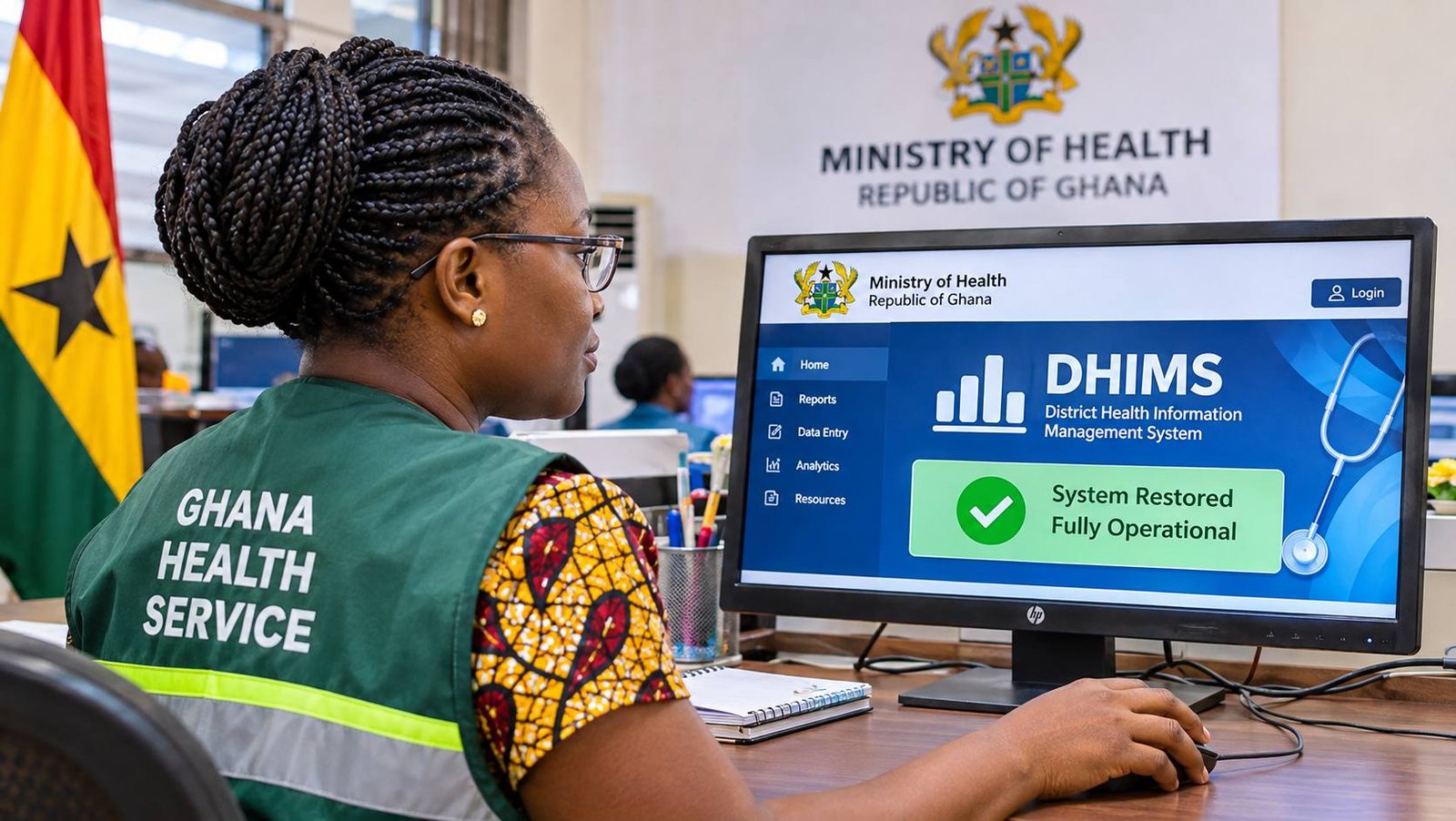
ACCRA, 7 November 2026 — Ghana’s Ministry of Health says the District Health Information Management System (DHIMS) has been restored and is fully operational after a temporary disruption that interrupted access to the national district-level health information platform. The announcement, issued on 6 November, follows reports that the Ghana Health Service had been unable to access several systems hosted on servers suspended over an outstanding payment.
The Ministry said DHIMS, which is managed by the Ghana Health Service (GHS), supports the collation and management of health information at district level. It thanked stakeholders for their patience during the disruption and reaffirmed its commitment to strengthening digital systems for health-service delivery and data management.
The Ministry also clarified that the Ghana Health Information Management System (GHIMS), used by hospitals to manage patient and medical records, was not affected and remained operational throughout the period. The distinction is important: the disruption to DHIMS should not be described as a shutdown of hospital patient records or as a loss of individual clinical files.
Outage followed suspension of hosted servers
Reports based on an internal GHS memorandum say the disruption began on 29 October after cloud-hosting provider Akamai suspended 10 servers associated with the Service’s account. The memorandum, dated 2 November and circulated to regional and divisional directors, cited an outstanding payment of US$64,510.95. The GHS Director-General said the shutdown had not resulted in a security breach or loss of data and that encrypted backups were held outside the suspended account.
The same memorandum, as reported by Ghanaian media, listed other services whose web access or integration had been affected, including the Planning and Budget Management Information System, eTracker, family-planning and health-care platforms, HIV and tuberculosis trackers, the National Malaria Data Repository, a non-communicable disease tracker and the Community Health Information Management portal. Some Android applications were reportedly able to continue collecting information offline.
During the outage, facilities and district offices were instructed to continue using paper registers and monthly summary forms so that routine information for October and November could be entered once access was restored. This approach can help preserve records during a technical interruption, but it also creates additional work for staff and requires careful reconciliation to avoid duplicate, delayed or incomplete reporting.
Restoring access is only the first step
The Ministry’s 6 November statement confirms the restoration of DHIMS, but it does not provide a system-by-system account of whether every other platform listed in the GHS memorandum has returned to service. That status should be clarified by the Ghana Health Service, particularly for systems supporting disease surveillance, immunisation reporting, programme monitoring and planning.
Ghana’s experience illustrates a broader challenge in digital health transformation. Health information platforms depend not only on software and equipment but also on routine financing for hosting, maintenance, cybersecurity, technical support and recovery arrangements. A system can be technically functional yet vulnerable if a contract renewal or payment approval is delayed and there is no tested alternative route for keeping essential services online.
Reliable data systems are important for monitoring disease trends, planning immunisation and outreach, tracking programme performance and allocating resources. When digital reporting is interrupted, manual records may preserve the information, but managers can lose timely access to consolidated data. The risk is greater when several interconnected services depend on the same hosting account or infrastructure provider.
Business continuity needs to be built into digital health plans
Health-sector digital infrastructure should have funded backup arrangements, clear responsibility for contract payments, tested disaster-recovery procedures and service-level agreements that define how essential systems will be maintained during disputes or technical failures. Redundant hosting and secure backups can reduce the risk of a single provider interruption affecting multiple programmes.
GHS should also publish a concise recovery report explaining which platforms were affected, when each was restored, whether any records remain to be uploaded from paper forms and how data quality will be checked. Such an update would help district health teams, programme managers and the public understand whether routine reporting has returned to normal.
For other African countries investing in digital health, the lesson is practical: system reliability is a public-health requirement, not simply an information-technology concern. A platform’s value depends on whether health workers can access it when needed and whether the data remain available for decisions during routine operations and emergencies.
Sources and further reading
- MyJoyOnline — Ministry says District Health Information Management System is fully restored (6 November 2026)
- MyJoyOnline — GHS health information systems shut down over US$64,510 hosting bill (5 November 2026)
- Ghana Broadcasting Corporation — GHS systems shutdown and manual reporting arrangements (5 November 2026)
- Ghana News Agency — Parliamentary calls for accountability after health information system disruption (6 November 2026)
- Ghana Health Service — official website
Discussion