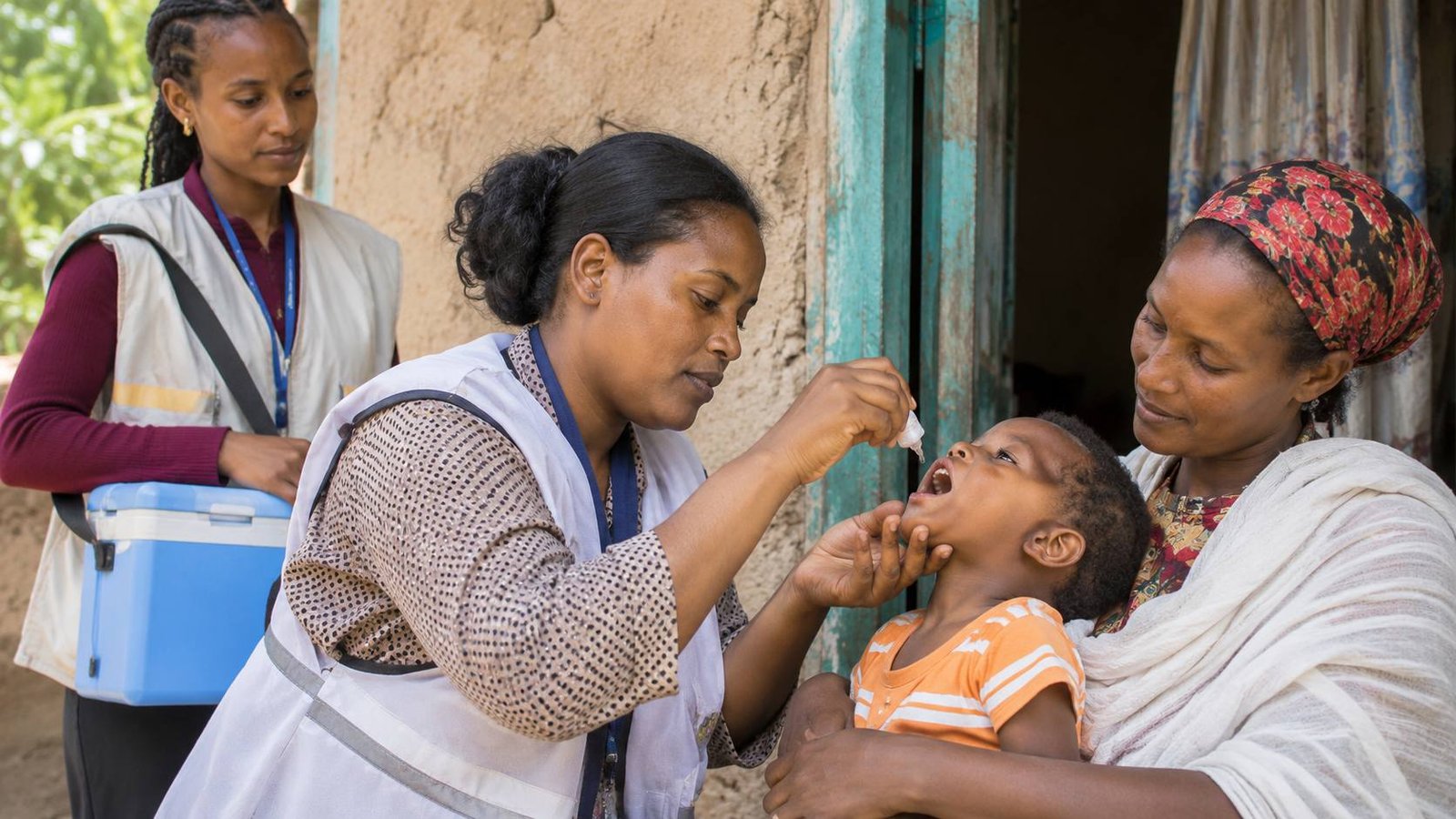
Addis Ababa, Ethiopia — 21 November 2026 — Ethiopia has launched a nationwide polio vaccination campaign aiming to protect more than 11.3 million children across five regions, as health authorities respond to circulating variant poliovirus and gaps in childhood immunisation. The first round runs from 21 to 24 November, with a second round planned for 18 to 21 December.
The campaign covers Addis Ababa, Oromia, Central Ethiopia, South Ethiopia and Southwest Ethiopia. Teams of health workers and community volunteers are conducting house-to-house visits to vaccinate eligible children. The campaign is coordinated by the Government of Ethiopia with WHO, UNICEF, Global Polio Eradication Initiative partners and other agencies.
Why Ethiopia is conducting the campaign
Ethiopia remains free of wild poliovirus, but circulating variant poliovirus type 1 has been reported this year in Gambella, Oromia and South Ethiopia. Variant poliovirus can spread where population immunity is insufficient, particularly among children who have missed routine vaccination or live in communities with uneven access to health services.
The campaign is designed to close immunity gaps and reduce the risk of transmission. WHO says previous response campaigns in Gambella, Benishangul-Gumuz and parts of Oromia reached more than one million children. The new rounds extend vaccination to a wider set of regions while focusing on ensuring children are not missed.
Campaign teams will also identify children missing routine vaccines
House-to-house visits are intended to reach children who may not regularly attend health facilities. During the visits, teams will identify zero-dose and under-vaccinated children and link them with routine immunisation services so that missed vaccines can be addressed beyond the polio campaign itself.
WHO has deployed 28 central and field staff to support planning, coordination, training, monitoring, data management and community engagement. Supervisors and independent monitors are being trained to use Open Data Kit (ODK) tools, with lot quality assurance sampling planned to assess campaign quality.
Surveillance remains essential alongside vaccination
Vaccination campaigns are only one part of polio eradication. Ethiopia and its partners are also strengthening surveillance for vaccine-preventable disease, including acute flaccid paralysis (AFP) surveillance and environmental surveillance. These systems help detect poliovirus circulation and identify areas requiring a rapid response.
WHO says surveillance quality is important for detecting transmission early and for assessing whether vaccination activities are reaching the intended populations. Monitoring during and after the campaign will help programme teams identify missed settlements, gaps in coverage and areas needing follow-up.
What the campaign means for families and health services
Parents and caregivers in the targeted regions are being asked to cooperate with vaccination teams and ensure eligible children receive the campaign dose. The campaign also provides an opportunity to connect families with routine immunisation, particularly where children have missed scheduled doses.
For health services, the operation requires coordination between regional authorities, local health facilities, community volunteers, vaccine logistics teams and surveillance staff. Campaign coverage alone will not demonstrate that transmission has been interrupted; monitoring, surveillance and follow-up are needed to assess performance.
What happens next
The first round ends on 24 November. A second round is scheduled for 18–21 December 2026. Health authorities and partners will review monitoring results, identify children or communities missed in the first round and adjust implementation as needed. Ethiopia’s response will also depend on sustained routine immunisation, surveillance and community trust after the campaign concludes.
Who is leading the response?
The Government of Ethiopia is leading the campaign with support from the Ministry of Health, regional health authorities, WHO, UNICEF, the Global Polio Eradication Initiative and other partners. Community health workers, vaccinators, volunteers, caregivers and local leaders are central to reaching children and supporting vaccine acceptance.
Related coverage: Africa Health Briefing, 22 November 2026.
Sources and limitations
This article is based on the WHO Ethiopia campaign announcement published 21 November 2026. The campaign’s target and schedule are announced plans, not independently verified coverage totals. The number of children vaccinated will require post-campaign monitoring and official reporting. Ethiopia is reported free of wild poliovirus, but circulating variant poliovirus type 1 has been detected in specified regions.
Discussion