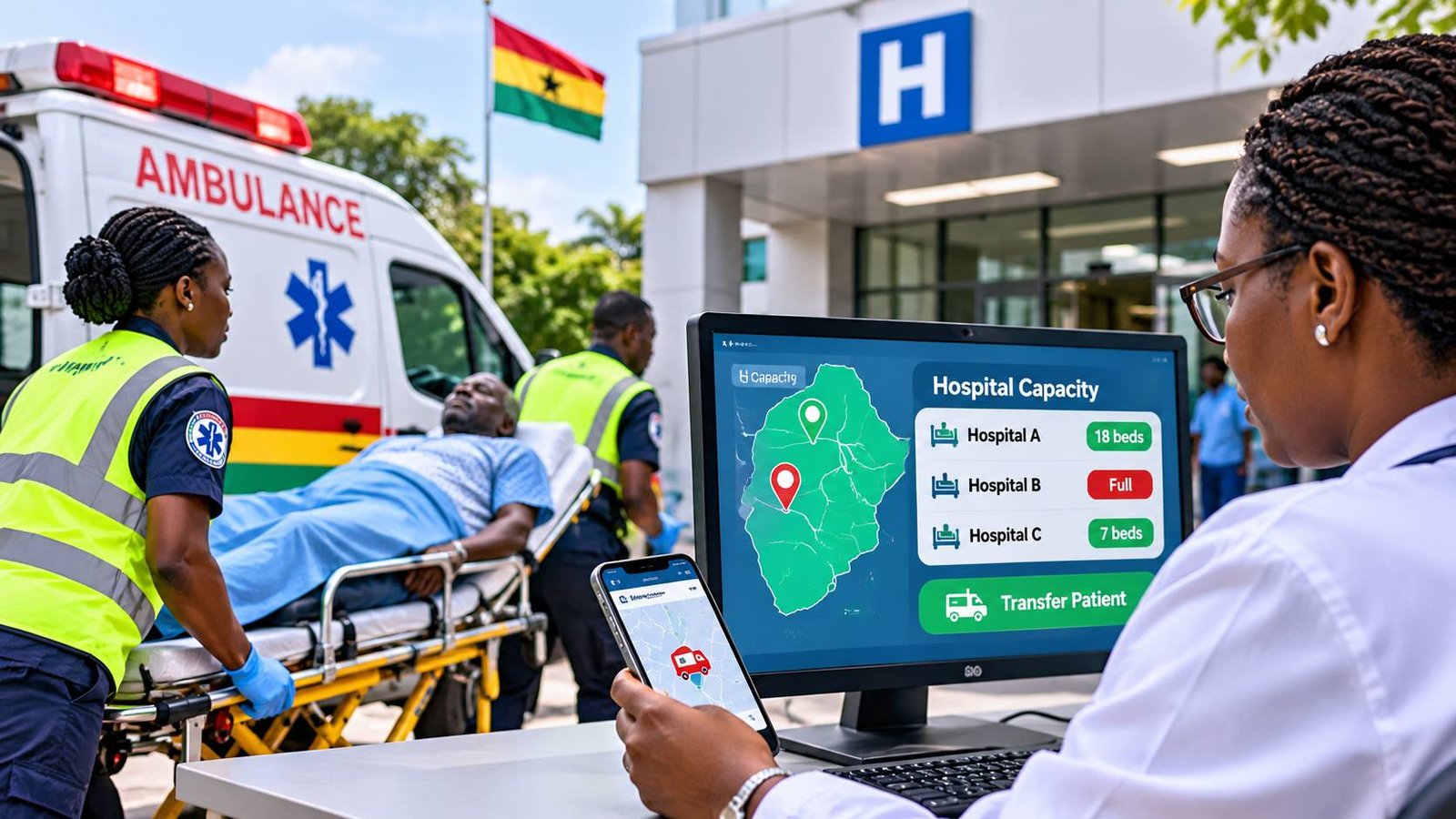
Accra, Ghana — Ghana is piloting a digital system designed to help hospitals and ambulance teams identify facilities with available capacity and coordinate emergency patient transfers, as the government seeks to address persistent delays associated with the country’s “no bed” problem.
Seven services are involved in the pilot
The Integrated Bed Management and Referral Coordination System (IBMRC) is being piloted through the Ministry of Health with six hospitals and the National Ambulance Service. The participating facilities are Korle Bu Teaching Hospital, Komfo Anokye Teaching Hospital, Tamale Teaching Hospital, Greater Accra Regional Hospital at Ridge, the 37 Military Hospital and the University of Ghana Medical Centre.
The system is intended to give referring facilities and ambulance teams better visibility of bed availability and the capacity of receiving hospitals. Instead of calling multiple facilities or transporting a patient without reliable information about where care can be provided, emergency teams are expected to use the shared information to identify an appropriate destination and coordinate a transfer.
The Ministry announced the pilot at the 68th Annual General Conference of the Ghana Medical Association, held on 6 November. WHO’s update on 11 November said the system was a key feature of the conference’s discussions on strengthening the full emergency-care pathway, from initial assessment and stabilisation to referral, transport, admission and follow-up.
Digital coordination cannot create beds on its own
Ghana’s no-bed challenge is not only a question of whether a hospital has an empty bed. A facility may have physical space but lack the staff, equipment, oxygen, medicines or specialist services needed to safely receive a critically ill patient. A digital directory that is not updated in real time could also direct an ambulance to a hospital whose capacity has changed.
For the IBMRC pilot to work, participating hospitals will need agreed definitions of available capacity, staff responsible for updating information, reliable connectivity and clear procedures for accepting or declining referrals. Ambulance dispatch teams must be able to access the information when making decisions, while receiving facilities must be able to stabilise patients before arranging a safe transfer where necessary.
WHO has identified referral coordination, hospital bed management, emergency-care workforce capacity and accountability for referral outcomes as priorities for Ghana. It also said the National Referral Policy was at an advanced stage of review and finalisation. The policy is expected to clarify responsibilities and strengthen pathways between facilities.
Government announces wider emergency-care plans
President John Dramani Mahama announced plans to expand emergency units at Korle Bu Teaching Hospital, Komfo Anokye Teaching Hospital, Tamale Teaching Hospital and the 37 Military Hospital. The stated aim is to raise emergency beds to at least 10% of each hospital’s functional bed capacity. At Korle Bu, this would increase the number of emergency beds from 65 to at least 150.
The government also plans to procure 100 new ambulances and spare parts to return another 100 vehicles to service. The Ghana Armed Forces Critical Care and Emergency Hospital has opened its services to the public, providing an additional source of emergency and critical-care capacity. These are government announcements and plans; they should not be reported as completed procurement or as proof that emergency waiting times have already fallen.
WHO’s support includes technical work on the National Referral Policy and the National Healthcare Quality Strategy 2024–2030. The organisation has said that improving emergency care requires attention to the whole pathway, including early assessment, stabilisation, communication between facilities, safe transport, adequate staffing and review of emergency deaths and referral outcomes.
What evidence will show whether the system works?
The pilot’s performance should be assessed using measures that reflect patient care rather than the number of facilities connected to a platform. Useful indicators would include the time taken to identify an appropriate receiving facility, the time from referral decision to ambulance departure, the proportion of transfers accepted by the first receiving facility, the accuracy of bed-capacity information and the number of patients who receive timely stabilisation before transfer.
Evaluation should also examine whether the system works outside major urban hospitals, whether facilities have enough staff to keep capacity information current, and whether ambulance teams can use the platform reliably during busy periods. Patient privacy and secure access to operational information will also matter. The available announcements describe the pilot’s purpose and participating institutions, but do not yet provide measured outcomes on referral delays, emergency deaths or patient experience.
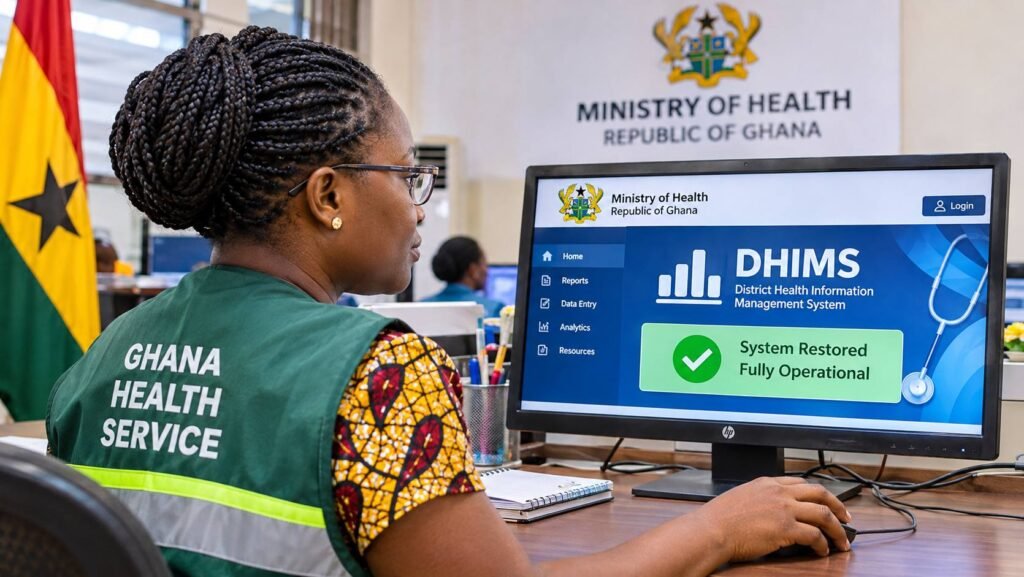
Ghana’s wider digital health experience also underlines the importance of dependable infrastructure. Health Signal Africa previously reported the restoration of the District Health Information Management System after a hosting-payment disruption. DHIMS and IBMRC are separate systems, but both illustrate why digital health services need reliable hosting, clear ownership, maintenance and operational accountability. See Ghana’s DHIMS restoration update and our coverage of the Africa Health Data Forum.
What comes next
The next step is to demonstrate that the pilot can support routine decisions across the participating hospitals and the ambulance service. That will require consistent data entry, interoperability with existing hospital and emergency-service processes, clear escalation arrangements and regular review of referral outcomes. Any expansion should be guided by evidence that the system is accurate, usable and sustainable, rather than by the number of facilities enrolled.
If Ghana can combine reliable capacity information with adequate staffing, equipment, ambulance availability and a functioning referral policy, digital coordination could become one part of a stronger emergency-care system. It cannot substitute for investment in beds, clinical teams or the services needed to treat patients once they arrive.
Sources and limitations
This report draws on the WHO Regional Office for Africa update of 11 November 2026 and the Ghana Information Services Department announcement of 6 November 2026. The IBMRC is described as a pilot. No published evaluation results were identified in the sources reviewed. Announced ambulance procurement and emergency-bed expansion are plans, not completed outputs.

Discussion