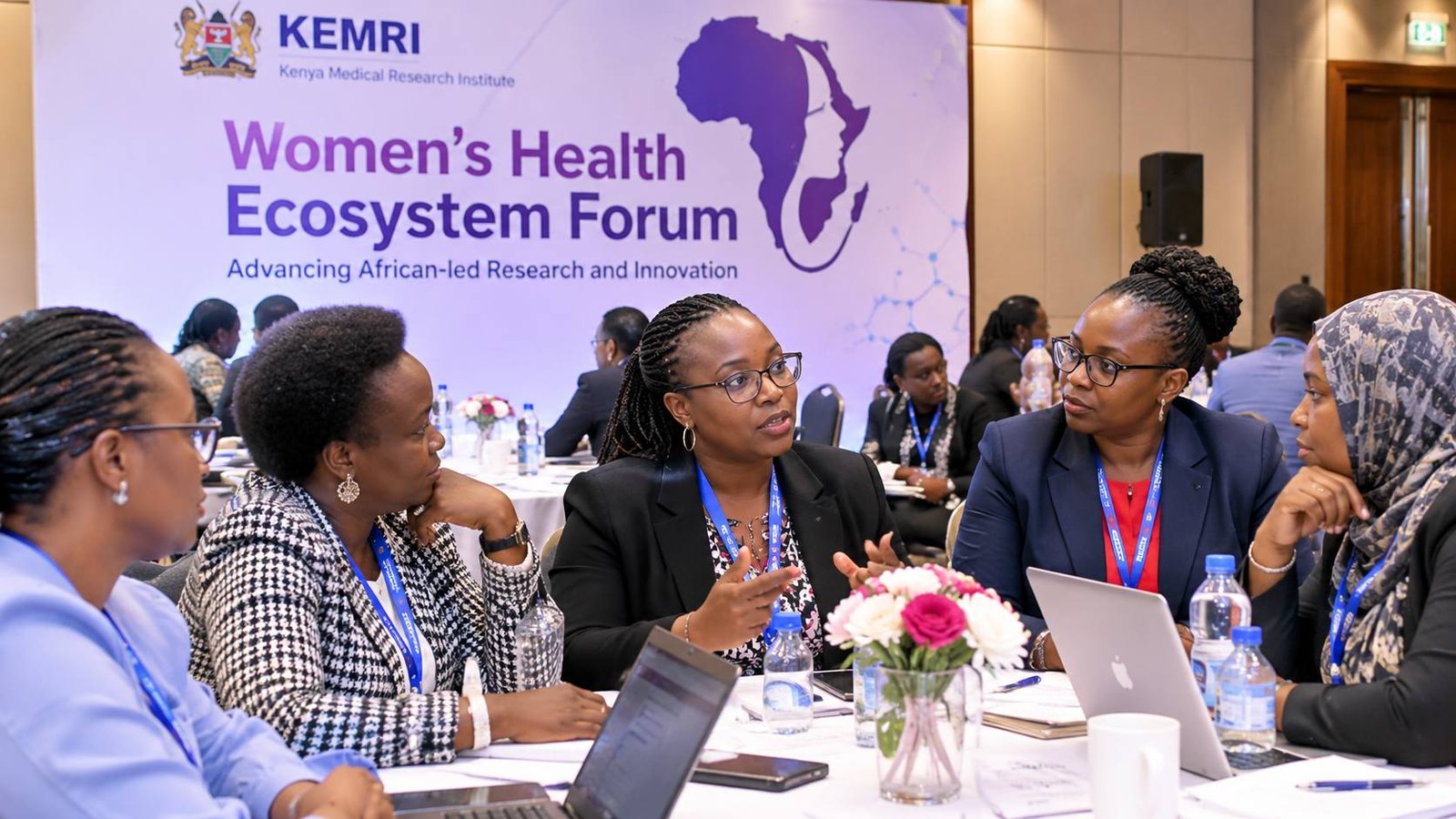
NAIROBI, 6 November 2026 — The Kenya Medical Research Institute (KEMRI) is seeking to strengthen the route from African women’s health research to practical products and services after hosting a continental forum that brought researchers, innovators, investors and development partners together in Nairobi.
The four-day Women’s Health Ecosystem Forum 2026 ran from 2 to 5 November under the theme “Building Africa’s Women’s Health Ecosystem: Connecting Research, Innovation and Investment”. KEMRI hosted the forum in partnership with the US National Academy of Medicine and the Leadership for Innovation and Excellence in Accelerating Research on Women’s Health (LEA-WH) Fellowship.
The forum focused on a persistent gap in health research: while maternal health and childbirth have received substantial attention, several conditions affecting women across the life course remain poorly understood, underfunded or inadequately served by available products. KEMRI identified endometriosis, menstrual disorders, menopause, sexually transmitted and reproductive tract infections, cervical cancer, the vaginal microbiome and contraceptive technologies among the areas requiring stronger evidence and innovation.
KEMRI’s report describes an inaugural fellowship cohort involving researchers and innovators from Cameroon, Nigeria, Ghana, Ethiopia, Malawi, South Africa, Zimbabwe, Uganda and Kenya. The programme is intended to strengthen African scientific leadership and help researchers move beyond publication towards solutions that can be tested, regulated, financed and used in health services.
Connecting research with product development and investment
Two programme tracks were designed to connect different stages of the innovation pipeline. The Boma Demo Day gives fellows working in product development and innovation an opportunity to present products, prototypes and business models to potential investors, accelerators and industry partners. The Baraza Briefs platform allows reproductive health researchers to present findings and grant proposals for peer review and possible non-dilutive funding support.
The distinction matters. A promising research finding does not automatically become a diagnostic test, medicine, device or service that women can access. Product development requires additional work on safety, performance, usability, regulatory requirements, manufacturing, affordability and distribution. Research teams also need partners who understand the realities of African health systems, including limited specialist capacity and the need for solutions that can work in primary-care settings.
KEMRI says the LEA-WH programme aims to advance five to ten women’s health products towards market testing, support up to ten start-ups and generate new patent applications. These are programme targets rather than completed achievements. Their value will ultimately depend on whether products demonstrate clinical and practical benefit, secure appropriate regulatory approvals and reach the women and health workers for whom they are intended.
Why the research gap affects everyday healthcare
Conditions such as endometriosis and heavy menstrual bleeding can affect education, work, family life and mental wellbeing. Menopause-related symptoms and reproductive tract infections also require evidence-based care, yet women may face delayed diagnosis, limited treatment choices or stigma when seeking help. When research priorities do not reflect these experiences, health systems risk overlooking needs that are common but poorly measured.
For African countries, locally led research can help ensure that diagnostic tools and interventions are designed for the populations, languages, costs and service-delivery conditions in which they will be used. It can also strengthen the ability of universities and research institutions to negotiate partnerships, generate intellectual property and retain more of the value created by scientific innovation.
During the forum, WHO’s Prof. James Kiarie called for accessible solutions suited to primary healthcare and stronger collaboration on local product development, technology transfer and regulatory cooperation. Those priorities are important because a product that works only in a highly specialised facility may not address the access barriers experienced by women in rural or under-resourced communities.
The forum does not mean that new products have been approved or that funding has been secured for every idea presented. The next test will be whether the partnerships formed in Nairobi lead to stronger research evidence, viable prototypes, grants, regulatory progress and measurable improvements in care.