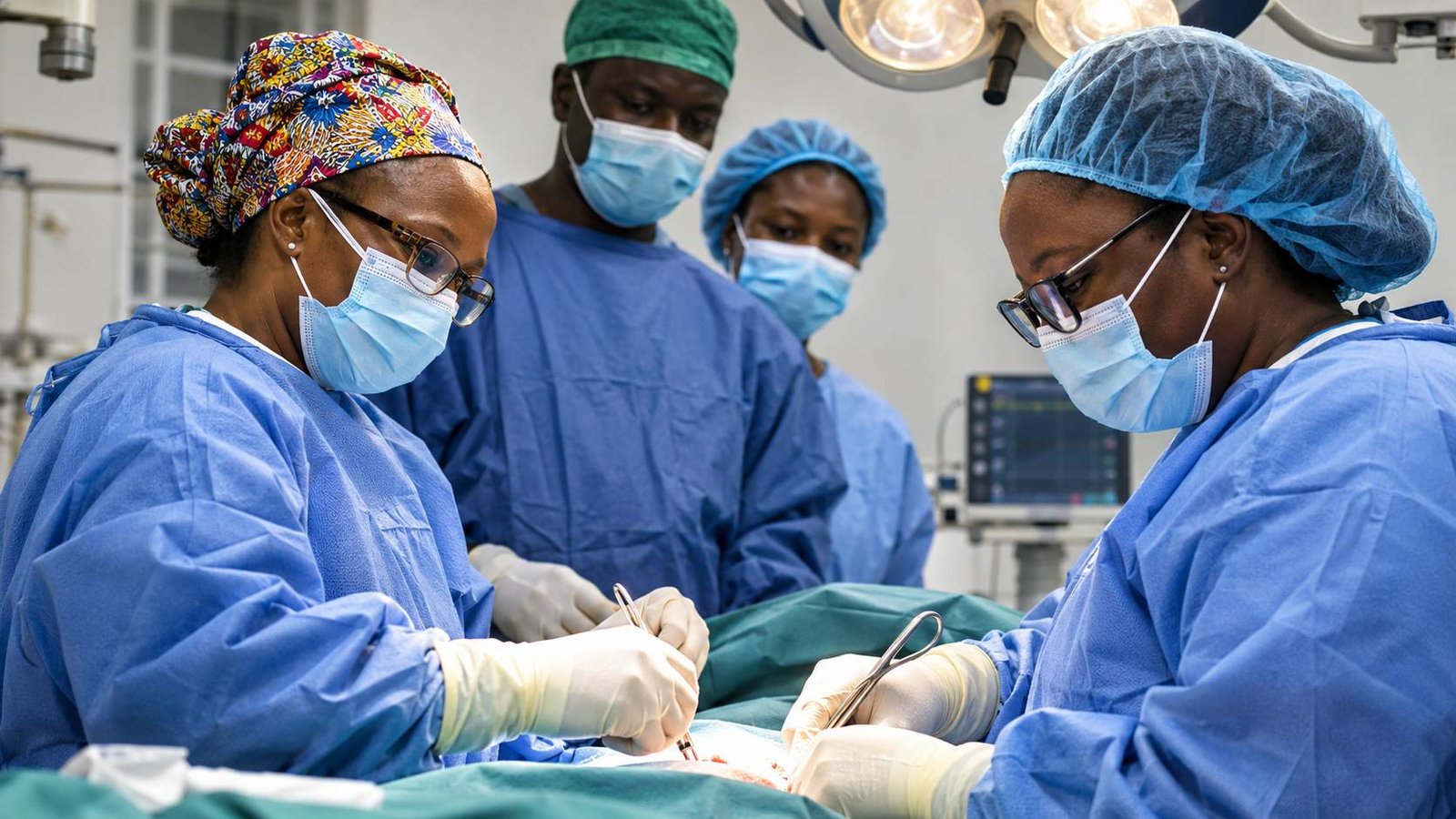
Freetown, Sierra Leone — Sierra Leone is expanding its ability to treat early-stage cervical cancer at home by training local doctors to perform complex gynaecological cancer surgery. Surgical camps organised by the Ministry of Health at Princess Christian Maternity Hospital, with support from the World Health Organization (WHO), Zambia’s Ministry of Health, Friends of Africa and other partners, have provided surgery to 15 women since 2024 while building the specialist skills needed to sustain the service.
In a feature published on 15 November 2026, WHO described how resident doctor Dr Rosalitta Jaida Toogbabu has progressed from observing radical hysterectomy procedures to taking on more responsibility during surgical camps. The latest camps were held in December 2025 and July 2026. For the first time, the 2026 camp was led by a Sierra Leone-based gynaecological oncologist rather than relying on visiting surgeons to lead the procedures.
From observing surgery to developing local expertise
Dr Toogbabu, who works at Princess Christian Maternity Hospital in Freetown, had observed radical hysterectomy only twice before joining the training programme and had never participated in the operation. Through supervised practice and mentorship, she has begun to anticipate the steps involved and take on greater responsibility alongside experienced surgeons.
The initiative began in 2024 and uses South-South cooperation between Sierra Leone and Zambia. Visiting specialists, including gynaecological oncologists from Zambia, initially led the camps while working with local teams. WHO says Dr Michael Ezeanochie, who leads the gynaecology department at Princess Christian Maternity Hospital and has mentored local clinicians since the programme began, led the 2026 camp independently.
The 15 women reported by WHO had early-stage cervical cancer and received complex surgery through the camps. The figure is cumulative since 2024; it does not mean that 15 women underwent surgery during the July 2026 camp alone. The programme combines patient care with hands-on training for local clinicians, reducing the need for some women to travel abroad for procedures that were previously unavailable in the country.
Why specialist capacity matters
Princess Christian Maternity Hospital is Sierra Leone’s only tertiary maternal health facility. Concentrating complex gynaecological oncology services in one national referral institution creates practical challenges for patients who live far from Freetown and for a health system seeking to provide continuity of care beyond occasional surgical camps.
WHO’s 2025 Sierra Leone annual report recorded 11 early-stage cervical cancer surgeries through South-South cooperation during that reporting period. The organisation’s November 2026 feature reports that 15 women have now received surgery through the camps since 2024. These are programme-reported service figures rather than a population-level assessment of survival, recurrence or long-term treatment outcomes.
Building local expertise can help reduce referral delays and the financial and logistical burden of travelling abroad. It also creates opportunities to strengthen multidisciplinary care involving pathology, imaging, surgery, oncology, nursing, rehabilitation and follow-up. However, surgical training alone cannot replace vaccination, screening, timely diagnosis, pathology services, radiotherapy where indicated and access to appropriate medicines.
Training needs extend beyond a small number of surgical camps
Dr Toogbabu has said that the experience gained through the camps is not sufficient for independent practice. She wants further exposure to a high volume of cases in centres where gynaecological oncology procedures are performed regularly, as well as training in other areas of the specialty that are not currently available in Sierra Leone.
That assessment points to the challenge of moving from periodic mentorship to a sustainable national service. The country will need a continuing pipeline of trained surgeons, anaesthetists, theatre nurses, pathologists and oncology staff, supported by reliable equipment, operating-theatre time, referral pathways and financing. Training opportunities must also allow clinicians to maintain their skills after visiting teams leave.
WHO’s earlier reporting on Sierra Leone’s cervical cancer programme describes expansion of screening and treatment services across all 16 districts, with 25 screening centres reported in 2025. The surgical camps add a specialist treatment component to prevention and early detection, but access to surgery must be linked to accurate diagnosis and appropriate follow-up.
What the programme needs next
The next phase will depend on sustained institutional support rather than isolated surgical missions. Priorities include structured mentorship, supervised case volume, specialist fellowships, multidisciplinary tumour review, dependable pathology and imaging, patient tracking and transparent monitoring of treatment outcomes. Strengthening referral links between district facilities and Princess Christian Maternity Hospital will also be important for women diagnosed outside Freetown.
For other African health systems, Sierra Leone’s experience illustrates the value of regional cooperation in building specialist capacity. Partnerships between countries can support practical skills transfer, but they need to be matched with national investment, local leadership and clear plans for retaining trained staff.
The programme’s reported 15 surgeries are an important service milestone, but they should not be interpreted as evidence that cervical cancer has been eliminated or that specialist care is yet available to every woman who needs it. WHO’s account itself highlights the need for further training and institutional support. The broader test will be whether women can obtain vaccination, screening, diagnosis, treatment and follow-up reliably across the country.
Sources and limitations
This article draws primarily on WHO’s 15 November 2026 feature on cervical cancer care in Sierra Leone and the WHO Sierra Leone Annual Report 2025. A secondary report by Daily News Egypt also summarised the latest surgical camp. The 15-patient figure is a cumulative programme report since 2024, not an independent clinical-outcomes study. The article does not infer survival benefit, cure rates or national coverage from the number of operations performed.
Discussion