17 November 2026 | Nairobi, Kenya
Africa’s health agenda is being shaped by the continuing Bundibugyo Ebola outbreak in the Democratic Republic of the Congo (DRC), a new Africa CDC–Canada health-security partnership, fresh attention to maternal and newborn survival in Kenya, and a week of continental policy discussions in Luanda. Climate and health are also on the agenda at COP31 in Türkiye. WHO has published new diagnostic guidance and laboratory procedures for bacterial and fungal infections and antimicrobial resistance (AMR), with a technical launch webinar scheduled for 17 November.
Central Africa: DRC Ebola response makes gains but remains under severe pressure
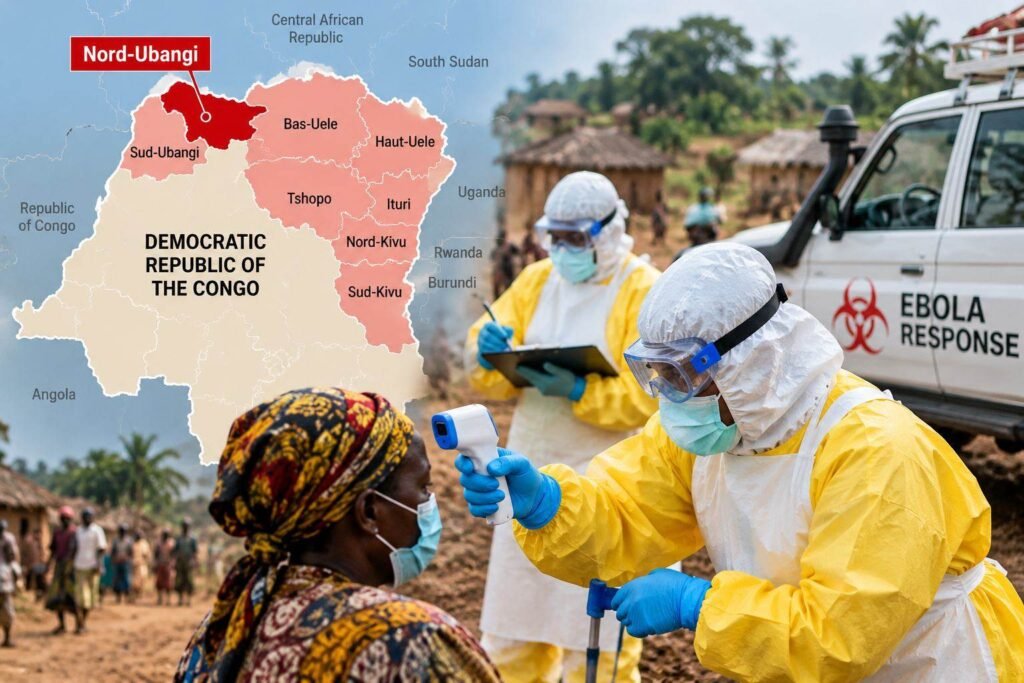
A joint statement published on 15 November by Africa CDC and United Nations partners says the Bundibugyo virus disease outbreak in the DRC has passed six months and continues to expand. More than 11,000 cases and 5,400 deaths have been reported since the outbreak began. The statement says 400–500 new cases are still being reported each week and that the outbreak has reached 67 health zones in eight provinces.
Children account for more than a quarter of confirmed cases and one-third of deaths. Seven in ten children under five with confirmed Ebola have died. Two-thirds of confirmed deaths have occurred in communities, suggesting that many infections are still being identified too late. Contact follow-up remains below target, while conflict, displacement and restricted access continue to disrupt surveillance and care.
The response has expanded its capacity: diagnostic services have grown from two laboratories to more than two dozen; close to 2,000 treatment beds are available across 104 treatment and transit centres; and about 3,000 people have been reported to have recovered. More than 17,000 community health workers and 46,000 community actors have been trained. However, the statement records more than 80 attacks on healthcare since the outbreak was declared, more than 1,000 contacts lost to follow-up after a recent attack, and three confirmed cases that remained unaccounted for. Delays in paying frontline responders are also undermining operations. A separate ECDC update published on 16 November gives a more precise snapshot: 11,376 confirmed cases and 5,568 related deaths in the DRC as of 15 November, using data through 14 November. ECDC recorded 1,681 patients hospitalised in isolation, 3,083 recoveries and 83.1% of identified contacts under follow-up. These figures have a defined cut-off and should not be treated as a live count.
The agencies say the next phase requires sustained funding through 2027, safe access for health teams, protection of health facilities, community participation and support for wider needs including food security, water and sanitation, maternal and newborn care, child protection and psychosocial support. Read the 15 November joint statement and Health Signal Africa’s DRC outbreak analysis.
West Africa: Nigeria completes contact monitoring, but surveillance continues
Nigeria’s Centre for Disease Control and Prevention announced on 13 November that all 62 contacts linked to the country’s imported Bundibugyo Ebola case had completed the 21-day monitoring period, with no secondary infection detected among them. The dashboard generated on 16 November provides a newer status check: it records one confirmed case, no deaths, seven negative cases, 62 contacts identified and none remaining under follow-up. Its epidemiological status line is dated 14 November, so the dashboard generation date and data cut-off should not be confused.
Thirteen contacts reportedly developed fever or other non-specific symptoms during monitoring, but all tested negative. Seven additional alerts investigated across five states were also negative. Completion of contact monitoring is an important containment milestone, not an official declaration that Nigeria’s outbreak is over. The 42-day countdown from the recovery or departure of the last confirmed patient, together with heightened surveillance, remains necessary before Nigeria can be declared Ebola-free. See the NCDC Ebola dashboard and Reuters’ report on the NCDC announcement.
Continental health security: Africa CDC and Canada sign cooperation framework
Africa CDC and the Public Health Agency of Canada have signed a memorandum of understanding covering epidemiological surveillance and public health intelligence; laboratory systems, biosafety and biosecurity; emergency preparedness and response; workforce development; and research, innovation and medical countermeasures. Africa CDC announced the agreement on 16 November after it was welcomed by Canadian Prime Minister Mark Carney at the 20th Sommet de la Francophonie in Phnom Penh.
Canada also announced $24 million for projects with Francophone African partners across several sectors. The specific Ebola allocation is $2 million over two years for UNICEF-supported preparedness and response in the DRC, Uganda and other at-risk African countries. The Canadian government says this is additional to $7 million already provided for the initiative. The wider $24 million package is not all health or Ebola funding, and the $2 million UNICEF contribution is separate from the Africa CDC–PHAC technical MoU. The Canadian release does not specify the currency, so the amounts are quoted as published and are not labelled US dollars. Neither Africa CDC nor the Canadian government has yet published a detailed implementation timetable or budget for the MoU. Read the Africa CDC announcement and the Canadian funding backgrounder.
East Africa: Kenya puts neonatal sepsis and pregnancy hypertension under the spotlight
Kenya’s Ministry of Health published details on 16 November of two policy briefs launched in Nairobi on 10 November. One addresses neonatal sepsis; the other focuses on hypertensive disorders of pregnancy. The Ministry says the briefs were developed with its reproductive, maternal, newborn, child and adolescent health division and research partners including CHAMPS.
The neonatal sepsis brief estimates that sepsis accounts for 16–20 per cent of neonatal deaths and cites evidence of substantial antimicrobial resistance in bacteria isolated from deceased newborns in Western Kenya. Among 229 neonatal deaths reviewed between 2021 and 2024, about one-third had a bacterial infection identified from blood samples. The brief reports high resistance in Klebsiella pneumoniae to commonly used antibiotics. These findings relate to a defined surveillance sample, not a nationwide prevalence survey. The KEMRI brief cites a prospective study in which 53 per cent of children with hospital-acquired infections died, compared with 24 per cent of children whose infections were identified in the community before admission. These are outcomes in different patient groups, not a 24 per cent intervention effect.
The pregnancy-hypertension brief estimates that hypertensive disorders account for 15–20 per cent of reported maternal deaths in Kenya and that pre-eclampsia affects about 5.6–6.5 per cent of pregnancies. It calls for early risk assessment, blood-pressure checks at every antenatal contact, reliable supplies of essential medicines, staff mentorship and stronger referral pathways. The Ministry’s announcement is available here. The publicly accessible KEMRI copy of the neonatal sepsis brief retains “draft” in its file name, so the final approved version should be confirmed.
Continental policy: African health ministers meet in Luanda
The African Union’s Sixth Ordinary Session of the Specialised Technical Committee on Health, Nutrition, Population and Drug Control is taking place in Luanda, Angola, from 16 to 20 November. The experts’ segment runs from 16 to 18 November, followed by the ministerial meeting on 19 and 20 November. Documents for consideration include the Continental Immunisation Strategy 2026–2030, a Health Financing Progress Tracker, continental nutrition investment targets and reports, a continental report on the causes and drivers of maternal mortality, progress on the Common African Position on AMR, and an update on the Africa CDC–WHO joint continental Ebola response. These are items for technical and ministerial consideration, not policies already adopted at this session. The meeting is anchored to the AU’s 2026 theme on sustainable water availability and safe sanitation. See the African Union event notice.
Climate and health: COP31 puts adaptation and primary care in focus
COP31 continues in Antalya, Türkiye, from 9 to 20 November. Amref Health Africa is using the meeting to argue that climate adaptation plans should place health systems at their centre. Its programme includes a 17 November side event, “Climate Adaptation Starts with Health”, from 18:30 to 20:00 in the Blue Zone’s Yellow Side Event Room. Amref cites analysis showing that only 4.9 per cent of bilateral and multilateral climate-adaptation finance went to health between 2009 and 2019. That is a historical financing estimate, not a measure of current-year spending. On 20 November, Amref and partners plan to discuss climate-resilient primary healthcare, including lessons from Isiolo and Marsabit in northern Kenya. See Amref’s COP31 programme.
Technology and research watch: AMR diagnostics, laboratories and Kenya’s NPOC pilot
WHO published two new AMR diagnostic resources on 16 November: an essential package of tests for bacterial and fungal infections and AMR, and a companion toolkit of standard operating procedures for bacteriology, mycology and antimicrobial susceptibility testing. The package maps rapid, microscopy, culture-based, serological and molecular tests to different levels of the health system, from primary care to tertiary hospitals. The SOP toolkit covers specimen collection and transport, organism identification, susceptibility testing, interpretation, reporting, quality control, biosafety and equipment management. A 17 November webinar is scheduled to introduce the resources. Publication of the tools does not mean they have already been adopted, financed or deployed by African health systems. Read the WHO essential diagnostic package, the laboratory SOP toolkit and the WHO World AMR Awareness Week events page.
The 15 November DRC joint statement also says research teams are evaluating candidate treatments and vaccines for Bundibugyo virus disease. It does not report efficacy results or approvals, so these candidates remain investigational. The expansion of Ebola diagnostic capacity from two laboratories to more than two dozen is a response-capacity gain, not evidence that the outbreak has been contained.
In Kenya, the NPOC ACCESS pilot remains an important innovation to watch. The programme is evaluating near-point-of-care Mini-Doc MTB testing alongside an AI-enabled digital stethoscope for people who cannot produce sputum in Thika, Juja, Lari and Limuru in Kiambu County. No new public trial result or implementation milestone was identified in the 15–17 November review window, so the pilot should be described as ongoing research rather than a proven diagnostic solution. The new Africa CDC–PHAC framework and WHO’s AMR diagnostic package also place diagnostic readiness, laboratory networks and quality systems high on the continental agenda.
Open health opportunities
The Health Signal Africa Opportunities page currently lists 22 open health-related jobs, consultancies and tenders, plus four general career and funding portals. Three additional verified records were added on 17 November: an ICRC prehospital emergency-care role in Mogadishu closing on 17 November (no exact time published); AFENET’s Zonal Partner Coordination Lead in Bunia, closing 30 November; and ALIMA’s Clinical Research Referent for the EBO-PEP trial, a 12-month role with travel to DRC and a 4 December deadline. The ALIMA listing is also on ReliefWeb (4238232); its official application page is linked in the record. The most time-sensitive listings include:
- 17 November: The MENTOR Initiative’s Programme Director role in Cabo Delgado, Mozambique. The issuer states the closing date but does not publish an exact time. Applicants need at least five years’ experience managing field-level humanitarian or health/vector-control programmes and fluent Portuguese and English.
- 17 November, 23:55 CAT: UNICEF’s Construction Supervision Consultant in Pemba, Mozambique. This is an 11-month, nationals-only consultancy requiring an engineering degree, at least four years’ relevant experience and Portuguese fluency.
- 18 November, 23:55 EAT: UNICEF’s P-4 Health Specialist – Adolescent Health, based in Nairobi. The role requires an advanced relevant degree and at least eight years’ progressively responsible experience.
- 20 November: UNICEF’s two national Social and Behaviour Change consultants for the DEFIS Nutrition Programme in Madagascar. French and Malagasy are mandatory.
- 22 November: UNICEF’s international consultant for Somalia’s Child Survival Action Plan, a 3.5-month assignment requiring a relevant master’s degree and extensive public-health planning experience.
- 17 November: ICRC’s Prehospital Emergency Care Field Officer in Mogadishu, a national/resident role requiring medical, paramedical or nursing qualifications, advanced prehospital-care training and five years’ relevant experience. The issuer does not state a closing time.
- 30 November: AFENET’s Zonal Partner Coordination Lead in Bunia, DRC, requiring an advanced public-health, field-epidemiology or humanitarian-response qualification, 5–7 years’ epidemic-response partner coordination experience and professional French; Swahili is an asset.
- 4 December: ALIMA’s Clinical Research Referent for the EBO-PEP Bundibugyo Ebola post-exposure prophylaxis trial. The 12-month role requires clinical research and trial-protocol experience, a relevant advanced qualification, and professional French and English; salary follows ALIMA’s scale.
- 6 December: MSF’s Health Promotion and Community Engagement Manager for its DRC Ebola Emergency Pool. The role requires at least B2 French and two years’ health-promotion programme management experience; salary is not disclosed.
Applicants should check the original issuer notice for the final deadline, eligibility, remuneration and application route. The Opportunities page was reviewed on 17 November; no additional ReliefWeb listing was added where a current official application page could not be confirmed.
Editorial watchlist and verification notes
The strongest immediate concerns are continued Ebola transmission and insecurity in eastern DRC, the need to sustain cross-border preparedness, and whether Kenya’s maternal and newborn recommendations are translated into funded services. The AU ministerial session and COP31 provide opportunities to connect these priorities to continental policy, water and sanitation, climate adaptation and health financing.
No new national immunisation campaign result or noncommunicable disease policy announcement was verified in the 15–17 November window. However, the AU session is considering a Continental Immunisation Strategy for 2026–2030 and related health-financing and nutrition documents. No new African clinical-trial efficacy result was reported; the DRC candidate vaccine and treatment work remains investigational, while NPOC ACCESS continues without a new public outcome update. The technology watch therefore focuses on diagnostic capacity, AMR laboratory systems and ongoing pilots rather than implying new AI deployment. Figures in outbreak reporting are tied to the publication dates shown above; dashboard generation dates and epidemiological data cut-offs are not interchangeable.

Discussion