Daffiama-Bussie-Issa, Ghana — Local authorities in Ghana’s Upper West Region are using district-level resources to help people receiving mental-health services establish small businesses, in an approach that links clinical support with income generation and social inclusion. The initiative in Daffiama-Bussie-Issa District provides seed capital to members of self-help groups established through health facilities, helping some participants meet everyday costs and pay for medicines when they are not available through public services.
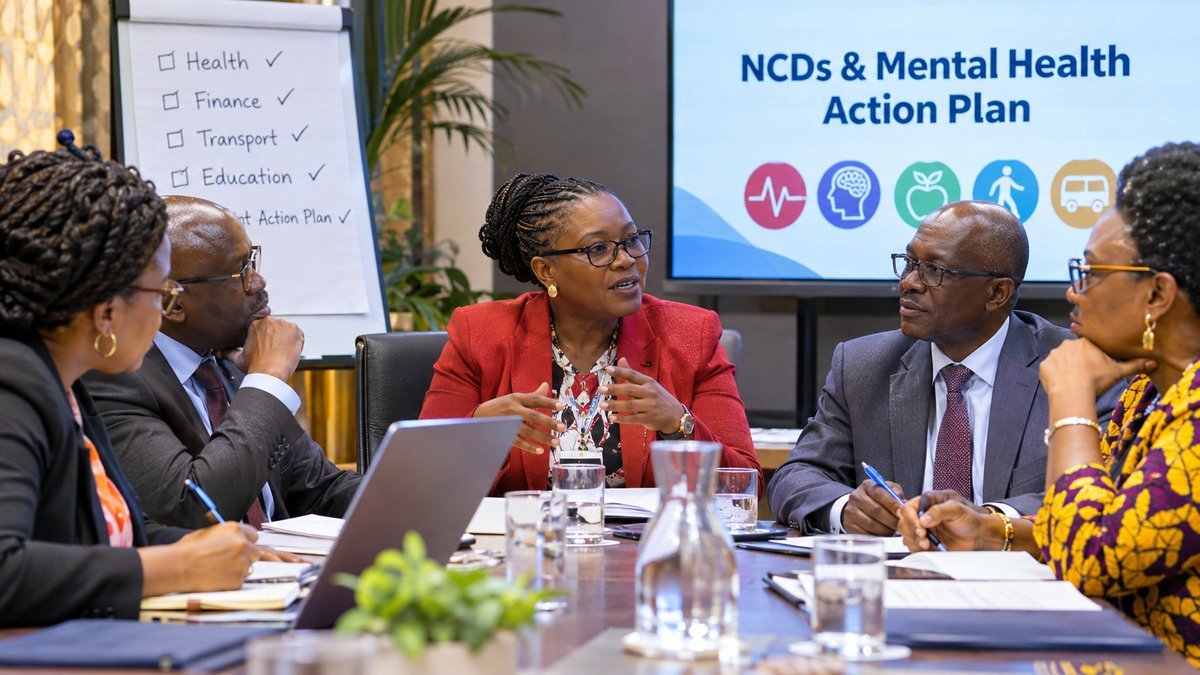
Illustrative image: Policymakers and health-sector partners discuss coordinated action on noncommunicable diseases and mental health in Africa. The image is illustrative and does not depict the Daffiama-Bussie-Issa initiative or its beneficiaries.
District resources support self-help group members
The District Assembly and District Health Directorate have worked together to identify members of mental-health self-help groups who may benefit from livelihood support. The Assembly has used part of the District Assemblies Common Fund allocation for persons with disabilities to provide seed capital for small businesses. The initiative has been running for nearly five years, according to a World Health Organization (WHO) feature published on 11 November 2026.
The District Health Directorate helps identify people already connected to self-help groups at health facilities, while the Assembly provides access to local government resources through the fund. The Department of Social Welfare also supports the process. The arrangement addresses a practical challenge identified by district officials: the social welfare office did not have a separate database of people living with mental-health conditions, so it worked with the health directorate to identify potential beneficiaries.
The support is intended to help people generate income, maintain treatment and participate more fully in community life. WHO reports that some beneficiaries have established businesses and are earning money to meet their needs. The feature does not provide the number of people supported, the amount of seed capital distributed or a formal evaluation of the initiative’s effect on treatment adherence or health outcomes.
Income can affect access to medicines
One beneficiary described by WHO is Fati Suglo, who lives with epilepsy and is a member of a self-help group. She had previously received medication free of charge at a health facility, but when supplies ran out she had to buy medicines elsewhere. Without a reliable income, paying for treatment became difficult.
Through the livelihood support, Suglo received assistance to develop income-generating activities. She now rears goats and produces shea butter, earning money that she says helps her meet daily needs and purchase medicines. Her experience illustrates how medicine availability and household income can interact: a patient may be connected to care but still struggle to maintain treatment when public supplies are interrupted and private purchases are unaffordable.
Epilepsy is a neurological condition and should not be conflated with mental illness. In this case, WHO presents Suglo’s experience as an example of a person supported through the district’s self-help group and livelihood model. Her story does not establish that the intervention has produced the same results for every participant.
Ghana’s mental-health treatment gap remains substantial
WHO estimates that more than 2.3 million people in Ghana live with mental-health conditions and that the country has a treatment gap of about 98%. The estimate has been cited by WHO in earlier work on Ghana’s mental-health system and is not a new national prevalence survey released in November 2026. It indicates that access to appropriate care remains a major challenge, even as government and partners work to strengthen services.
The barriers extend beyond the availability of clinics and specialists. WHO identifies medication costs, limited income, stigma and social exclusion as factors that can make it harder for people to manage their conditions and participate in community life. A livelihood programme cannot replace diagnosis, counselling, medicines, specialist referral or continuity of care, but it can address some of the economic pressures that make treatment difficult to sustain.
Ghana’s wider mental-health agenda includes the WHO Special Initiative for Mental Health, which has supported efforts to strengthen services and improve access. The country has also been working to integrate mental-health services into broader health systems and community-level care. Local government partnerships can help connect those services with social protection and economic inclusion, provided that support is transparent and reaches people who need it.
What would make the model stronger?
The Daffiama-Bussie-Issa approach highlights the value of coordination between health services, social welfare and local government. To assess whether it can be sustained or adapted elsewhere, district authorities would need to publish clear information on eligibility, the number of participants, the amounts and timing of support, and the kinds of businesses funded. Follow-up should examine whether participants can maintain their income-generating activities and whether the support helps them remain connected to treatment.
Medicine supply remains a separate health-system responsibility. People should not have to rely on small businesses or personal income to compensate for repeated shortages of essential medicines. Livelihood assistance can reduce financial pressure, but consistent procurement, distribution and financing of mental-health medicines are still necessary.
For other districts, the initiative offers a practical example of how existing disability-support resources can be linked with community health structures. Its wider value will depend on evidence, reliable funding, accessible clinical services and safeguards that protect the privacy and dignity of beneficiaries.
Sources and limitations
This report draws on the WHO Ghana feature published 11 November 2026, WHO’s 2023 account of the country’s mental-health treatment gap and the WHO Special Initiative for Mental Health in Ghana. The 2.3 million and 98% figures are longstanding WHO estimates, not new survey results. WHO’s feature describes the district initiative and an individual beneficiary but does not provide a beneficiary count, funding amount or formal impact evaluation.

Discussion