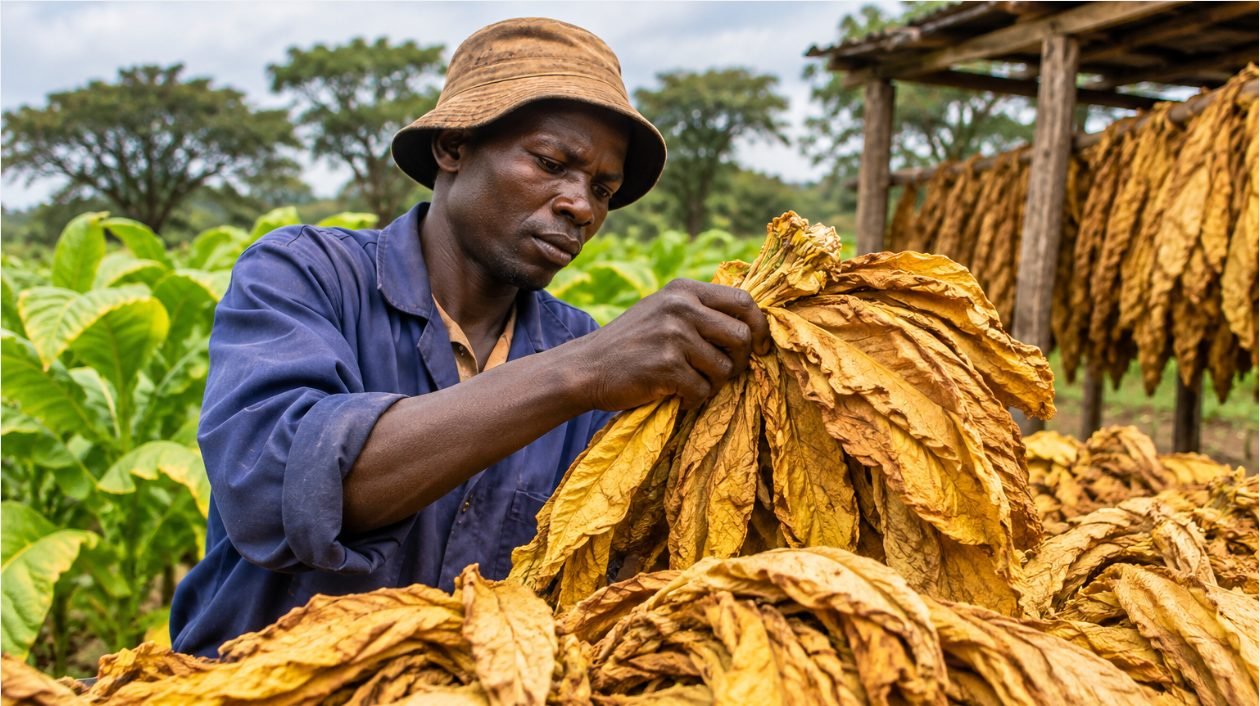
Kampala, Uganda — Uganda is stepping up efforts to help farmers move away from tobacco cultivation as new World Health Organization (WHO) data highlight the crop’s limited contribution to national exports and the health, environmental and livelihood risks associated with production.
A WHO report on the status of tobacco production and trade in Africa found that global tobacco leaf production fell by 18.8% between 2012 and 2024, while production in Africa increased by 8.61%. The trend has raised concern that the tobacco industry is relying increasingly on African farmers as production declines elsewhere.
Uganda produced nearly 32,000 metric tonnes of tobacco leaf in 2024, accounting for approximately 5% of Africa’s total production and placing it among the continent’s five largest producers.
Tobacco’s economic contribution remains limited
Despite its position as a tobacco producer, the crop occupies a relatively small share of Uganda’s agricultural economy. Tobacco cultivation covered 0.16% of the country’s agricultural land in 2024. Tobacco leaf exports represented 0.43% of total exports, while cigarettes accounted for a further 0.28%.
WHO noted that tobacco leaf exports account for less than 1% of gross domestic product in all but two African countries. The figures challenge the perception that tobacco is indispensable to national economic growth or rural livelihoods.
The public health burden remains significant. Uganda’s noncommunicable disease risk-factor survey found that 5.6% of adults use smoked tobacco. WHO estimates tobacco-related mortality at 31 deaths per 100,000 people among adults aged 25 years and older.
Initiative aims to support alternative livelihoods
Uganda’s Tobacco-Free Farms Initiative brings together WHO, the Food and Agriculture Organization of the United Nations, the World Food Programme, the Ministry of Health, the Ministry of Agriculture, Animal Industry and Fisheries, and other partners. It supports farmers to transition towards sustainable and economically viable alternatives to tobacco cultivation.
The initiative is intended to reduce exposure to tobacco-related harms while addressing the financial insecurity and limited options that can affect farming households. Regions including Bunyoro, West Nile and the Southwest have been identified among areas affected by tobacco cultivation.
WHO also reported that Africa’s cigarette import bill more than doubled between 2012 and 2024, rising from US$833 million to US$1.77 billion. The increase points to a wider imbalance in which countries may export raw tobacco while importing more manufactured tobacco products.
The transition will depend on farmer support
Moving away from tobacco requires more than asking farmers to change crops. Farmers need access to reliable markets, extension services, finance, quality inputs, storage and transport infrastructure. Without these supports, alternative crops may not provide dependable income or compete with established tobacco-buying arrangements.
Public health and agricultural agencies will also need to monitor whether transition programmes improve household incomes, food security and environmental conditions. The long-term value of tobacco-free farming will depend on whether farmers can sustain viable livelihoods after leaving the crop.
Source and limitations
The production, trade and health figures in this article are those cited by WHO. The article does not assume that all tobacco-growing households have already transitioned to alternative crops.




Discussion