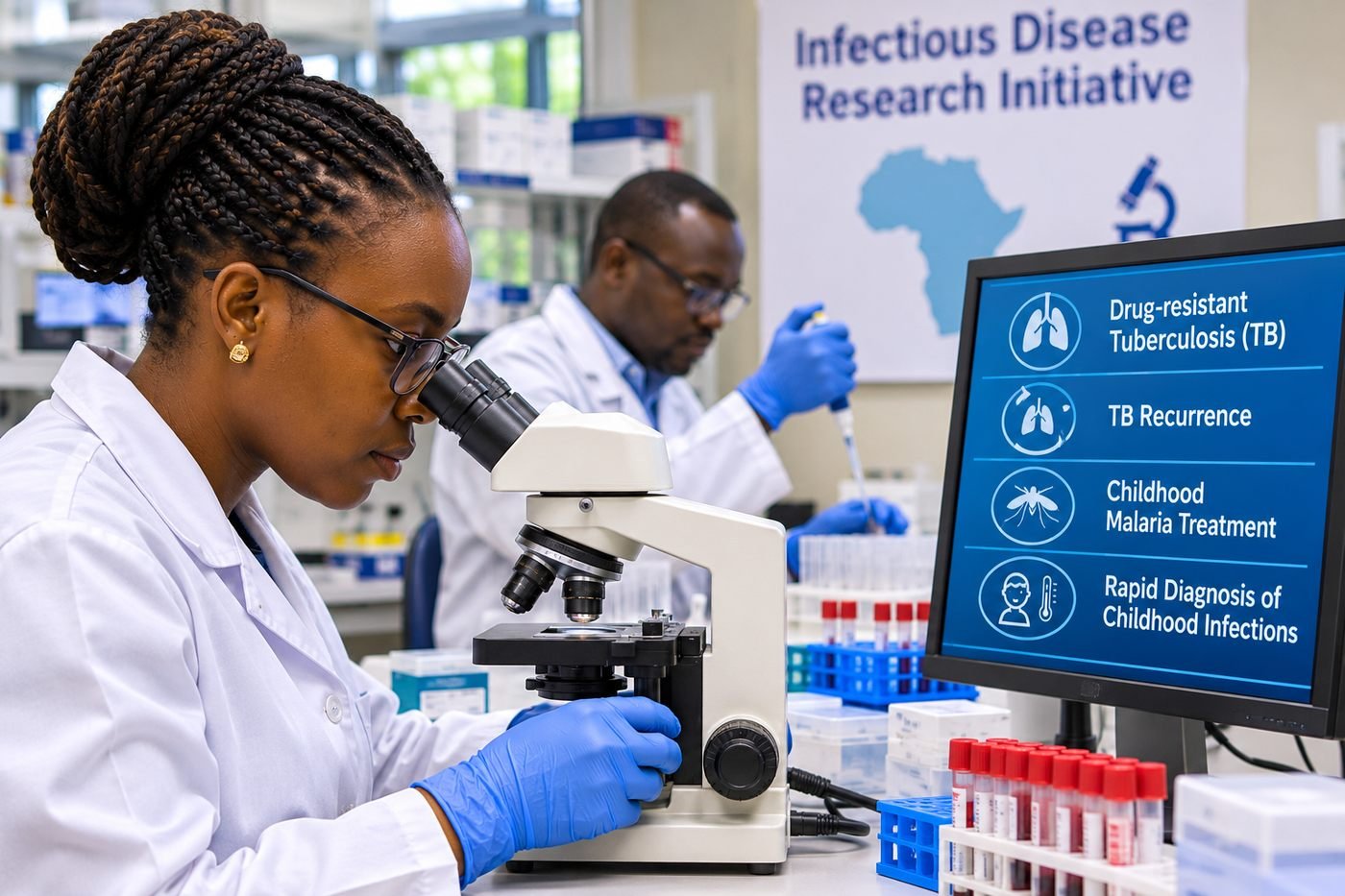
Nairobi, Kenya – Four new research initiatives backed by more than €9 million are targeting persistent gaps in the prevention, diagnosis and treatment of infectious diseases across sub-Saharan Africa. The projects cover drug-resistant tuberculosis (TB), TB recurrence, childhood malaria treatment and rapid diagnosis of childhood infections.
The projects, supported by the Global Health European and Developing Countries Clinical Trials Partnership 3 (Global Health EDCTP3), aim to move promising technologies and interventions closer to clinical evaluation and implementation in African health systems. They are relevant to ministries of health because they address several recurring challenges: tests that take too long to evaluate, people who become ill again after completing TB treatment, medicines that are difficult for young children to take, and fever cases that cannot be diagnosed quickly at frontline facilities.
New approaches to drug-resistant tuberculosis
One project, R2D2-xDRTB, is developing a shared platform to accelerate the evaluation of diagnostic tests for drug-resistant TB. It will enrol 500 adults and adolescents with rifampicin-resistant TB results, alongside 100 people with rifampicin-sensitive infections, at study sites in South Africa and Georgia. Candidate tests will be compared with established reference methods.
The project seeks to address a major bottleneck: new diagnostic technologies can take considerable time and resources to evaluate, delaying decisions about which tools should be introduced into national programmes. A more coordinated evaluation approach could help generate comparable evidence for regulators and TB programmes.
A second initiative, RECENT-TB, will investigate whether a 12-week course of isoniazid and rifapentine can prevent TB recurrence among people who have recently completed treatment. The study plans to recruit 1,800 participants in South Africa and Uganda and follow them for two years. Researchers will also explore risk markers that could help identify individuals most likely to benefit from preventive treatment.
Child-friendly malaria treatment
The ASAQ-PAC project is developing a child-friendly formulation of artesunate-amodiaquine. Researchers plan to use MicroCoat micropellets to mask the bitter taste of amodiaquine, making the medicine easier to administer to young children.
A clinical trial in Malawi will compare the formulation with standard tablets. A separate study will examine whether combining it with child-friendly primaquine could help reduce malaria transmission. The work comes amid concern that antimalarial drug resistance could undermine existing treatment options. The study will need to establish not only whether children can take the formulation more easily, but also whether it delivers the required medicine exposure safely and effectively.
Rapid diagnosis of childhood infections
The fourth project, PATHFINDER, is developing a portable laboratory-on-a-chip diagnostic device intended to identify infections through the body’s response to disease. The technology aims to generate a probable diagnosis in approximately 20 minutes.
Researchers plan to assess the device among 1,000 children with fever in Burkina Faso and Ghana. The approach could help clinicians distinguish between causes of childhood fever, reduce diagnostic uncertainty and limit unnecessary antibiotic prescriptions. Its practical value will depend on diagnostic accuracy across different infections and patient groups, affordability, ease of use and the ability of facilities to act on results.
What this means for African health systems
These initiatives demonstrate a shift towards diagnostics and treatments designed around frontline healthcare delivery. For African ministries of health, the key consideration will be whether technologies can deliver reliable results at affordable costs and be integrated into existing laboratory, procurement and clinical systems.
The projects remain at the research and evaluation stage. They should not yet be regarded as approved or routinely available interventions. Their outcomes could, however, provide evidence to guide national treatment guidelines, diagnostic procurement, clinical training and future investment in local health technology capacity.
From innovation to implementation
The next test is whether African health systems can move promising innovations from clinical research into affordable, accessible services without creating additional fragmentation. That will require early planning for regulatory review, local validation, procurement, maintenance, health-worker training and sustainable financing. Countries should also consider how study results will be shared with national TB, malaria and child-health programmes so that evidence informs policy rather than remaining confined to research sites.
Source: Global Health EDCTP3, “Diagnosing faster, treating smarter: four new tools for global health systems”, 10 November 2026. Global Health EDCTP3.
Discussion