Published in PLOS One on 2026-06-10, this study is presented as an attributed evidence briefing. The excerpts below are the original researchers’ words, reproduced under their Creative Commons Attribution licence. Health Signal has selected the abstract and, where needed, opening background paragraphs; the complete methods, results, limitations and references remain in the linked paper.
Original authors: Yvette Neema Ufoy Mungu, Joëlle Desreux, Elettra Bianchi, Burubu Lisi-Ankiene Junior, Roland Marini Djang’eing’a, Durkin Keith, Artesi Maria, Katenga Bosunga, Vincent Bours
Source: PLOS One • DOI 10.1371/journal.pone.0350982
Read the complete primary study ↗ · Creative Commons Attribution licence
From the researchers
Abstract
Cervical cancer due to high-risk human papillomavirus (HR-HPV) is the leading gynecological cancer in Sub-Saharan Africa and in the Democratic Republic of the Congo (DRC), where approximately one-quarter of people carries the sickle cell allele. This study aims to identify the HR-HPV genotypes and factors associated with major cervical abnormalities among women living in the sickle cell endemic area of Kisangani, DRC.
This hospital-based cross-sectional study consisted to a face-to-face and semi-structured questionnaire for collecting data of the socio-demographic, clinical and sexual behaviors characteristics of participants. The sickle cell status was confirmed using liquid chromatography coupled with mass spectrometry. Cervical smears were collected using the ThinPrep® Pap-test solution (Hologic Inc, Marlborough, USA). The HR-HPV molecular analysis was performed using the Cobas® 6800 system (Roche Molecular Systems, Somerville, USA) for real time polymerase chain reaction (RT-PCR) and the Oxford Nanopore platform (Oxford Nanopore Technologies, Oxford, England) for the viral genome sequencing. Cytological analyses were performed using the ThinPrep 5000 processor (Hologic), and the results were reported according to the 2014 Bethesda System classification. The logistic regression model was used to estimate the adjusted Odd ratio (aOR) during the risk factor assessments.
Among 712 women enrolled, the prevalence of HR-HPV was 28.4% (95% CI: 25.1–31.7). HPV35, HPV52 and HPV31 were the most common genotypes; while the sequencing identified two new variants of HPV103 and HPV223. The following factors were associated with HR-HPV infection: (i) age between 25 and 34 years (aOR: 2.10, 95% CI:1.22–3.69); (ii) being unmarried (aOR: 1.54, 95% CI: 1.05–2.27) and (iii) HIV-positive status (aOR: 14.85, 95% CI: 2.36–288.25). No correlation was observed between hemoglobin AS (HbAS) status and HR-HPV infection or cytological abnormalities. However, women aged 45–54 years (aOR: 3.8, 95% CI: 1.34–11.65), those using intravaginal herbal (aOR: 3.59, 95% CI: 1.26–11.28) and those infected with HPV33 (aOR: 8.45, 95% CI: 1.68–34.05) were more likely to present major cervical abnormalities in our series.
Our study shows a high prevalence of cervical HR-HPV infection in Kisangani, DRC. HPV35, HPV52, and HPV31 are the three most common genotypes, while novel variants of HPV types 103 and 223 were identified. Our findings also highlight that advanced age, HPV33 infection and intravaginal herbal use are the main factors associated with major cervical abnormalities. Although HbAS has not been associated with HR-HPV infection or cervical lesions, further studies are needed to determine this association in women with sickle cell disease (HbSS).
Introduction
Human papillomavirus (HPV) is one of the most common sexually transmitted infections worldwide, affecting more than 80% of men and women at some point in their lifetimes [1,2]. Since 1985, many studies have firmly proven this virus to be the most important etiological agent for the development of cervical intraepithelial neoplasia (CIN) and invasive cervical cancer [1,3].
Reading this evidence
Use the full paper to check the study design, participant selection, comparator and outcome definitions before drawing a practical conclusion. An association does not by itself show cause and effect. A reported performance measure needs its denominator and uncertainty. A finding from a particular facility, sample or time period should retain that scope when it is discussed elsewhere.
This briefing makes the source accessible within the wider hospital systems desk. It does not assess an individual patient or certify a product. When considering relevance to another health system, examine the original authors’ account of context and limitations, then seek local implementation evidence. The related reporting below provides other studies to read alongside this one; it is a topic connection, rather than a claim that their results are directly comparable.
© 2026 Yvette Neema Ufoy Mungu, Joëlle Desreux, Elettra Bianchi, Burubu Lisi-Ankiene Junior, Roland Marini Djang’eing’a, Durkin Keith, Artesi Maria, Katenga Bosunga, Vincent Bours. Excerpts reproduced under CC BY. Selection, formatting and contextual notes by Health Signal. The researchers are the authors of the source study, not members of Health Signal’s staff.
Explore connected evidence
- Evidence brief: Prevalence of high-risk human papillomavirus genotypes and associated factors among HIV-infected women in a reproductive age group attending antiretroviral therapy in Nekemte town, Oromia, Ethiopia
- Evidence brief: Impact of menopausal status on human papillomavirus detection and cervical neoplasia in middle-aged Senegalese women
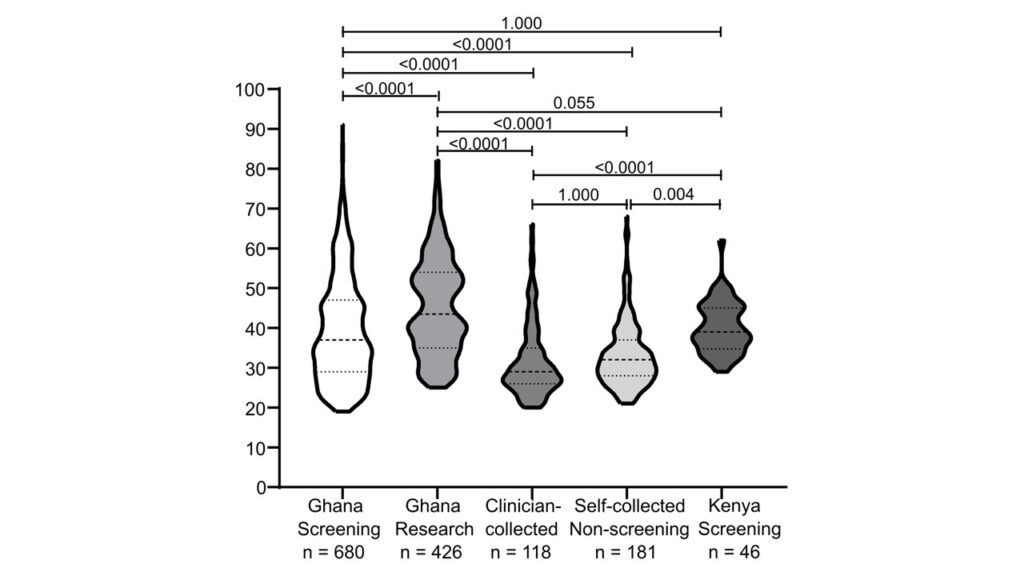
- Evidence brief: Genotype distribution of high-risk and potential high-risk HPV types among women in different screening and clinic settings in Ghana and Kenya