Published in PLOS One on 2026-08-18, this study is presented as an attributed evidence briefing. The excerpts below are the original researchers’ words, reproduced under their Creative Commons Attribution licence. Health Signal has selected the abstract and, where needed, opening background paragraphs; the complete methods, results, limitations and references remain in the linked paper.
Original authors: Prince C Nnadozie, Sylva C Nnadozie, Abimbola T Awopeju, Inumanye N Ojule
Source: PLOS One • DOI 10.1371/journal.pone.0325868
Read the complete primary study ↗ · Creative Commons Attribution licence
From the researchers
Abstract
Monitoring the treatment of tuberculosis(TB) and human immunodeficiency virus(HIV) co-infection is very important to improve patient management and compliance; however, treatment outcome monitoring remains inadequate in Nigeria. This study assessed the treatment outcomes of registered TB/HIV co-infected patients enrolled in the Directly Observed Treatment Short course(DOTS) program.
A retrospective study was conducted in a tertiary-care hospital in Port Harcourt, Nigeria from January 1, 2014 to December 31, 2019. Data were extracted from the National TB program register and analyzed using the statistical software package(IBM SPSS version30.0). Bivariate and multivariate logistic regressions were used to identify factors associated with treatment outcomes at 95% confidence intervals.
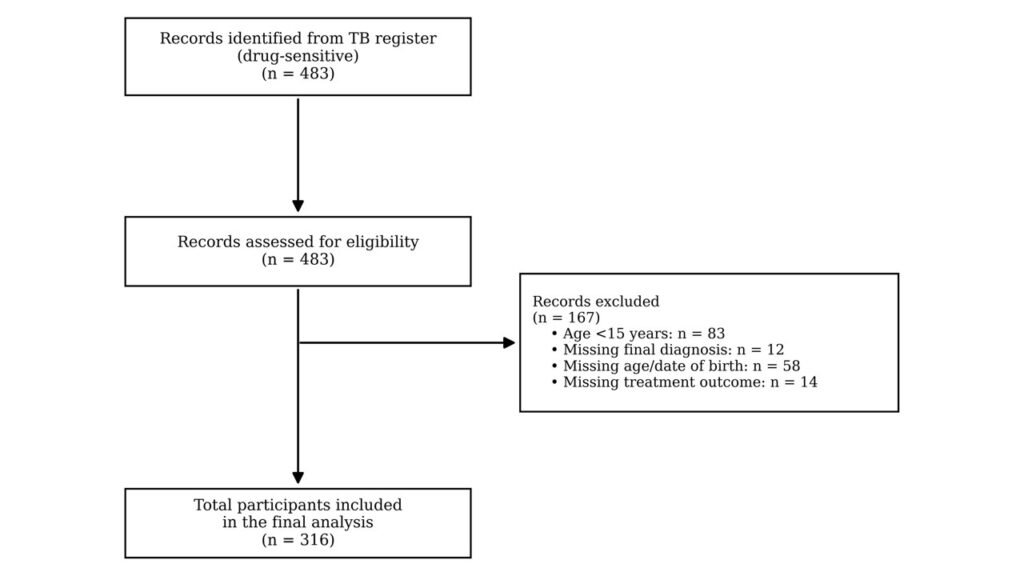
Among 305(37.4%) TB/HIV co-infected patients, the mean age was 29.2years, with 29.8% in the 0−14 age group, 89.5% new cases, and 89.2% pulmonary TB(PTB) cases. Males(50.2%) slightly outnumbered females(49.8%). Antiretroviral therapy(ART) and cotrimoxazole preventive therapy(CPT) uptake were high(95.1% and 93.4%, respectively). Treatment outcomes were: 19.0% cured, 23.3% completed treatment, 0.3% failed treatment, 23.6% died, 14.8% lost to follow-up, 10.8% transferred out, and 8.2% not evaluated. Overall, treatment success rate was 52.2%. Age(15−24 years: adjusted odds ratio [AOR]=6.35, 95%CI:1.56–25.86; 25−34 years: AOR = 3.97, 95%CI:1.37–11.45; and 45−54 years: AOR = 6.40, 95%CI:2.27–18.06) and alternative diagnostic method(AOR = 0.32, 95%CI:0.12–0.76) were significantly associated with unsuccessful treatment outcomes.
The treatment success rate of TB/HIV co-infected patients was relatively low and fell below the World Health Organization’s (WHO) target despite high uptake of ART and CPT. Study underscores the need for integrating targeted interventions, including alternative diagnostic methods, into clinical practice and policy to improve treatment outcomes among TB/HIV co-infected patients, particularly in specific age groups.
Introduction
Nigeria's tertiary-care facilities are fighting a recurring battle against the preventable diseases, TB and HIV infections. Despite ongoing efforts to manage these two major interconnected public health challenges, Nigeria's situation remains concerning. Globally, progress in combating TB and HIV infections is marked by tremendous setbacks and retrogression. According to the WHO Global Tuberculosis Report 2023, 10.6 million people worldwide contracted TB in 2022, with 6.3% of those cases involving people living with HIV (PLWHIV) [1]. This indicates an increase from the estimated 10 million global TB cases in 2019, of which 8.2% involved PLWHIV [2].
Multiple factors contribute to the rising prevalence of TB/HIV co-infection, its morbidity and mortality. Among these include the corona virus disease (COVID-19) pandemic, poverty, drug resistance, and stigmatization [3–6]. TB and HIV are closely linked, causing deleterious effects in co-infected patients [7]. If left untreated, these infections compromise the immune system and reduce patients’ lifespan and quality of life [8,9]. While TB can influence disease progression in HIV positive patients, HIV infection can cause TB progression from the latent phase to the active phase and increase the incidence of TB [10,11].
Reading this evidence
Use the full paper to check the study design, participant selection, comparator and outcome definitions before drawing a practical conclusion. An association does not by itself show cause and effect. A reported performance measure needs its denominator and uncertainty. A finding from a particular facility, sample or time period should retain that scope when it is discussed elsewhere.
This briefing makes the source accessible within the wider technology & industry desk. It does not assess an individual patient or certify a product. When considering relevance to another health system, examine the original authors’ account of context and limitations, then seek local implementation evidence. The related reporting below provides other studies to read alongside this one; it is a topic connection, rather than a claim that their results are directly comparable.
© 2026 Prince C Nnadozie, Sylva C Nnadozie, Abimbola T Awopeju, Inumanye N Ojule. Excerpts reproduced under CC BY. Selection, formatting and contextual notes by Health Signal. The researchers are the authors of the source study, not members of Health Signal’s staff.
Explore connected evidence
- Evidence brief: Determinants of tuberculosis presentation and successful treatment outcome among tuberculosis patients in Geita, Tanzania
- Evidence brief: Predictors of tuberculosis mortality among patients on treatment: A retrospective cohort study at a rural general hospital in Zambia
- Evidence brief: Impact of demographic factors and HIV status on Hepatitis B vaccination adherence and completion rate among high-risk populations in Lagos State, Nigeria