Published in PLOS One on 2026-06-24, this study is presented as an attributed evidence briefing. The excerpts below are the original researchers’ words, reproduced under their Creative Commons Attribution licence. HealthSignal has selected the abstract and, where needed, opening background paragraphs; the complete methods, results, limitations and references remain in the linked paper.
Original authors: Collins Mukubesa, Lukundo Siame, Malan Malumani, Faceroy Nkole, Propheria C. Lwiindi, Matenge Mutalange, Geofrey Mupeta, Memory Ngosa, Martin Chakulya, Benson M. Hamooya, Chitalu Chanda
Source: PLOS One • DOI 10.1371/journal.pone.0345056
Read the complete primary study ↗ · Creative Commons Attribution licence
From the researchers
Abstract
Despite decades of global efforts and the availability of curative and preventive measures, tuberculosis (TB) continues to be the world’s leading infectious disease cause of mortality, particularly in resource-limited settings. However, in developing countries, there is limited evidence on determinants of mortality during TB treatment, making it difficult to design targeted interventions. This study aimed to determine the incidence and factors associated with mortality among people diagnosed with TB at a rural health facility in Zambia.
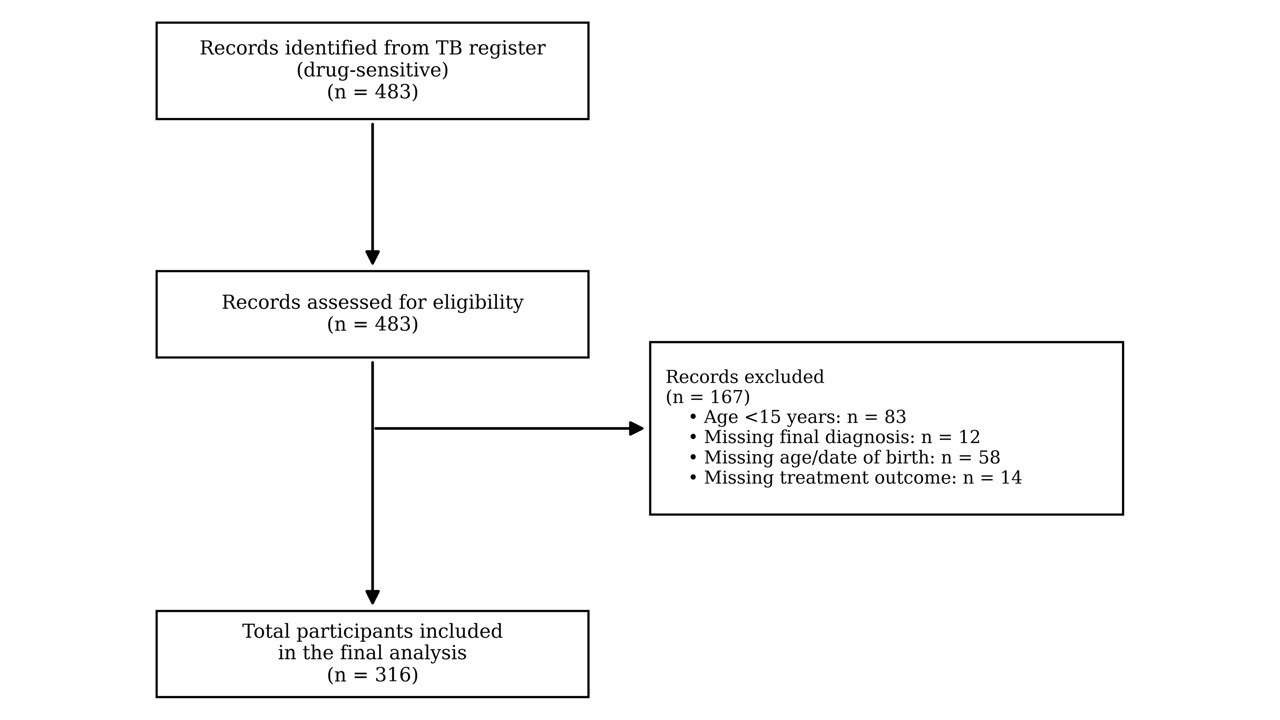
We conducted a retrospective cohort study among 316 individuals who started TB treatment between May 2019 and March 2024. Participants were followed from treatment initiation until a treatment outcome was recorded, with a maximum follow-up time of 12 months. Demographic and clinical information were collected from medical records using a data collection tool via KoboTool software. The primary outcome was mortality. We used a multivariable Cox regression model to identify factors associated with TB mortality using Stata version 15.
The participants had a median age of 41 years (IQR: 32–54) and a median follow-up of 174 days (IQR: 155–191). Overall, 19.0% (n = 60; 95% CI: 14.8–23.8) of participants died, corresponding to an incidence rate of 42.1 per 100 person-years based on 51,968 person-days of follow-up (95% CI: 31.6–54.0). Age (adjusted hazard ratio (aHR): 1.017, 95% CI: 1.000–1.033, P = 0.042), clinically diagnosed TB had a significantly higher risk of mortality compared to those with bacteriologically confirmed TB (aHR: 1.97, 95% CI: 1.14–3.41, p = 0.015), and People living with HIV (aHR: 1.84, 95% CI: 1.03–3.29, P = 0.039) were significantly associated with increased mortality. While being on family-based directly observed therapy (DOT) (aHR: 0.42, 95% CI: 0.24–0.74, P = 0.003) and every unit increase in baseline weight (aHR: 0.96, 95% CI: 0.92–0.99, p = 0.004) was associated with a reduced risk of mortality.
This study reveals a high incidence of TB-related mortality in a rural setting, which is significantly influenced by demographic and clinical determinants. The findings highlight the need for closer evaluation of patients with clinically diagnosed TB and strengthening family-based DOT as strategies to reduce mortality.
Introduction
Tuberculosis (TB) remains one of the leading causes of mortality from infectious diseases worldwide, despite the availability of effective diagnostic tools and treatment [1]. In 2021, an estimated 10 million people developed TB, resulting in approximately 1.3 million deaths among HIV-negative individuals and 214,000 deaths among those co-infected with HIV [2]. The persistence of TB-related deaths highlights the ongoing challenges in TB control, particularly in low- and middle-income countries [3]. Zambia continues to experience a significant burden of TB and is classified among the 30 high TB-burden countries globally, ranking 21st in prevalence [4]. Although the national TB mortality rate has declined from 30 per 100,000 population in 2015–21 per 100,000 in 2021, TB remains a major public health problem [4].
Reading this evidence
Use the full paper to check the study design, participant selection, comparator and outcome definitions before drawing a practical conclusion. An association does not by itself show cause and effect. A reported performance measure needs its denominator and uncertainty. A finding from a particular facility, sample or time period should retain that scope when it is discussed elsewhere.
This briefing makes the source accessible within the wider research & evidence desk. It does not assess an individual patient or certify a product. When considering relevance to another health system, examine the original authors’ account of context and limitations, then seek local implementation evidence. The related reporting below provides other studies to read alongside this one; it is a topic connection, rather than a claim that their results are directly comparable.
© 2026 Collins Mukubesa, Lukundo Siame, Malan Malumani, Faceroy Nkole, Propheria C. Lwiindi, Matenge Mutalange, Geofrey Mupeta, Memory Ngosa, Martin Chakulya, Benson M. Hamooya, Chitalu Chanda. Excerpts reproduced under CC BY. Selection, formatting and contextual notes by HealthSignal. The researchers are the authors of the source study, not members of HealthSignal’s staff.
Explore connected evidence
- Evidence brief: Time to treatment initiation in pregnant women with tuberculosis in Cape Town, South Africa
- Evidence brief: Determinants of favorable treatment outcomes in multidrug-resistant tuberculosis in Zambia: A retrospective cross sectional study, 2018–2022
- Evidence brief: In-hospital survival and predictors of mortality among stroke patients at a tertiary hospital in Ghana: A retrospective cohort study


