Published in PLOS One on 2026-09-28, this study is presented as an attributed evidence briefing. The excerpts below are the original researchers’ words, reproduced under their Creative Commons Attribution licence. Health Signal has selected the abstract and, where needed, opening background paragraphs; the complete methods, results, limitations and references remain in the linked paper.
Original authors: Hale Teka, Mussie Alemayehu, Mengistu Hagazi Tequare, Hailesllassie Berhe, Hailemariam Gebrearegay Haileeyesus, Rahel Nardos
Source: PLOS One • DOI 10.1371/journal.pone.0358569
Read the complete primary study ↗ · Creative Commons Attribution licence
From the researchers
Abstract
Task-shifting and task-sharing are strategies for redistributing or collaboratively delivering clinical tasks within health workforce teams to address shortages and expand access. In Ethiopia, Integrated Emergency Surgical Officers (IESOs) were introduced to provide emergency obstetric and essential surgical care in underserved areas. In Tigray, conflict-related damage, displacement, workforce attrition, and disruption of referral and training systems intensified pre-existing surgical workforce shortages. Evidence on how IESOs have been integrated, supported, and retained in this fragile health-system context remains limited. This study assessed the status and experiences of IESOs in Tigray and identified strategies for strengthening their integration and retention.
We conducted a concurrent mixed-methods study in November 2024. Of the 84 IESOs practising in Tigray, 59 attended the region-wide safe-cesarean-delivery training and all 59 completed the survey, giving a 100% response rate among invtied participants and representing 70.2% of practising IESOs in the region. Two focus group discussions with nine participants each and five in-depth interviews were conducted. Quantitative data were analyzed descriptively using R version 4.2.2, and qualitative data were analyzed thematically. Findings were integrated through triangulation and a joint display.
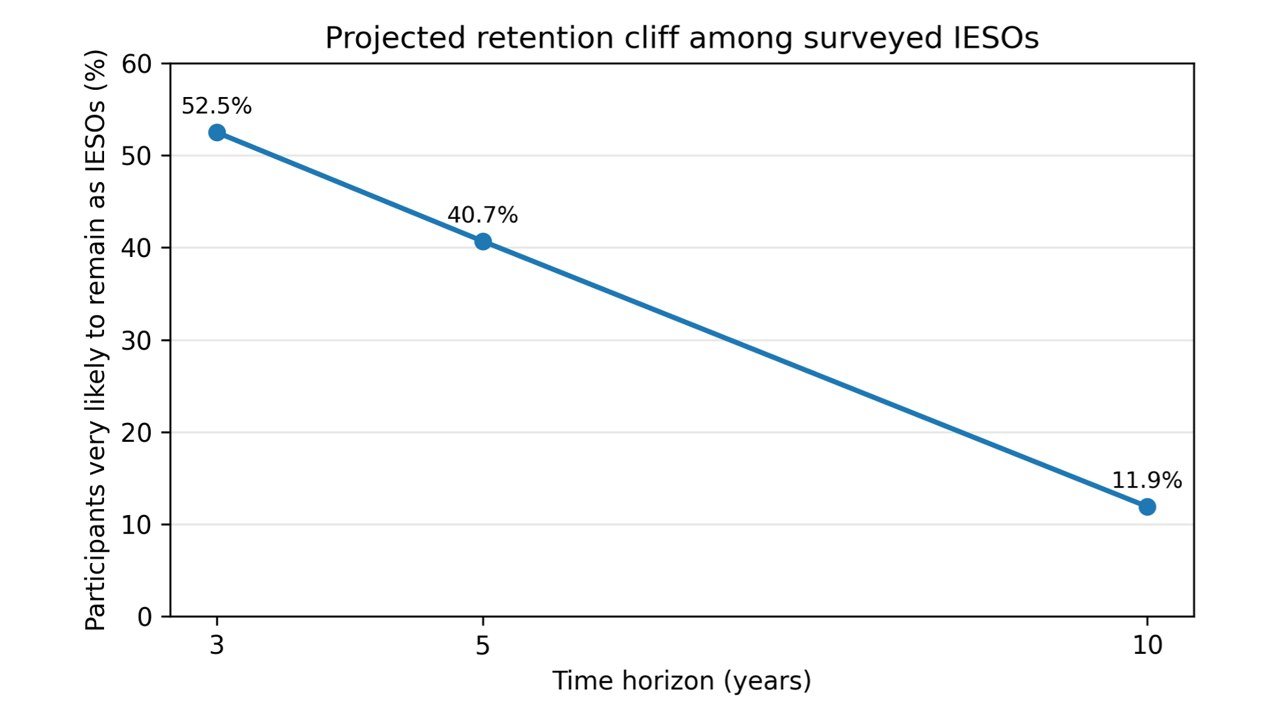
Participants worked across general hospitals, primary hospitals, and health centers. Most strongly agreed that IESOs contributed to reducing maternal mortality, 54(91.5%) and perinatal or neonatal mortality 48 (88.1%). The proportions who were very likely to remain in the profession declined from 31 (52.5%) at three years to 24 (40.7%) at five years and 7 (11.9%) at ten years, demonstrating a pronounced projected retention cliff. Resource shortages, limited managerial recognition, inter-professional conflict, and absent career-progression pathways were the dominant challenges, whereas community acceptance and the opportunity to initiate lifesaving services in remote settings were major sources of motivation.
IESOs extend emergency obstetric and surgical services to underserved communities in Tigray, but their long-term retention is precarious. A sustainable program requires a nationally and regionally defined scope of practice, an appropriate salary and professional grading structure, funded continuing professional development, formal IESO specialization or advanced clinical career pathways, reliable surgical supplies and infrastructure, and structured collaborative governance with surgeons and obstetrician-gynecologists.
Background
The global shortage and unequal distribution of skilled health workers remain major barriers to universal health coverage [1,2]. The World Health Organization distinguishes task-shifting, in which selected tasks are transferred to appropriately trained cadres, from task-sharing, in which responsibility is delivered collaboratively across a team according to competence, regulation, and supervision [3,4]. Both approaches can expand coverage, shorten delays, and improve continuity of essential services when accompanied by adequate training, governance, referral systems, and resources [5,6]. Mid-level health professionals can also be trained more rapidly and at lower cost than physicians and may be more likely to remain in rural areas [7].
Reading this evidence
Use the full paper to check the study design, participant selection, comparator and outcome definitions before drawing a practical conclusion. An association does not by itself show cause and effect. A reported performance measure needs its denominator and uncertainty. A finding from a particular facility, sample or time period should retain that scope when it is discussed elsewhere.
This briefing makes the source accessible within the wider financing & policy desk. It does not assess an individual patient or certify a product. When considering relevance to another health system, examine the original authors’ account of context and limitations, then seek local implementation evidence. The related reporting below provides other studies to read alongside this one; it is a topic connection, rather than a claim that their results are directly comparable.
© 2026 Hale Teka, Mussie Alemayehu, Mengistu Hagazi Tequare, Hailesllassie Berhe, Hailemariam Gebrearegay Haileeyesus, Rahel Nardos. Excerpts reproduced under CC BY. Selection, formatting and contextual notes by Health Signal. The researchers are the authors of the source study, not members of Health Signal’s staff.
Explore connected evidence
- Evidence brief: Perceptions and experiences of women and providers on barriers and facilitators of quality emergency obstetric and newborn care services in public hospitals of West Shoa Zone, Oromia, Ethiopia: A phenomenological qualitative study
- Evidence brief: Preconception care services in Northern Ethiopia: A qualitative exploration of awareness, experiences, challenges, opportunities, and prospects
- Evidence brief: Integrated malaria service delivery and its determinants among pregnant women in Ethiopia: Multi level analysis of 2021/22 National Service Provision Assessment Survey


