Published in PLOS One on 2026-09-23, this study is presented as an attributed evidence briefing. The excerpts below are the original researchers’ words, reproduced under their Creative Commons Attribution licence. Health Signal has selected the abstract and, where needed, opening background paragraphs; the complete methods, results, limitations and references remain in the linked paper.
Original authors: Esther M. Choo, Jonathan Lara-Arevalo, Catherine Achieng, Merceline Odhiambo, Maurine Anyango Okello, Mary Masheti, Kirkby D. Tickell, Mame M. Diakhate, Benson O. Singa, Christine J. McGrath, Arianna Rubin Means
Source: PLOS One • DOI 10.1371/journal.pone.0358775
Read the complete primary study ↗ · Creative Commons Attribution licence
From the researchers
Abstract
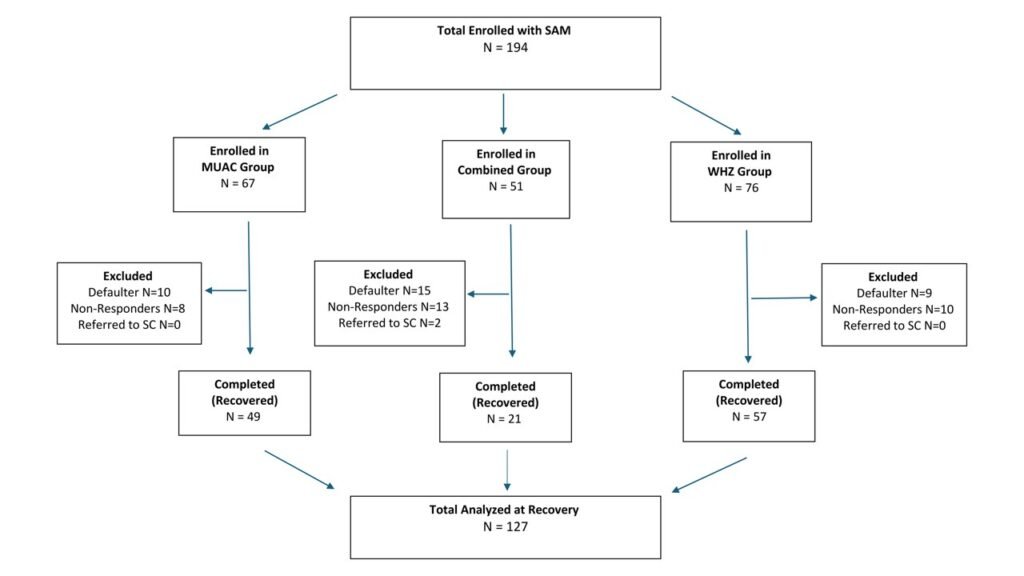
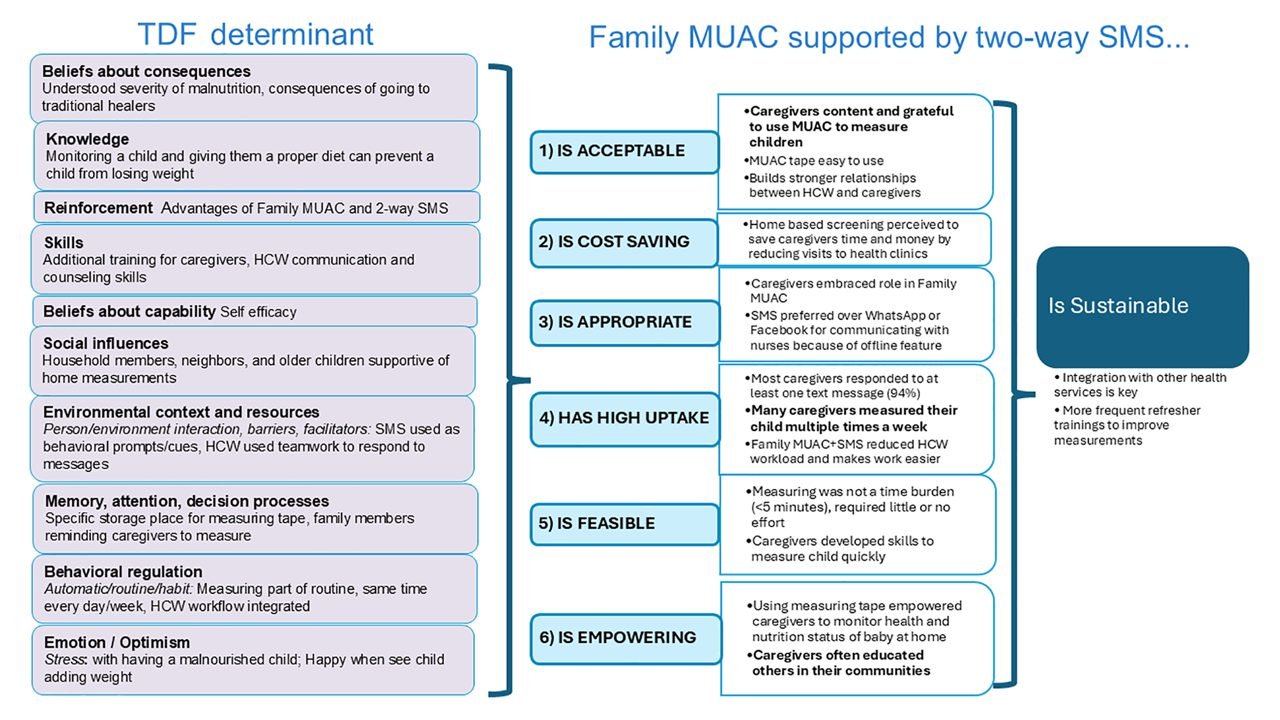
Early identification and treatment of acute malnutrition can decrease mortality and morbidity related to wasting or low weight-for-height. Teaching caregivers to measure mid-upper arm circumference (MUAC), an approach known as Family MUAC, may support early diagnosis of wasting. Family MUAC paired with mobile support from healthcare workers resulted in a 37% reduction in child wasting in the Mama Aweza trial in Kenya. This study examines the intervention’s acceptability, feasibility, appropriateness, uptake, perceptions of cost savings, and factors influencing engagement with Family MUAC. This qualitative study involved eight focus group discussions with caregivers enrolled in the Mama Aweza trial and fourteen in-depth interviews with caregivers who participated in the intervention arm, Family MUAC supported by two-way short message service (SMS). Caregivers were purposively selected based on engagement level with the intervention. Eighteen program staff and healthcare workers from three facilities in western Kenya participated in in-depth interviews. The Theoretical Domains Framework informed design of data collection tools. Caregiver and healthcare worker perceptions of Family MUAC with two-way SMS centered on seven themes. The intervention was viewed as acceptable, cost-saving, appropriate, feasible, and empowering. Caregiver uptake was high, and integrating child growth monitoring with other health services may help enhance sustainability. Barriers to uptake included inconsistent MUAC measurements, limited social support, and issues with phone sharing. Refresher trainings could increase accuracy of MUAC measurements and improve engagement. Direct communication with healthcare workers via SMS built trust and strengthened patient-provider relationships. Caregivers also reported perceived cost savings, as SMS communication reduced unnecessary travel to health centers when children were not malnourished. This study supports Family MUAC with two-way SMS as a promising approach to empower caregivers and highlights their critical role in child health and nutrition interventions. Future interventions can focus on improving measurement accuracy and mitigating negative social influences on caregiver-led interventions.
Introduction
Nearly half of all deaths of children under five years of age are linked to undernutrition, primarily in low-and middle-income countries (LMICs) [1]. Over 45 million children are estimated to be acutely malnourished or wasted (a form of malnutrition characterized by low weight-for-height) globally, which can increase the risk of death amongst children under five by 12-fold [2]. Yet, it is estimated that only 1 in 3 children with wasting receive treatment [3]. Early identification of undernutrition and initiation of treatment can prevent wasting, and the World Health Organization (WHO) and UNICEF recommends integrating early detection and treatment of child wasting into routine primary health care services [4,5].
One promising approach to early detection and treatment is engaging with caregivers during their child’s infancy and empowering them with the knowledge and tools needed to measure their child’s mid-upper arm circumference (MUAC) at home, an approach known as Family MUAC. In some settings, home-based monitoring of a child’s MUAC by caregivers has led to earlier identification of malnutrition in comparison to active and passive screening by field workers [6,7]. Moreover, when provided with appropriate training, caregivers can perform MUAC assessments with a level of accuracy comparable to that of community healthcare workers [6]. However, there remains limited evidence on effective approaches to support caregivers in consistently performing MUAC measurements over time and in seeking appropriate care when measurements indicate childhood wasting [8].
Reading this evidence
Use the full paper to check the study design, participant selection, comparator and outcome definitions before drawing a practical conclusion. An association does not by itself show cause and effect. A reported performance measure needs its denominator and uncertainty. A finding from a particular facility, sample or time period should retain that scope when it is discussed elsewhere.
This briefing makes the source accessible within the wider research & evidence desk. It does not assess an individual patient or certify a product. When considering relevance to another health system, examine the original authors’ account of context and limitations, then seek local implementation evidence. The related reporting below provides other studies to read alongside this one; it is a topic connection, rather than a claim that their results are directly comparable.
© 2026 Esther M. Choo, Jonathan Lara-Arevalo, Catherine Achieng, Merceline Odhiambo, Maurine Anyango Okello, Mary Masheti, Kirkby D. Tickell, Mame M. Diakhate, Benson O. Singa, Christine J. McGrath, Arianna Rubin Means. Excerpts reproduced under CC BY. Selection, formatting and contextual notes by Health Signal. The researchers are the authors of the source study, not members of Health Signal’s staff.
Explore connected evidence
- Evidence brief: Facilitators and barriers to the implementation of a caregiver-led training programme for caregivers of children with cerebral palsy in rural Malawi
- Evidence brief: Prevalence, diagnostic methods, and clinical outcomes of wasting among paediatric cancer patients in Africa: A systematic review and meta-analysis
- Evidence brief: Perceptions and experiences of Hospital-Acquired Diarrhea among children aged 0–59 months with Severe Acute Malnutrition at Mwanamugimu Nutrition Unit, Mulago, Uganda: A qualitative study