Published in PLOS One on 2026-09-15, this study is presented as an attributed evidence briefing. The excerpts below are the original researchers’ words, reproduced under their Creative Commons Attribution licence. Health Signal has selected the abstract and, where needed, opening background paragraphs; the complete methods, results, limitations and references remain in the linked paper.
Original authors: Zeyede Teshome, Abebe Animut, Belete Adefris Legesse, Mirutse Giday, Esayas Aklilu
Source: PLOS One • DOI 10.1371/journal.pone.0358040
Read the complete primary study ↗ · Creative Commons Attribution licence
From the researchers
Abstract
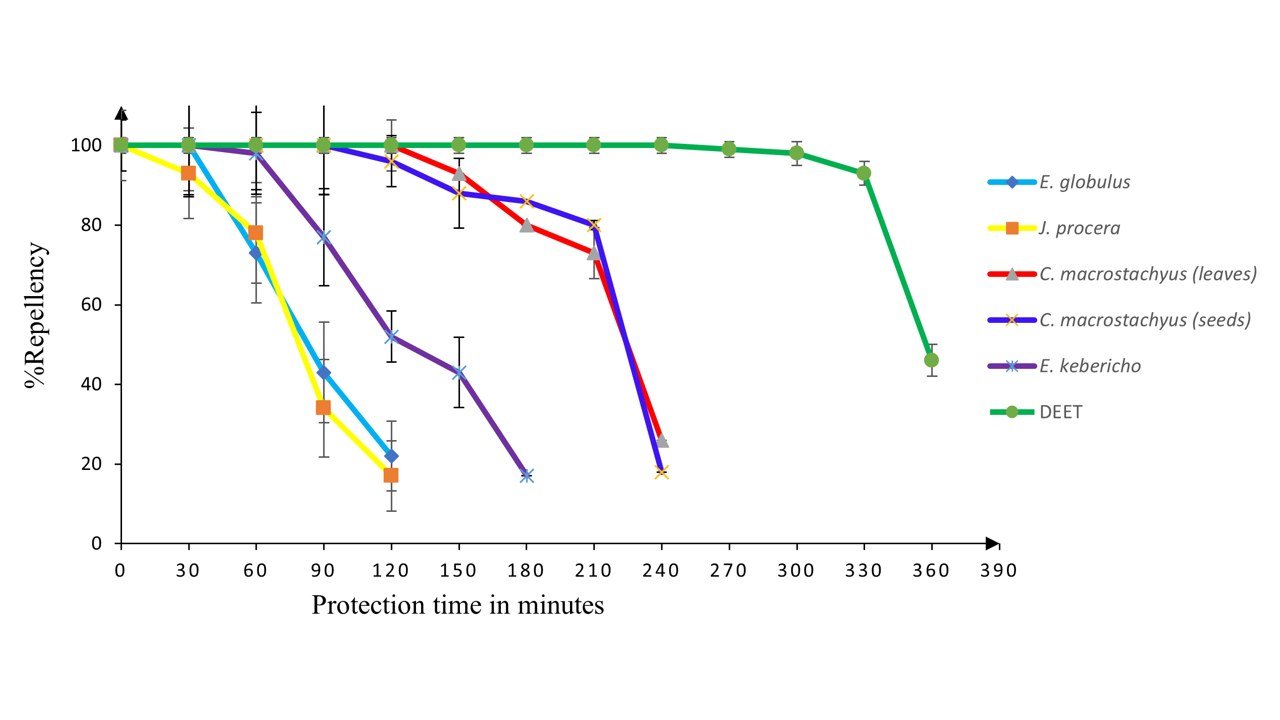
Botanical repellents provide a traditional means of personal protection, yet optimizing their formulations is increasingly required to address shifting mosquito feeding behaviors and mitigate disease transmission. The current study aimed to evaluate the repellent efficacy of essential oils and their binary combinations as complex matrices against Anopheles arabiensis bites, the major malaria vector in Ethiopia. Essential oils were extracted from fresh parts of four ethnobotanically investigated medicinal plants in the Ghibe Valley, Ethiopia, namely Croton macrostachyus, Echinops kebericho, Eucalyptus globulus, and Juniperus procera using hydrodistillation. The chemical composition of the essential oils was analyzed by Gas Chromatography-Mass Spectrometry (GC-MS). Arm-in-cage bioassays using laboratory-reared mosquitoes and human volunteers determined the effective dosage and complete protection time of the essential oils at 10% and 20% concentrations. A total of 131 chemical constituents were identified across the four analyzed essential oils. The C. macrostachyus leaf and seed oils provided a significantly longer protection time (p < 0.001), reaching 180 minutes with a mean percentage repellency of 85% to 100%. The essential oil of J. procera blended with C. macrostachyus or E. kebericho exhibited significant synergistic repellency (p < 0.001). The protection duration demonstrating by C. macrostachyus oil underscores their potential to meet the regulatory performance standards for natural insect repellents. Future investigations should include larger sample sizes, dermal toxicity assessments and field validation to fully support the commercialization of these essential oils.
Introduction
Malaria causes significant public health challenge despite decades of control efforts. It infected over 280 million people and claimed 600,000 lives in 2024 of which over 90% of the cases and deaths were from Africa [1,2]. The disease is the top cause of morbidity and mortality in Ethiopia, driven by a population distribution where approximately 75% of individuals reside in high-endemic areas, 18% in epidemic-prone, and only 7% in low-transmission or malaria-free regions [3–6].
Malaris is transmitted by over 70 Anopheles species, of which Anopheles gambiae s.s. and An. arabiensis are the most effective vectors, while An. funestus, An. bwambae, An. merus, and An. melas are involved in localized transmission in sub-Saharan Africa [7,8]. The predominant and most widespread vector in Ethiopia is An. arabiensis while An. nili, An. pharoensis, and An. funestus serve as secondary roles in limited settings [9,10]. An. stephensi, reported recently, is also a potential vector [11,12].
Vector control remained the primary strategy to combat malaria [13,14]. The use of long-lasting insecticide-treated nets and indoor residual insecticide spraying has been effective to control malaria in indoor settings [13,15,16]. However, these strategies are being challenged by vectors resistance to insecticides [17,18], shift in biting from late-night to early-night and indoor to outdoor [19,20]. This entails the need for alternative control tools including mosquito repellents to suppress vectors regardless of their biting patterns [17,21].
Reading this evidence
Use the full paper to check the study design, participant selection, comparator and outcome definitions before drawing a practical conclusion. An association does not by itself show cause and effect. A reported performance measure needs its denominator and uncertainty. A finding from a particular facility, sample or time period should retain that scope when it is discussed elsewhere.
This briefing makes the source accessible within the wider public health desk. It does not assess an individual patient or certify a product. When considering relevance to another health system, examine the original authors’ account of context and limitations, then seek local implementation evidence. The related reporting below provides other studies to read alongside this one; it is a topic connection, rather than a claim that their results are directly comparable.
© 2026 Zeyede Teshome, Abebe Animut, Belete Adefris Legesse, Mirutse Giday, Esayas Aklilu. Excerpts reproduced under CC BY. Selection, formatting and contextual notes by Health Signal. The researchers are the authors of the source study, not members of Health Signal’s staff.
Explore connected evidence
- Evidence brief: Seasonal variation in species composition, deltamethrin susceptibility, and kdr mutations in anopheles mosquitoes in Northwest Ethiopia
- Evidence brief: Field evaluation of 3-(N-acetyl-n-butyl) aminopropionic acid ethyl ester – IR3535 as a spatial repellent to control malaria: A Randomised, Before-After-Control-Intervention trial
- Evidence brief: Ethnomedicinal knowledge of plants used in alternative medicine as uterotonics in Lubumbashi, Haut-Katanga, Democratic Republic of Congo
