Published in PLOS One on 2026-09-15, this study is presented as an attributed evidence briefing. The excerpts below are the original researchers’ words, reproduced under their Creative Commons Attribution licence. Health Signal has selected the abstract and, where needed, opening background paragraphs; the complete methods, results, limitations and references remain in the linked paper.
Original authors: Adugna Olani, Gedefa Bayisa, Merga Chala, Lami Gurmessa, Jiregna Fayera
Source: PLOS One • DOI 10.1371/journal.pone.0358136
Read the complete primary study ↗ · Creative Commons Attribution licence
From the researchers
Abstract
Vaccination competency is a critical determinant of immunization quality and safety. However, limited evidence exists on the practical skills of frontline providers in Ethiopia.
A facility-based observational study assessing vaccination competency among health care providers involved in routine childhood immunization.
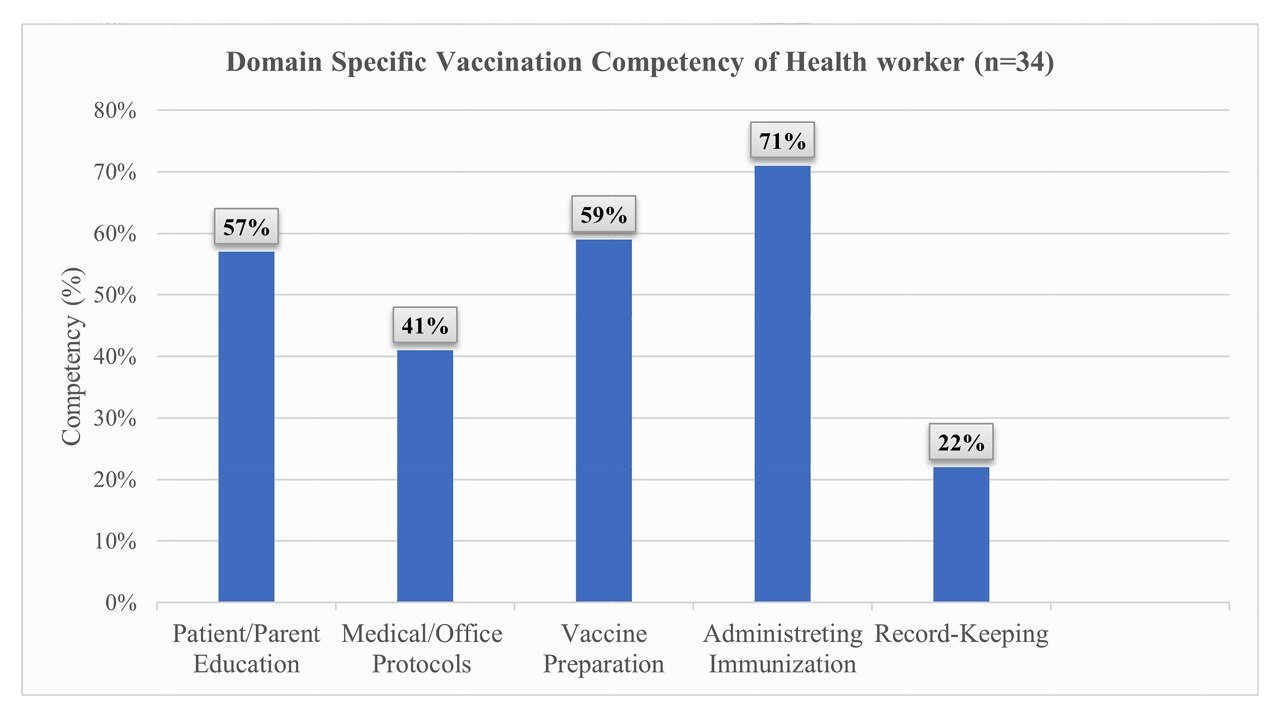
A total of 34 providers were observed while administering 10 vaccine doses each, resulting in 340 observed vaccination encounters. Competency was assessed using a structured checklist covering patient/parent education, medical and office protocols, vaccine preparation, vaccine administration, and record-keeping. A composite competency score was calculated for each provider and expressed as a percentage. Domain-specific competency scores were summarized using descriptive statistics, and providers scoring ≥80% were classified as competent. We observed 340 vaccination procedures performed by healthcare providers in 34 health facilities. Most providers were aged 30–39 years (19/34), male (22/34), held a Bachelor of Science (23/34), and had 6–10 years of work experience (20/34). Competency varied across domains, with the highest performance in vaccine administration (71%) and the lowest in record-keeping (22%). The overall mean competency score was 50%, below the predefined 80% competence threshold.
Moderate technical skills but failure in infection control, patient communication, and documentation resulted in weak practical competency, were observed from this study. Data indicate a gap between knowledge-based practice and actual performance. To improve immunization service, it is essential to enhance supervision and mentorship, focus on vaccine information system usage, and provide regular competency-based training for EPI providers. Strengthening routine monitoring and supportive supervision is critical, along with further research to identify barriers and assess training effectiveness. Addressing these gaps is vital for enhancing the quality and coverage of immunization services.
Introduction
Immunization is widely acknowledged as one of the most cost – effective public health measures, and it is essential in lowering the morbidity and mortality rates of diseases that can be prevented by vaccination [1]. The World Health Organization (WHO) estimates that vaccinations avert 2–3 million deaths annually [2]. But the availability of vaccines is not the only factor that affects the quality of vaccination services; healthcare providers’ ability to follow safe and efficient procedures is also a factor. This implies using the right vaccination administration methods, following infection control guidelines, and keeping thorough records [3]
Ethiopia has achieved notable progress in increasing the coverage of childhood vaccinations. The Expanded Program on Immunization (EPI), which was put into place by the Ethiopian government, has improved vaccine accessibility nationwide [4]. According to the latest WHO/UNICEF Estimates of National Immunization Coverage (WUENIC), Ethiopia achieved 84% coverage for the first dose (DTP1) and 74% coverage for the third dose (DTP3) of the diphtheria–tetanus–pertussis vaccine in 2024, indicating that routine immunization coverage remains below national and global targets [5].. But even with these advancements, there are still issues with making sure vaccinations are given in a safe and efficient manner. There have been reports of problems like poor documentation practices, inconsistent adherence to infection prevention guidelines, and insufficient training of healthcare providers [6]
Reading this evidence
Use the full paper to check the study design, participant selection, comparator and outcome definitions before drawing a practical conclusion. An association does not by itself show cause and effect. A reported performance measure needs its denominator and uncertainty. A finding from a particular facility, sample or time period should retain that scope when it is discussed elsewhere.
This briefing makes the source accessible within the wider hospital systems desk. It does not assess an individual patient or certify a product. When considering relevance to another health system, examine the original authors’ account of context and limitations, then seek local implementation evidence. The related reporting below provides other studies to read alongside this one; it is a topic connection, rather than a claim that their results are directly comparable.
© 2026 Adugna Olani, Gedefa Bayisa, Merga Chala, Lami Gurmessa, Jiregna Fayera. Excerpts reproduced under CC BY. Selection, formatting and contextual notes by Health Signal. The researchers are the authors of the source study, not members of Health Signal’s staff.
Explore connected evidence
- Evidence brief: Challenges, opportunities and best practices in routine childhood vaccination services delivery in urban slums and pastoralist regions of Ethiopia: An exploratory qualitative study in marginalized settings
- Evidence brief: Perceptions and experiences of women and providers on barriers and facilitators of quality emergency obstetric and newborn care services in public hospitals of West Shoa Zone, Oromia, Ethiopia: A phenomenological qualitative study
- Evidence brief: Prevalence, spatial patterns and determinants of zero-dose vaccination among children aged 12–23 months in Sub-Saharan Africa: A multilevel spatial analysis

