Published in PLOS One on 2026-08-20, this study is presented as an attributed evidence briefing. The excerpts below are the original researchers’ words, reproduced under their Creative Commons Attribution licence. Health Signal has selected the abstract and, where needed, opening background paragraphs; the complete methods, results, limitations and references remain in the linked paper.
Original authors: Birhane Alem Berihu, Hayelom Kebede Mekonen, Afework Mulugeta, Tony Magana, Yibrah Berhe Zelelow, Masresha Tessema, Feyissa Challa, Yohannes Belay, Mehari Meles, Wossene Habtu, Tigist Getahun, Yosef Tolcha, Tafere Gebreegziabher Belay
Source: PLOS One • DOI 10.1371/journal.pone.0356720
Read the complete primary study ↗ · Creative Commons Attribution licence
From the researchers
Abstract
The Tigray region of northern Ethiopia has one of the highest reported prevalences of neural tube defects (NTDs) globally. Red blood cell (RBC) folate is the gold-standard biomarker for assessing long-term folate status and predicting the risk of folate-sensitive NTDs. This study assessed RBC folate concentrations and dietary diversity among first-trimester pregnant women in Tigray.
A facility-based cross-sectional study was conducted from March to April 2025 in five randomly selected public hospitals in Tigray, Ethiopia. A total of 400 first-trimester pregnant women (≤13 weeks of gestation) were selected using systematic random sampling. Sociodemographic, anthropometric, obstetric, and dietary data were collected using interviewer-administered questionnaires and a 24-hour dietary recall based on the Food and Agriculture Organization Minimum Dietary Diversity for Women (MDD-W) tool. RBC folate concentrations were measured using electrochemiluminescence immunoassay. Descriptive statistics summarized the data, and an exploratory L2-penalized (Ridge) logistic regression model was fitted because of the rarity of folate sufficiency.
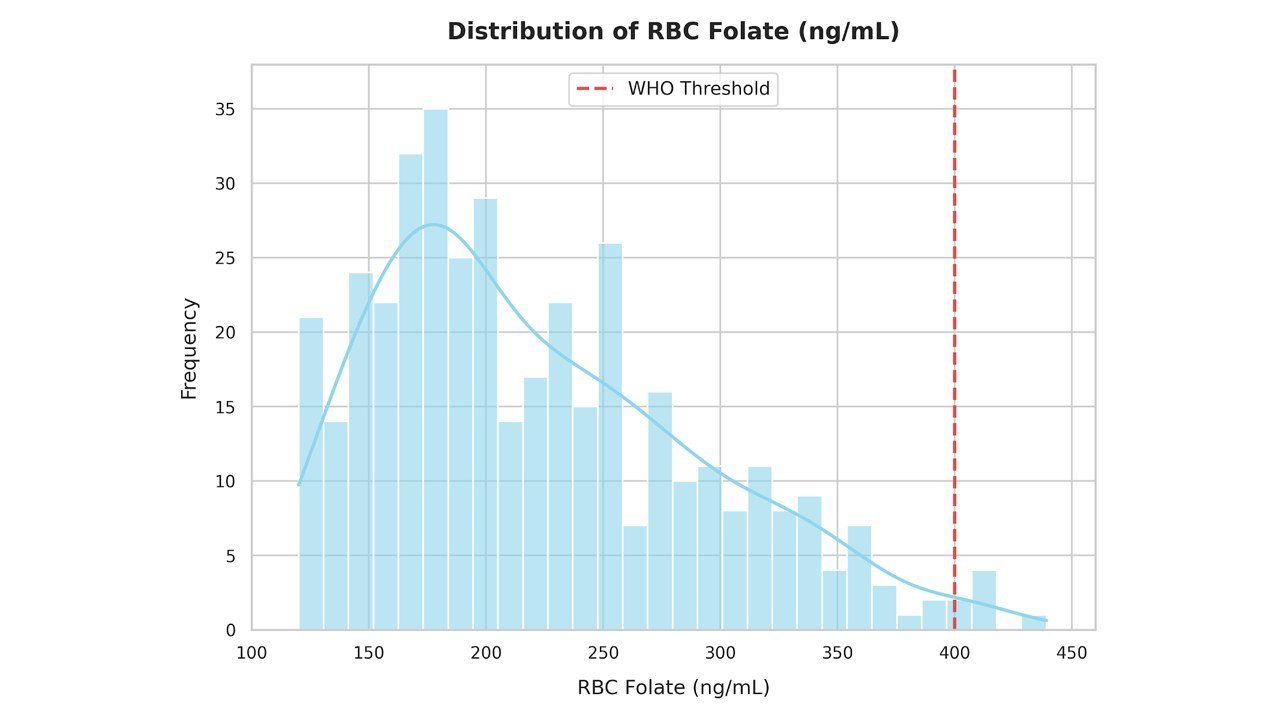
The mean RBC folate concentration was 221.6 ± 68.6 ng/mL, with a median of 204.9 ng/mL. Overall, 98.8% of participants (395/400; 95% CI: 97.1%–99.6%) had RBC folate concentrations below the WHO-recommended threshold of 400 ng/mL for optimal NTD prevention. Additionally, 79.5% (318/400) of participants did not achieve the minimum dietary diversity threshold (<5 food groups). Among women who achieved minimum dietary diversity, 97.6% (80/82) remained folate deficient. In the exploratory Ridge regression, achieving minimum dietary diversity was positively associated with folate sufficiency (AOR = 1.82), whereas increasing maternal age was inversely associated (AOR = 0.67).
This study demonstrates that maternal RBC folate deficiency was present in almost all first-trimester pregnant women in Tigray, highlighting a substantial public health concern in a region with a high burden of neural tube defects. The finding that clinical deficiency crosses all demographic and dietary tiers indicates that individual-level dietary modification and sporadic supplementation are insufficient to protect maternal reserves. Safely addressing this structural micronutrient emergency and reducing the high burden of NTDs requires an immediate transition toward mandatory, large-scale food fortification of staple grains in Northern Ethiopia.
Background
Folate, a B-vitamin essential for DNA synthesis, repair, and methylation, plays a critical role in cellular division and growth, particularly during periods of rapid fetal development in early pregnancy [1–3]. Inadequate maternal folate levels during the periconceptional period have been strongly associated with neural tube defects (NTDs) a group of severe congenital malformations of the brain and spinal cord, including spina bifida and anencephaly [3,4]. NTDs are among the most common congenital anomalies worldwide and contribute substantially to neonatal mortality, accounting for approximately 300,000 neonatal deaths annually [5,6]. Red blood cell (RBC) folate is considered the most reliable biomarker for assessing long-term folate status and correlates strongly with NTD risk [1,2,4]. Unlike serum folate, which reflects short-term status, RBC folate indicates longer-term folate stores. The World Health Organization (WHO) recommends RBC folate concentrations ≥400 ng/mL to minimize the risk of NTDs [7–9]. Despite global efforts to promote folic acid supplementation and food fortification, folate deficiency remains a public health challenge, especially in low-resource settings [10–12].
Reading this evidence
Use the full paper to check the study design, participant selection, comparator and outcome definitions before drawing a practical conclusion. An association does not by itself show cause and effect. A reported performance measure needs its denominator and uncertainty. A finding from a particular facility, sample or time period should retain that scope when it is discussed elsewhere.
This briefing makes the source accessible within the wider hospital systems desk. It does not assess an individual patient or certify a product. When considering relevance to another health system, examine the original authors’ account of context and limitations, then seek local implementation evidence. The related reporting below provides other studies to read alongside this one; it is a topic connection, rather than a claim that their results are directly comparable.
© 2026 Birhane Alem Berihu, Hayelom Kebede Mekonen, Afework Mulugeta, Tony Magana, Yibrah Berhe Zelelow, Masresha Tessema, Feyissa Challa, Yohannes Belay, Mehari Meles, Wossene Habtu, Tigist Getahun, Yosef Tolcha, Tafere Gebreegziabher Belay. Excerpts reproduced under CC BY. Selection, formatting and contextual notes by Health Signal. The researchers are the authors of the source study, not members of Health Signal’s staff.
Explore connected evidence
- Evidence brief: Prevalence of undernutrition and its associated factors among pregnant women attending antenatal care service in public hospitals in Mogadishu, Somalia
- Evidence brief: Magnitude and determinants of iron deficiency anemia among first antenatal care attending pregnant women at Addis Ababa, Ethiopia
- Evidence brief: Addressing abortion through individual and community-level determinants: Evidence from Southern Ethiopia

