Published in PLOS One on 2026-08-17, this study is presented as an attributed evidence briefing. The excerpts below are the original researchers’ words, reproduced under their Creative Commons Attribution licence. Health Signal has selected the abstract and, where needed, opening background paragraphs; the complete methods, results, limitations and references remain in the linked paper.
Original authors: Mary A. Bitta, Symon M. Kariuki, Daniel M. Mwanga, Mercy Atieno, Nuru Kibirige, Elias Fondo, Gergana Manolova, Neerja Chowdhary, Tarun Dua, Belinda Lennox, Charles RJC Newton, on behalf of the EPInA Study Group
Source: PLOS One • DOI 10.1371/journal.pone.0352643
Read the complete primary study ↗ · Creative Commons Attribution licence
From the researchers
Abstract
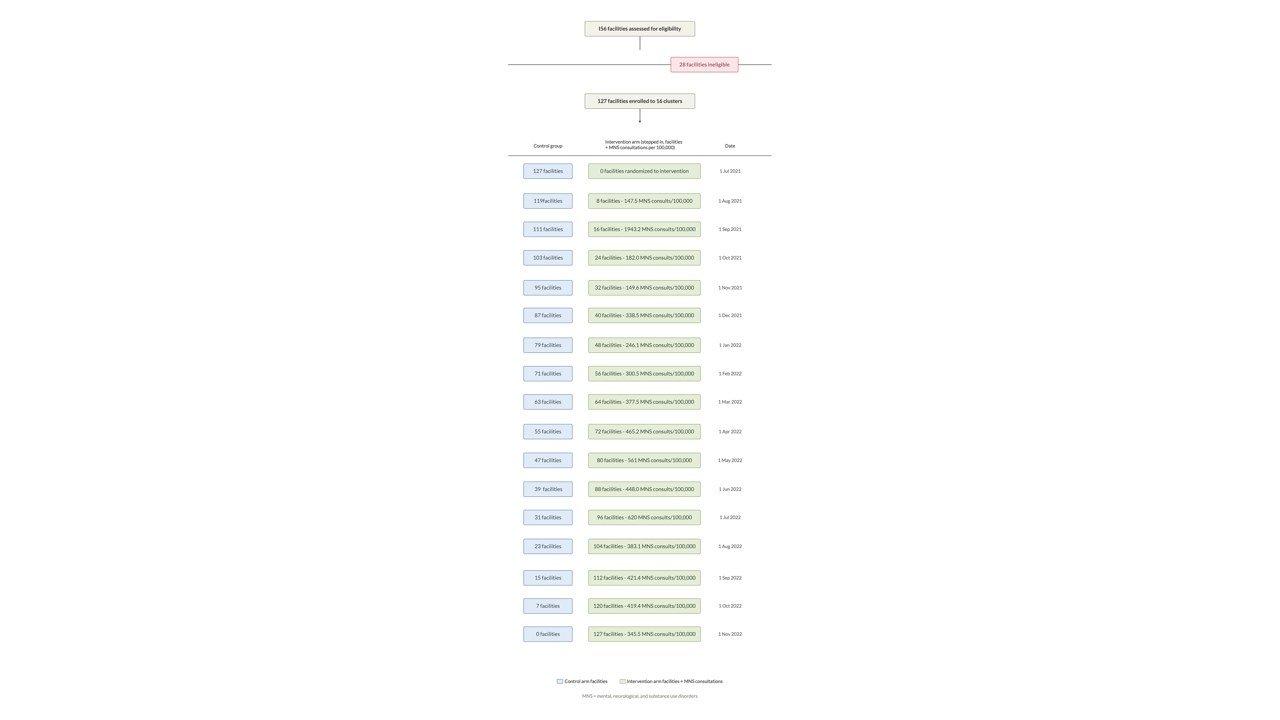
In resource-limited settings, improving care for mental, neurological and substance misuse (MNS) disorders is essential. This study evaluated the feasibility and effectiveness of implementing all adult modules of the WHO mental health Gap Action Programme Intervention Guide (mhGAP-IG) in primary healthcare (PHC) in rural Kenya through training non-specialist primary healthcare workers. We conducted a stepped-wedge cluster randomized trial across 127 public primary care facilities in Kilifi County, Kenya. Facilities were grouped into 16 clusters and randomly assigned to one of 16 monthly intervention start dates between August 2021 and November 2022. All clusters began in the control condition and sequentially crossed over to the intervention. The intervention comprised a 10-day mhGAP-IG training followed by quarterly supportive supervision. The primary outcome was the monthly rate of clinical consultations for MNS disorders per 100,000 outpatient consultations. Secondary outcomes included healthcare worker stigma and patient-level measures of illness severity, disability, and quality of life. A total of 172 healthcare workers were trained, and 5,320,423 adult outpatient consultations were recorded. Compared to the control period, the monthly rate of epilepsy diagnoses increased from 191.35 to 395.49 per 100,000 consultations (crude absolute increase 204.13 per 100,000), with an adjusted intervention effect of β = 119.19 (95% CI 34.70–203.67; p = 0.006). Depression diagnoses increased from 1.41 to 15.24 per 100,000 consultations (crude increase 13.82 per 100,000; β = 9.70, 95% CI 5.69–13.71; p < 0.001), dementia from 0.25 to 5.58 (crude increase 5.33 per 100,000; β = 4.11, 95% CI 2.51–5.71; p < 0.001), and substance misuse disorders from 0.04 to 2.14 (crude increase 2.10 per 100,000; β = 1.78, 95% CI 0.95–2.61; p < 0.001). Although crude increases were observed for psychosis (18.55 to 49.38 per 100,000), suicidality (0.17 to 0.46), and a decrease for other mental health complaints (108.44 to 81.15), the adjusted intervention effects for these outcomes were not statistically significant. Healthcare worker stigma and patient outcomes improved significantly. Large-scale implementation of mhGAP-IG in rural Kenyan PHC was feasible and associated with improved detection of MNS disorders and better provider and patient outcomes. Further studies in diverse settings are needed to assess generalizability.
Pan African Clinical Trials registry [PACTR202011741472301]
Background
Mental, neurological and substance misuse disorders (MNS) contribute substantially of the global burden of diseases, yet access to care remains limited in many low and middle-income countries (LMIC) where specialist services are scarce and largely concentrated in urban settings. As a result, a large proportion of individuals with MNS do not receive appropriate care, even when they present to primary care facilities, where healthcare workers often lack training and resources to assess and manage these conditions. These persistent treatment gap reflects broader health system constraints and highlights the need for scalable approaches to integrating mental healthcare into primary care [1].
Reading this evidence
Use the full paper to check the study design, participant selection, comparator and outcome definitions before drawing a practical conclusion. An association does not by itself show cause and effect. A reported performance measure needs its denominator and uncertainty. A finding from a particular facility, sample or time period should retain that scope when it is discussed elsewhere.
This briefing makes the source accessible within the wider technology & industry desk. It does not assess an individual patient or certify a product. When considering relevance to another health system, examine the original authors’ account of context and limitations, then seek local implementation evidence. The related reporting below provides other studies to read alongside this one; it is a topic connection, rather than a claim that their results are directly comparable.
© 2026 Mary A. Bitta, Symon M. Kariuki, Daniel M. Mwanga, Mercy Atieno, Nuru Kibirige, Elias Fondo, Gergana Manolova, Neerja Chowdhary, Tarun Dua, Belinda Lennox, Charles RJC Newton, on behalf of the EPInA Study Group. Excerpts reproduced under CC BY. Selection, formatting and contextual notes by Health Signal. The researchers are the authors of the source study, not members of Health Signal’s staff.
Explore connected evidence
- Evidence brief: Implementation bottlenecks of near point of care HIV viral load monitoring for children and young people in Tanzania: A Qualitative Study
- Evidence brief: Improving maternal outcomes of young mothers through mobile health (mHealth) and community-based interventions: Evidence from a quasi-experimental trial in Kwale County, Coastal Kenya
- Evidence brief: Factors contributing to low tuberculosis diagnosis among children aged 0–14 years in Gem Sub County in Siaya County, Kenya

