Published in PLOS One on 2026-08-06, this study is presented as an attributed evidence briefing. The excerpts below are the original researchers’ words, reproduced under their Creative Commons Attribution licence. Health Signal has selected the abstract and, where needed, opening background paragraphs; the complete methods, results, limitations and references remain in the linked paper.
Original authors: Florian Vogt, Antoine Nkuba-Ndaye, Anja De Weggheleire, Sheila Makiala-Mandanda, Placide Mbala-Kingebeni, Benoit Mputu-Ngoyi, Eddy Kinganda-Lusamaki, Elisabeth Pukuta, Lorenzo Subissi, Birgit De Smet, Jozefien Buyze, Steve Ahuka-Mundeke
Source: PLOS One • DOI 10.1371/journal.pone.0355216
Read the complete primary study ↗ · Creative Commons Attribution licence
From the researchers
Abstract
Chikungunya fever presents a diagnostic challenge in Sub-Saharan Africa due to the absence of a region-specific case definition, especially in settings with high disease burden and diverse aetiologies of acute febrile illnesses. Our study aimed to develop an evidence-based clinical case definition for acute Chikungunya virus (CHIKV) infection suitable for use at resource-limited primary health care level.
We conducted a cross-sectional study in Kinshasa, Democratic Republic of the Congo, between June and November 2019 during an ongoing CHIKV outbreak. Patients aged ≥3 years with symptoms suggestive of acute CHIKV infection were enrolled. Clinical examination data and blood samples were collected for CHIKV diagnosis via PCR and ELISA. Malaria rapid diagnostic tests were also performed. We used Classification and Regression Tree (CART) analysis with 10-fold cross-validation and predictive logistic regression models with lasso penalty, with performance assessed via the Area under the Receiver Operating Characteristics Curve (AUC).
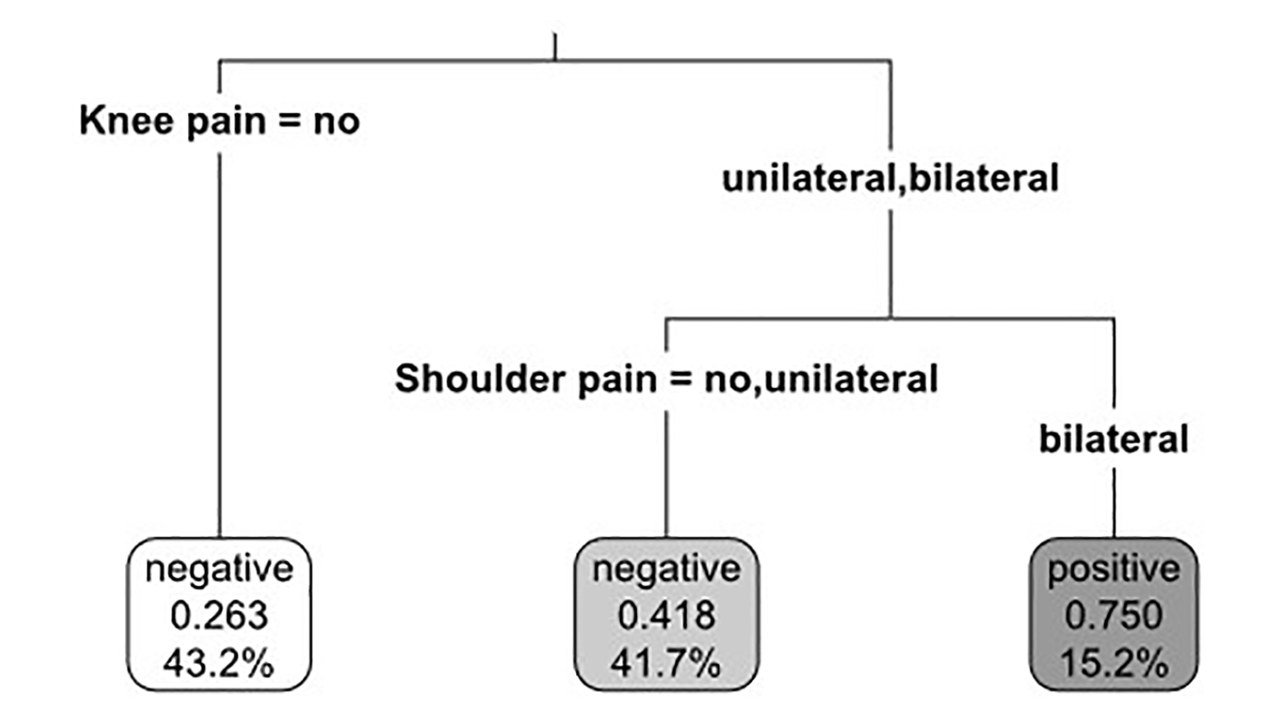
Of 132 analysed patients, 40.2% had acute CHIKV infection. CART analysis identified knee and shoulder pain as potential predictors, however classifying only 67.4% of patients correctly while missing 71.7% of cases (cross-validated AUC 53%; 95%CI 43%−63%). Logistic regression achieved 61.1% accuracy, with a corresponding cross-validated AUC of 62% (95%CI 52%−72%). Exploratory analysis excluding malaria co-infections yielded similar CART performance, while logistic regression failed to identify any reliable predictors.
While our study provides valuable insights into the clinical presentation of CHIKV in Sub-Saharan Africa, it highlights the challenges of developing a simple symptom-based diagnostic algorithm suitable for resource-limited primary health care settings. Certain joint pain patterns showed predictive value, however no model achieved sufficient accuracy for clinical use. Improved access to serological testing and integration of epidemiological context are essential for CHIKV diagnosis in such contexts. Further research is needed to refine clinical criteria and support outbreak response in resource-limited regions.
Introduction
Chikungunya fever is a mosquito-borne viral disease caused by the Chikungunya virus (CHIKV), an enveloped positive single-strain RNA alphavirus of the Togaviridae family. [1] Three genotypes have been described to date: Asian, West African and East/Central/South African (ECSA). [2] In Africa, CHIKV transmission is maintained in a sylvatic cycle involving wild non-human primates and various arboreal Aedes mosquitoes. Mosquito-to-human transmission in urban transmission cycles is dominated by A. aegypti and A. albopictus. [1,3] Since the first recorded epidemic in Tanzania in 1952, CHIKV outbreaks have been reported in many countries around the world and with increasing frequency in Sub-Saharan Africa during recent years.
The proportion of symptomatic CHIKV infections during epidemics has been reported to be between 70–97%. [2] For people who develop symptomatic illness, the incubation period is usually between three to seven days (range one to twelve days). Patients typically present with abrupt onset of fever, and severe (mostly symmetric) joint pain followed in some cases by a rash. Other symptoms may include headache, conjunctival redness, nausea and vomiting. Severe manifestations are rare, but can include myocarditis, hepatitis, ocular and neurological disorders. [1,2] The viraemic period of CHIKV lasts two to ten days, which matches the acute symptomatic phase of the disease and possible detection through viral nucleic acid-based tests. Laboratory confirmation of CHIKV infection is done using CHIKV-specific real-time reverse-transcription polymerase chain reaction (RT-PCR) tests, Enzyme linked Immunosorbent Assays (ELISA), and CHIKV-specific IgM by immunofluorescence assays (IFA). [4,5] PCR technology and serological methods are complex, expensive, and only available at few central laboratories in most low-resource settings.
Reading this evidence
Use the full paper to check the study design, participant selection, comparator and outcome definitions before drawing a practical conclusion. An association does not by itself show cause and effect. A reported performance measure needs its denominator and uncertainty. A finding from a particular facility, sample or time period should retain that scope when it is discussed elsewhere.
This briefing makes the source accessible within the wider technology & industry desk. It does not assess an individual patient or certify a product. When considering relevance to another health system, examine the original authors’ account of context and limitations, then seek local implementation evidence. The related reporting below provides other studies to read alongside this one; it is a topic connection, rather than a claim that their results are directly comparable.
© 2026 Florian Vogt, Antoine Nkuba-Ndaye, Anja De Weggheleire, Sheila Makiala-Mandanda, Placide Mbala-Kingebeni, Benoit Mputu-Ngoyi, Eddy Kinganda-Lusamaki, Elisabeth Pukuta, Lorenzo Subissi, Birgit De Smet, Jozefien Buyze, Steve Ahuka-Mundeke. Excerpts reproduced under CC BY. Selection, formatting and contextual notes by Health Signal. The researchers are the authors of the source study, not members of Health Signal’s staff.
Explore connected evidence
- Evidence brief: Improving the field accuracy of a malaria diagnostic algorithm combining sequential interpretation of rapid diagnostic test detecting PfHRP2 and pLDH in febrile children in a seasonal hyperendemic malaria transmission area in Burkina Faso
- Evidence brief: “It doesn’t require blood!”: Perceptions around non-invasive malaria testing tools in Indonesia, Peru, and Rwanda
- Evidence brief: Exploring spatial variation and multilevel modeling of malaria prevalence among children aged 6-59 months based on RDT in Niger: Insights for public health decision-making