Published in PLOS One on 2026-09-08, this study is presented as an attributed evidence briefing. The excerpts below are the original researchers’ words, reproduced under their Creative Commons Attribution licence. Health Signal has selected the abstract and, where needed, opening background paragraphs; the complete methods, results, limitations and references remain in the linked paper.
Original authors: Senaji Khamonya Nightingale, Rogers Kajabwangu, Maxwell Okello, Emmanuel Okurut, Marie Pascaline Sabine Ishimwe, Peter Okello, Happy Tukirinawe, Perez Fernando, Ubarnel Almenares, James Okello, Yarine Fajardo, Theoneste Hakizimana
Source: PLOS One • DOI 10.1371/journal.pone.0354584
Read the complete primary study ↗ · Creative Commons Attribution licence
From the researchers
Abstract
Uterine leiomyoma, is a common benign neoplasm among women of reproductive age with a potential of causing significant health complications and financial burdens in severe cases. Recent research suggests a possible link between vitamin D deficiency and uterine leiomyoma development; however, this relationship has not been established in the Ugandan population. For this reason, there is no individualized or public health interventions targeting this modifiable risk factor. The study aimed to determine the relationship between hypovitaminosis D and uterine leiomyoma among women of reproductive age attending Jinja, Lira and Fort Portal Regional Referral Hospitals in Uganda.
A cross-sectional multicentre study was conducted at Jinja, Lira and Fort Portal Regional Referral Hospitals between 1st October 2022–31st January 2023. 246 non-pregnant women of reproductive age were included in the study. Questionnaires were administered to the participants, their serum vitamin D analysed and a transabdominal pelvic scan done. A p value of ≤0.05 was the threshold for statistical significance.
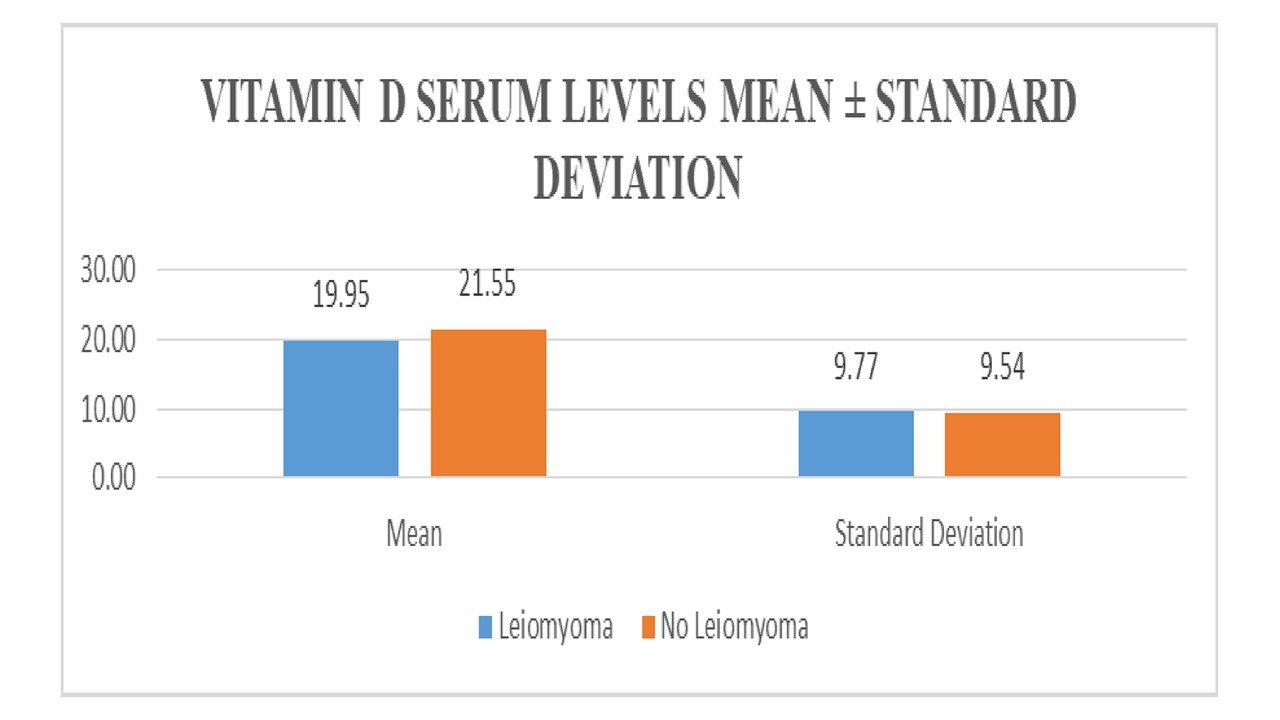
The prevalence of hypovitaminosis D among participants was high at 54.1%. There was no significant difference in the proportions of leiomyoma among those with and without hypovitaminosis D (χ2 = 0.503, p = 0.478 > 0.05). The mean serum vitamin D level was lower in individuals with uterine leiomyomas compared to those without (19.954 ± 9.77 versus 21.552 ± 9.54 [95% CI: −0.04 to 4.24, p = 0.235]). There was no statistically significant association between hypovitaminosis D and uterine leiomyoma (OR 1.22, 95% CI 0.70–2.12; p = 0.478). There was a weak negative correlation observed between serum vitamin D levels and leiomyoma site number (r = −0.2482, p = 0.0342 < 0.05).
The prevalence of hypovitaminosis D was high among women of reproductive age. There was no statistically significant relationship between hypovitaminosis D and uterine leiomyomas despite a weak negative correlation between vitamin D levels and leiomyoma site number which was statistically significant. High prevalence of hypovitaminosis D underscores the need for health education and public health measures by healthcare providers to manage and prevent vitamin D deficiency-related morbidity among women of reproductive age. Further research by the scientists is needed to investigate the potential association between hypovitaminosis D and uterine leiomyoma, in regards to increased site number, among the African population.
Introduction
About half of the world’s population has vitamin D deficiency, including 18.46% of Africans [1]. Sakyi et al., observed that despite the abundance of sunlight in Ghana, 43.6 percent of the adult Ghanaian population was vitamin D deficient [2]. The prevalence of hypovitaminosis D among Egyptian women of childbearing age was about 43% of the participants for Vitamin D deficient and 13% for Vitamin D insufficiency while another study done in Sudan found a prevalence of 82.6% for vitamin D deficiency among Sudanese women [3,4]. A majority of these women however use covered clothing style.
Reading this evidence
Use the full paper to check the study design, participant selection, comparator and outcome definitions before drawing a practical conclusion. An association does not by itself show cause and effect. A reported performance measure needs its denominator and uncertainty. A finding from a particular facility, sample or time period should retain that scope when it is discussed elsewhere.
This briefing makes the source accessible within the wider hospital systems desk. It does not assess an individual patient or certify a product. When considering relevance to another health system, examine the original authors’ account of context and limitations, then seek local implementation evidence. The related reporting below provides other studies to read alongside this one; it is a topic connection, rather than a claim that their results are directly comparable.
© 2026 Senaji Khamonya Nightingale, Rogers Kajabwangu, Maxwell Okello, Emmanuel Okurut, Marie Pascaline Sabine Ishimwe, Peter Okello, Happy Tukirinawe, Perez Fernando, Ubarnel Almenares, James Okello, Yarine Fajardo, Theoneste Hakizimana. Excerpts reproduced under CC BY. Selection, formatting and contextual notes by Health Signal. The researchers are the authors of the source study, not members of Health Signal’s staff.
Explore connected evidence
- Evidence brief: Hepatitis B vaccine uptake and associated factors among pregnant women attending antenatal care at Gulu Regional Referral Hospital, Northern Uganda
- Evidence brief: Maternal serum vitamin D levels and preeclampsia among Kenyan pregnant women: A matched case-control study
- Evidence brief: Occupation is a significant independent predictor of hypocalcemia among diabetic patients in Jinja, Uganda