Published in PLOS One on 2026-07-08, this study is presented as an attributed evidence briefing. The excerpts below are the original researchers’ words, reproduced under their Creative Commons Attribution licence. Health Signal has selected the abstract and, where needed, opening background paragraphs; the complete methods, results, limitations and references remain in the linked paper.
Original authors: Valentina Todisco, Jennifer F. Hoyal Cuthill, Anatoly Krupitsky, Galina Shapoval, Boris Nalitkin, Anna Romanovich, Raluca Vodă, Marko Mutanen, Roger Vila, Nazar Shapoval, Vazrick Nazari
Source: PLOS One • DOI 10.1371/journal.pone.0343793
Read the complete primary study ↗ · Creative Commons Attribution licence
From the researchers
Abstract
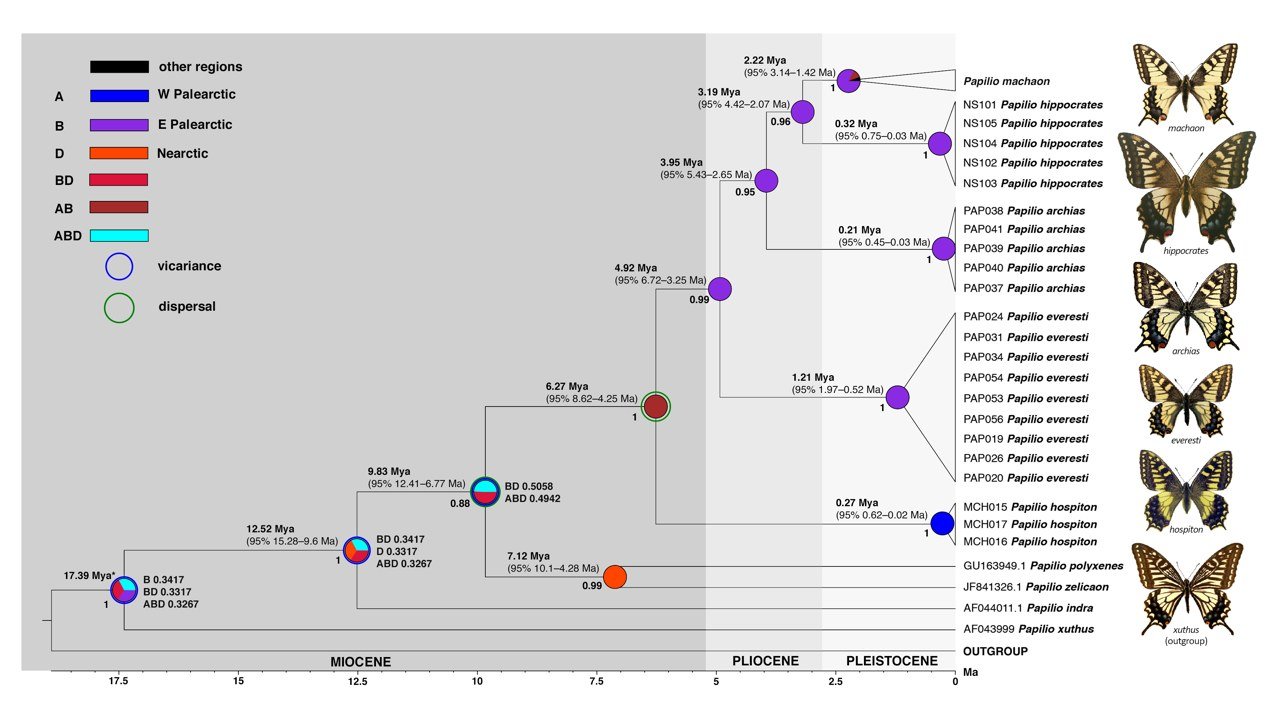
Based on a dataset of 585 samples originating from across the Palearctic region and four genes (COI, CAD, Ca-ATPase, and 28S) for a subset of these samples, we studied the phylogenetic relationships within and between the Old World Swallowtail (Papilio machaon Linnaeus, 1758) and its closest relatives in the Palearctic region. We used Machine Learning (ML) to investigate the concordance of morphological characteristics with the molecular data. Our phylogenetic analyses showed that the Palearctic taxa everesti, archias and hippocrates formed strongly supported sister-group relationships with P. machaon. Within the Palearctic machaon a few distinct mitochondrial linages were observed, including one from the Himalayas and Central Asia, and another one that included all of the north African samples (taxa mauretanica, saharae and neosaharae) without any distinction. ML clustering was supportive of the haplotype and geographic analyses and a positive correlation was measured between average genetic phylogenetic and machine learnt specimen-image distances. Screening for Wolbachia revealed infection only in females of P. archias. We present a biogeographic scenario for the evolution of the P. machaon species group in the Palearctic region.
Introduction
In recent decades, taxonomic and phylogeographic studies on Holarctic insects have contributed immensely to our knowledge of speciation, zoogeography and history of the continental connections and have provided insights on the types of habitats that may have existed during these connections [1–9]. The effects of Pleistocene glaciations on the distribution and evolution of species inhabiting the Holarctic region are well studied [10,11]. In many organisms, morphological traits provide a phenotypic link between genotypes and the environment [12–15]. Only very recently, new methods for machine learning (ML) in evolution and ecology (reviewed in [16]) have enabled tests for inter-species phenotypic diversity and it can now be used to quantify variation across different butterfly groups [17,18]. Even though butterflies are among the best-studied invertebrates, comprehensive taxonomic and phylogeographic studies on widespread Holarctic species are still rare [19–23]. This is especially true for the Old World Swallowtail, Papilio machaon Linnaeus, 1758, an iconic butterfly that belongs to the large family of swallowtail butterflies (Papilionidae), famous for its beauty and unique in the genus Papilio for having a Holarctic distribution. Papilio machaon also represents the nominate species of the entire superfamily Papilionoidea (true butterflies) and hence is the “true” butterfly species by definition. Found throughout the entire Palearctic region and across Alaska and Canada, this species displays different ecological races occupying habitats as varied as the Arctic tundra, high altitude steppe, Saharan desert oases, temperate coastal forests, vegetable gardens, and citrus orchards.
Several closely related species are recognized under a machaon “species group” [(i.e., subgenus Papilio sensu stricto; see 24–33)], and the taxonomy of the group continues to be revised. In the Nearctic region, at least three subspecies of P. machaon (aliaska Scudder, 1869, pikei Sperling 1987, and hudsonianus Clark, 1932) are recognized, together with closely-related sister species P. kahli F. & R. Chermock, 1937 and P. bairdii Edwards, 1866, as well as some hybrid lineages with P. polyxenes Fabricius, 1775 (e.g., P. brevicauda Saunders, 1868, and P. joanae Heitzman, 1973) [34,35]. The latest treatment of this species complex in the Palearctic region has recognized P. saharae Oberthür, 1879, P. everesti Riley, 1927, P. hospiton Géné, 1839, P. verityi Fruhstorfer, 1907, P. archias Fruhstorfer, 1907, and P. hippocrates C. & R. Felder, 1864 as separate species, alongside 15 subspecies of P. machaon [36]. Taxa P. hospiton, P. zelicaon Lucas, 1852, P. polyxenes, and P. indra Reakirt, 1866 are generally recognized as sisters to the machaon species group, with the Asiatic P. xuthus Linnaeus, 1767 as a more distant relative [34,35]. Hybridization (natural and artificial) between many of these lineages has been extensively documented (e.g., [37–45]).
Reading this evidence
Use the full paper to check the study design, participant selection, comparator and outcome definitions before drawing a practical conclusion. An association does not by itself show cause and effect. A reported performance measure needs its denominator and uncertainty. A finding from a particular facility, sample or time period should retain that scope when it is discussed elsewhere.
This briefing makes the source accessible within the wider technology & industry desk. It does not assess an individual patient or certify a product. When considering relevance to another health system, examine the original authors’ account of context and limitations, then seek local implementation evidence. The related reporting below provides other studies to read alongside this one; it is a topic connection, rather than a claim that their results are directly comparable.
© 2026 Valentina Todisco, Jennifer F. Hoyal Cuthill, Anatoly Krupitsky, Galina Shapoval, Boris Nalitkin, Anna Romanovich, Raluca Vodă, Marko Mutanen, Roger Vila, Nazar Shapoval, Vazrick Nazari. Excerpts reproduced under CC BY. Selection, formatting and contextual notes by Health Signal. The researchers are the authors of the source study, not members of Health Signal’s staff.
Explore connected evidence
- Evidence brief: Machine learning-based prediction of fever among under-five children in Ethiopia: A national-level study
- Evidence brief: Beyond health: A machine learning analysis of structural barriers to school attainment in Somalia
- Evidence brief: Geospatial variation and machine learning approaches to predict open defecation practice in Zambia
