Published in PLOS One on 2026-05-14, this study is presented as an attributed evidence briefing. The excerpts below are the original researchers’ words, reproduced under their Creative Commons Attribution licence. Health Signal has selected the abstract and, where needed, opening background paragraphs; the complete methods, results, limitations and references remain in the linked paper.
Original authors: Negesso Gebre, Jemal Mohammed, Rudwan Yasin Abrahim, Mohammed Ahmed, Kedir Urgesa
Source: PLOS One • DOI 10.1371/journal.pone.0348978
Read the complete primary study ↗ · Creative Commons Attribution licence
From the researchers
Abstract
Lower respiratory tract infections are among the diseases that pose an existential threat to global public health. Clinical presentations of various bacterial lower respiratory infections and presumptive pulmonary tuberculosis are often overlap, hindering prompt patient care and correct diagnosis. In developing countries like Ethiopia, the management of presumptive tuberculosis cases that test negative for Gene Xpert is often empirical. Consequently, it is imperative to address potential overlooked bacterial infections in cases that are negative for tuberculosis.
This study aimed to determine the prevalence of pathogenic bacteria, antimicrobial susceptibility patterns, and associated factors of lower respiratory tract infection among Gene Xpert-negative presumptive tuberculosis adult patients at Hiwot Fana Comprehensive Specialized Hospital, eastern Ethiopia.
A hospital-based cross-sectional study was conducted among 371 study participants from January 01 to April 30, 2024. Socio-demographic and health related data were collected using structured questionnaire. Gene Xpert MTB/RIF was used for initial tuberculosis screening, and sputum culture was used to isolate bacterial pathogens. Bacterial isolates were identified based on gram staining, colony characteristics, and biochemical reactions. Antimicrobial susceptibility test was done using Kirby-Bauer disc diffusion method. Methicillin resistance S. aureus was confirmed using cefoxitin (30 µg). Logistic regression analysis was used to assess the association between outcome and predictor variables.
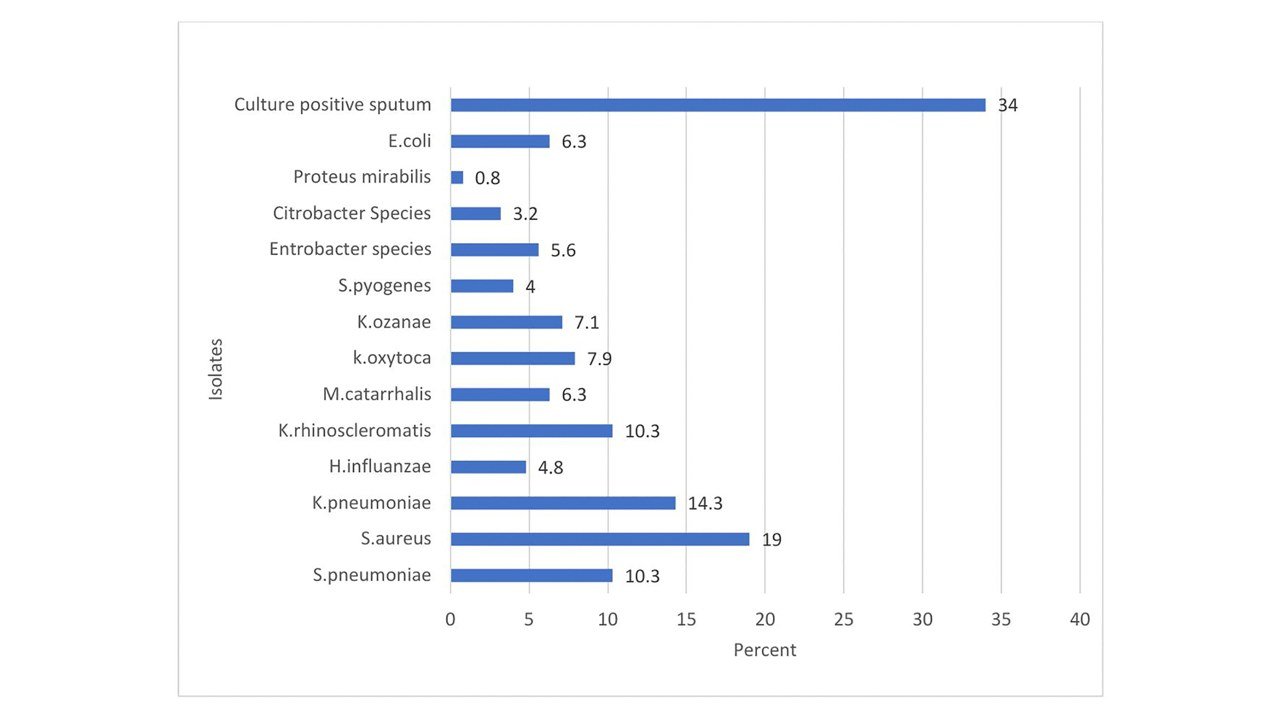
The overall prevalence of pathogenic bacterial lower respiratory tract infection was 34.0% (95% CI; 29.2, 38.8). Gram-negative bacteria accounted for 66.7%. S. aureus (19.0%) was the predominant isolate followed by K. pneumoniae (14.3%). The proportion of multi-drug resistant bacteria and methicillin-resistance S. aureus was 39.7% and 16.7% respectively. Primary education (AOR = 4.01; 95% CI = 1.62, 9.92), history of antibiotic usage (AOR = 1.87; 95% CI = 1.13, 3.08) and crowded living condition (AOR = 5.11; 95% CI = 3.03, 8.61) were factors associated with pathogenic bacterial lower respiratory tract infections.
This study revealed that patients with presumptive tuberculosis who tested negative on Gene Xpert- were predominantly infected with gram negative pathogenic bacteria. Therefore, it’s important to prioritize sputum culture and antibiotic susceptibility testing. This study underscore the need to avoid the misuse of antibiotics and crowded living conditions.
Introduction
Globally, lower respiratory tract infections (LRTIs) are a leading causes of morbidity and mortality, particularly in developing countries [1,2]. Global burden of disease study 2019 indicates that, in the last three decades LRTIs causes an estimated 489 million incidence cases and 2.4 million deaths of which Sab-Saharan Africa regions accounts largest incidence and mortality from lower respiratory infections [3]. In Ethiopia, LRTIs are the main reason for hospital admissions and the third leading cause of death, accounting 8.2% of all deaths reported in 2019 [4]. In cases presumptive tuberculosis that test negative using Gene Xpert, the most frequently identified bacteria responsible for LRTIs includes Klebsiella pneumoniae, Staphylococcus aureus, Haemophilus influenzae, and Streptococcus pneumoniae [5,6].
Reading this evidence
Use the full paper to check the study design, participant selection, comparator and outcome definitions before drawing a practical conclusion. An association does not by itself show cause and effect. A reported performance measure needs its denominator and uncertainty. A finding from a particular facility, sample or time period should retain that scope when it is discussed elsewhere.
This briefing makes the source accessible within the wider research & evidence desk. It does not assess an individual patient or certify a product. When considering relevance to another health system, examine the original authors’ account of context and limitations, then seek local implementation evidence. The related reporting below provides other studies to read alongside this one; it is a topic connection, rather than a claim that their results are directly comparable.
© 2026 Negesso Gebre, Jemal Mohammed, Rudwan Yasin Abrahim, Mohammed Ahmed, Kedir Urgesa. Excerpts reproduced under CC BY. Selection, formatting and contextual notes by Health Signal. The researchers are the authors of the source study, not members of Health Signal’s staff.
Explore connected evidence
- Evidence brief: Bacterial isolates and antimicrobial susceptibility profiles of pediatric meningitis at comprehensive specialized hospitals in Bahir Dar, Northwest Ethiopia
- Evidence brief: Contribution of xpert MTB/RIF assay and Urine LF-LAM for the diagnosis of tuberculosis in children aged 5 – 14 years, at selected health facilities in Ethiopia, 2016 – 2019
- Evidence brief: Sepsis neonatorum: Bacterial profile, antimicrobial resistance patterns, among neonates and associated factors, Dilla University Referral Hospital, southern Ethiopia, with special reference to WHO prioritized pathogens


