Published in PLOS One on 2026-09-09, this study is presented as an attributed evidence briefing. The excerpts below are the original researchers’ words, reproduced under their Creative Commons Attribution licence. Health Signal has selected the abstract and, where needed, opening background paragraphs; the complete methods, results, limitations and references remain in the linked paper.
Original authors: Michael O. Adu, David O. Yawson
Source: PLOS One • DOI 10.1371/journal.pone.0357467
Read the complete primary study ↗ · Creative Commons Attribution licence
From the researchers
Abstract
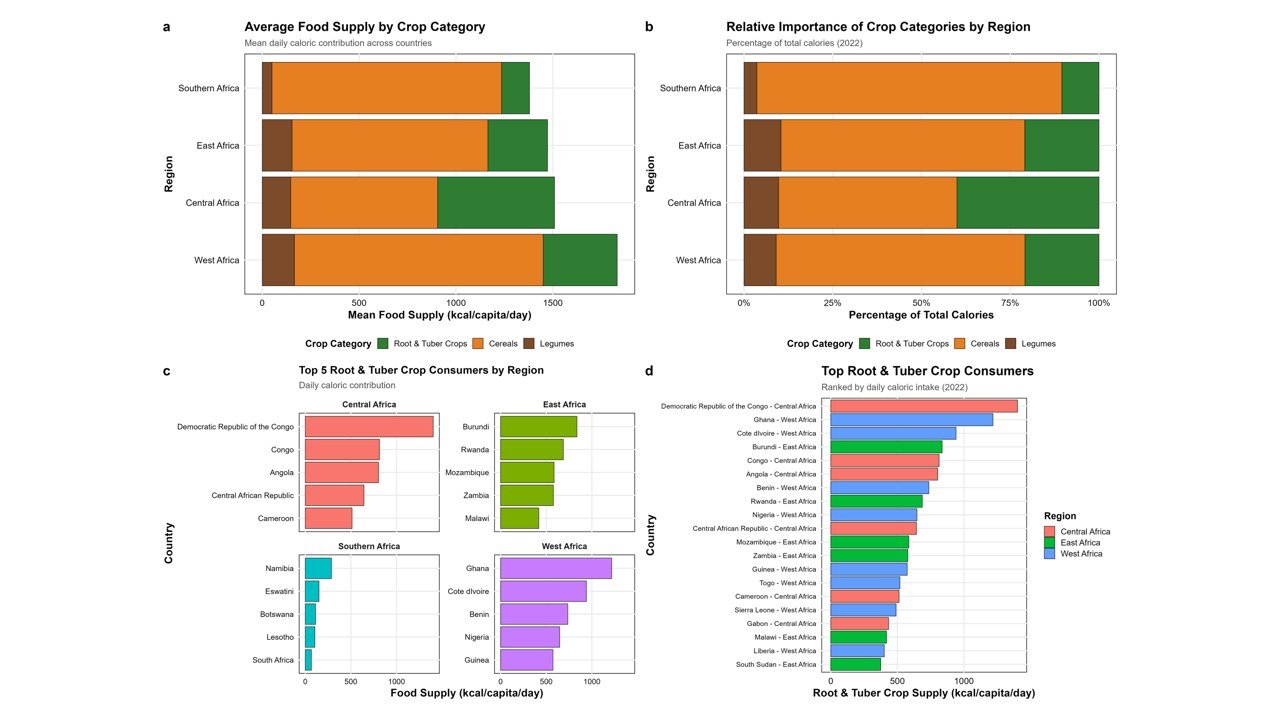
Root and tuber crops (RTCs) provide 354 kcal/capita/day across sub-Saharan Africa (17.7% of dietary energy from major crop categories), and several countries derive over 40% of crop calories from cassava, yam, sweet potato, taro, and cocoyam. Despite this, research on the root systems that give rise to their harvested storage organs remains limited and concentrated in regions where RTCs contribute little to food security.
We combined food supply data for 46 sub-Saharan African countries (2018–2022) with a systematic bibliometric analysis of 893 RTC publications (1939–2025; 148 specifically on root system architecture, RSA), a Root Crop Dependency Index (RCDI), and scenario-based economic models, testing whether research attention is inversely related to food-security importance and whether targeted investment could yield measurable returns.
Observed results: Sub-Saharan Africa accounts for only 9.5% of global research output on root system development, despite hosting 60% of cassava production and most yam cultivation; research is concentrated in Asia (44% of publications) and North America (16%), inverting the production geography. Research effort prioritises potato (22% of publications, 13% of regional RTC calories), while yams provide 23% of calories but receive only 4% of research attention, and taro and cocoyam receive under 6%; cassava dominates regional diets (175 kcal capita-1 day-1) but accounts for only 30% of global publications. The most RTC-dependent countries (the Democratic Republic of the Congo, the Republic of the Congo, and Burundi) contribute minimal research output. Modelled projections: Scenario models suggest yield improvements of 12–25% and economic returns of 5:1–10:1, with the highest for the most neglected crops (taro, cocoyam, yam). These are modelled projections under stated assumptions, not empirical yield trials, and require field validation.
Research capacity for crops that sustain African food security is concentrated in regions where these crops contribute minimally to nutrition. This misalignment may reflect institutional path dependence, donor preferences, and the concentration of infrastructure in high-income countries rather than a systematic assessment of food-security priorities. Given their importance to food security, productivity potential, and current neglect, RTCs appear to be promising, underexplored targets for agricultural research investment; confirming the projected returns will require field trials, breeding pipelines, and adoption studies.
1 Introduction
Next to cereals, root and tuber crops (RTCs) are the most important dietary energy source worldwide and are key to global food security. In developing countries, RTCs are the primary source of dietary energy for over 2 billion people. In sub-Saharan Africa (SSA), the cultivation and consumption of RTCs such as cassava (Manihot esculenta), yam (Dioscorea spp.), sweet potato (Ipomoea batatas), taro (Colocasia esculenta), and cocoyam (Xanthosoma sagittifolium) are critical for food security and livelihoods [1–3]. In most parts of SSA, these crops account for the largest share of cultivated land and of harvested food. The predominance of RTCs in SSA could be attributed to their resilience to climate variability, capacity for year-round production, and adaptability to marginal soils and low-input production systems, making them particularly suited to smallholder farming systems [4,5]. Yet, parts of SSA face acute and chronic food insecurity, compounded by worsening climate variability, recurrent drought, degraded soils, and the limited adaptive capacity of smallholder-dominated farming systems, a set of structural vulnerabilities that are widespread across the developing tropics but most severe in SSA.
Reading this evidence
Use the full paper to check the study design, participant selection, comparator and outcome definitions before drawing a practical conclusion. An association does not by itself show cause and effect. A reported performance measure needs its denominator and uncertainty. A finding from a particular facility, sample or time period should retain that scope when it is discussed elsewhere.
This briefing makes the source accessible within the wider public health desk. It does not assess an individual patient or certify a product. When considering relevance to another health system, examine the original authors’ account of context and limitations, then seek local implementation evidence. The related reporting below provides other studies to read alongside this one; it is a topic connection, rather than a claim that their results are directly comparable.
© 2026 Michael O. Adu, David O. Yawson. Excerpts reproduced under CC BY. Selection, formatting and contextual notes by Health Signal. The researchers are the authors of the source study, not members of Health Signal’s staff.
Explore connected evidence
- Evidence brief: Prevalence and associated factors of intimate partner violence against reproductive-age women in Africa and Asia regions: Insights from 2022–2024 DHS datasets
- Evidence brief: Seeding food security: Overcoming barriers to quality potato seed adoption among smallholders in Kenya
- Evidence brief: Molecular evidence of recent hybridization between eastern and western populations of a whitefly species on cassava in the Democratic Republic of the Congo: A potential threat to the spread of cassava brown streak disease