Published in PLOS One on 2026-09-11, this study is presented as an attributed evidence briefing. The excerpts below are the original researchers’ words, reproduced under their Creative Commons Attribution licence. Health Signal has selected the abstract and, where needed, opening background paragraphs; the complete methods, results, limitations and references remain in the linked paper.
Original study title: Body composition of children born HIV-exposed uninfected in rural Zimbabwe
Original authors: Joe D. Piper, Robert Ntozini, Idah Mapurisa, Tsitsi Mashedze, Clever Mazhanga, Florence D. Majo, Bernard Chasekwa, Naume V. Tavengwa, Kim Michaelsen, Jean Humphrey, Jonathan Wells, Andrew J. Prendergast
Source: PLOS One • DOI 10.1371/journal.pone.0319542
Read the complete primary study ↗ · Creative Commons Attribution licence
From the researchers
Abstract
Globally, 15 million children were born HIV-exposed uninfected (CHEU) from mothers living with HIV. CHEU have increased mortality, morbidity and stunting compared to children HIV-unexposed (CHU). Our objective was to compare body composition between CHEU and CHU, which may underlie this vulnerability.
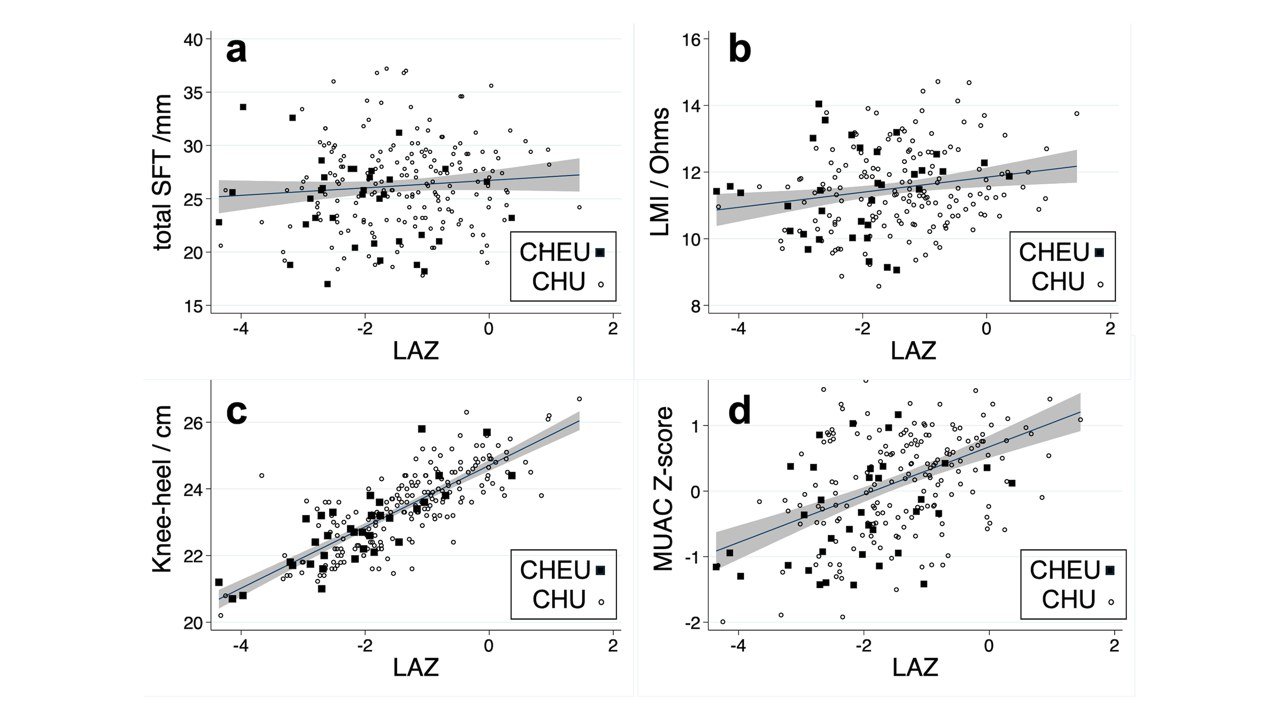
In a substudy among 223 children (36 CHEU and 187 CHU) enrolled in the Sanitation Hygiene Infant Nutrition Efficacy (SHINE) trial in rural Zimbabwe, we measured height, knee-heel length, weight, calf circumference, skinfold thicknesses (triceps, subscapular and calf), and bio-electrical impedance at 2 years of age. Generalised estimating equations were used to compare body composition between CHEU and CHU, and interactions with linear growth and birthweight.
CHEU had significantly lower length-for-age, knee-heel length, weight-for-age, mid-upper arm circumference and calf circumference compared to CHU. CHEU had a lower impedance index (adjusted mean difference −0.49, 95% CI −0.87, −0.11), reflecting less lean mass, and lower skinfold thicknesses (subscapular Z-score adjusted mean difference −0.49 (95% CI −0.97, −0.02); triceps Z-score −0.48 (95% CI −0.83, −0.13)), indicating reduced subcutaneous fat. In early-life, CHEU had lower birthweight. However, no significant interaction between stunting or birthweight and HIV exposure was observed for body composition outcomes.
CHEU have a distinct pattern of body composition by 2 years of age, characterised by reduced lean and fat mass compared to CHU which was not explained by reduced linear growth or lower birthweight. This pattern of early-life growth may contribute to the increased vulnerability of CHEU to mortality, morbidity and reduced neurodevelopment.
Introduction
The success of prevention of mother-to-child transmission (PMTCT) of HIV has driven an increase in the number of children who are HIV-exposed uninfected (CHEU) [1]. By 2021, the number of CHEU was estimated at 16 million globally, and this population continues to grow [2]. In sub-Saharan Africa, CHEU are more likely to be born premature or small-for-gestational age [3], and have poorer postnatal growth compared to children unexposed to HIV [4–6]. In rural Zimbabwe, in the current ART era, half of all CHEU are stunted by 18 months of age [1], compared to ~30% of children who are HIV-unexposed (CHU) [7]. Stunting has effects across the life-course, and is associated with reduced educational attainment [8]. CHEU therefore represent a vulnerable group, who fail to reach their growth and developmental potential in early life.
The causes and consequences of growth failure in CHEU remain poorly understood. Mechanistic insights into the pattern and timing of growth failure would be valuable to inform interventions and to predict long-term health outcomes. Measuring body composition (i.e., fat and lean mass) provides useful insights into the quality of growth, and can inform future homeostatic reserve [9]. There is evidence that both fat and lean mass are reduced in stunting [10,11]. Fat mass provides short-term benefits for immune function [11] and survival [12]; however, it also has longer-term metabolic health costs [9]. The distribution of fat within the body is also important: genes associated with immune function are highly expressed in intra-abdominal fat [13] which helps drive inflammation [14]. An ecogeographical analysis reported that central compared to peripheral fat mass is linked more closely with pathogen load across populations, indicating its role in providing energy for immune function [15]. Lean mass is associated with increased organ size [16] and reduced cardio-metabolic risk [17]. Lean mass is also much more closely associated with neurodevelopment than is fat mass [18].
Reading this evidence
Use the full paper to check the study design, participant selection, comparator and outcome definitions before drawing a practical conclusion. An association does not by itself show cause and effect. A reported performance measure needs its denominator and uncertainty. A finding from a particular facility, sample or time period should retain that scope when it is discussed elsewhere.
This briefing makes the source accessible within the wider public health desk. It does not assess an individual patient or certify a product. When considering relevance to another health system, examine the original authors’ account of context and limitations, then seek local implementation evidence. The related reporting below provides other studies to read alongside this one; it is a topic connection, rather than a claim that their results are directly comparable.
© 2026 Joe D. Piper, Robert Ntozini, Idah Mapurisa, Tsitsi Mashedze, Clever Mazhanga, Florence D. Majo, Bernard Chasekwa, Naume V. Tavengwa, Kim Michaelsen, Jean Humphrey, Jonathan Wells, Andrew J. Prendergast. Excerpts reproduced under CC BY. Selection, formatting and contextual notes by Health Signal. The researchers are the authors of the source study, not members of Health Signal’s staff.
Explore connected evidence
- Evidence brief: Association between anthropometric criteria and body composition among children aged 6–59 months with uncomplicated severe acute malnutrition: A prospective cohort study from South Sudan
- Evidence brief: A cross‑sectional analysis of vitamin D status and associated factors in children recovering from severe acute malnutrition in Zambia and Zimbabwe
- Evidence brief: Optimizing the location of point-of-care infant HIV testing devices in Zimbabwe to maximize impact and value: A modeling analysis