Published in PLOS One on 2026-09-16, this study is presented as an attributed evidence briefing. The excerpts below are the original researchers’ words, reproduced under their Creative Commons Attribution licence. Health Signal has selected the abstract and, where needed, opening background paragraphs; the complete methods, results, limitations and references remain in the linked paper.
Original authors: Yankuba Singhateh, Tshepiso Mechele Matoko, Mannini Shaabe, Selloane Amelia Maepe, Francis Dumobong Ngmenasong Abobo, Sarah Waithera Wanyoike
Source: PLOS One • DOI 10.1371/journal.pone.0358555
Read the complete primary study ↗ · Creative Commons Attribution licence
From the researchers
Abstract
Lesotho, a lower middle-income country in southern Africa, has historically had relatively high routine immunization coverage over the last three decades. Since 1996, the country has been implementing measles elimination strategies. This manuscript evaluates Lesotho’s performance, from 2011 to 2025, against the World Health Organization’s criteria for measles and rubella elimination.
We conducted a retrospective review of Lesotho’s immunization and surveillance data during 2011–2025. This included Lesotho’s annual WHO/UNICEF Estimates of National Immunization Coverage (WUENIC) for routine measles-containing vaccine (MCV) doses; performance in the periodic measles rubella vaccination campaigns and case-based surveillance; and the trends of measles and rubella incidences.
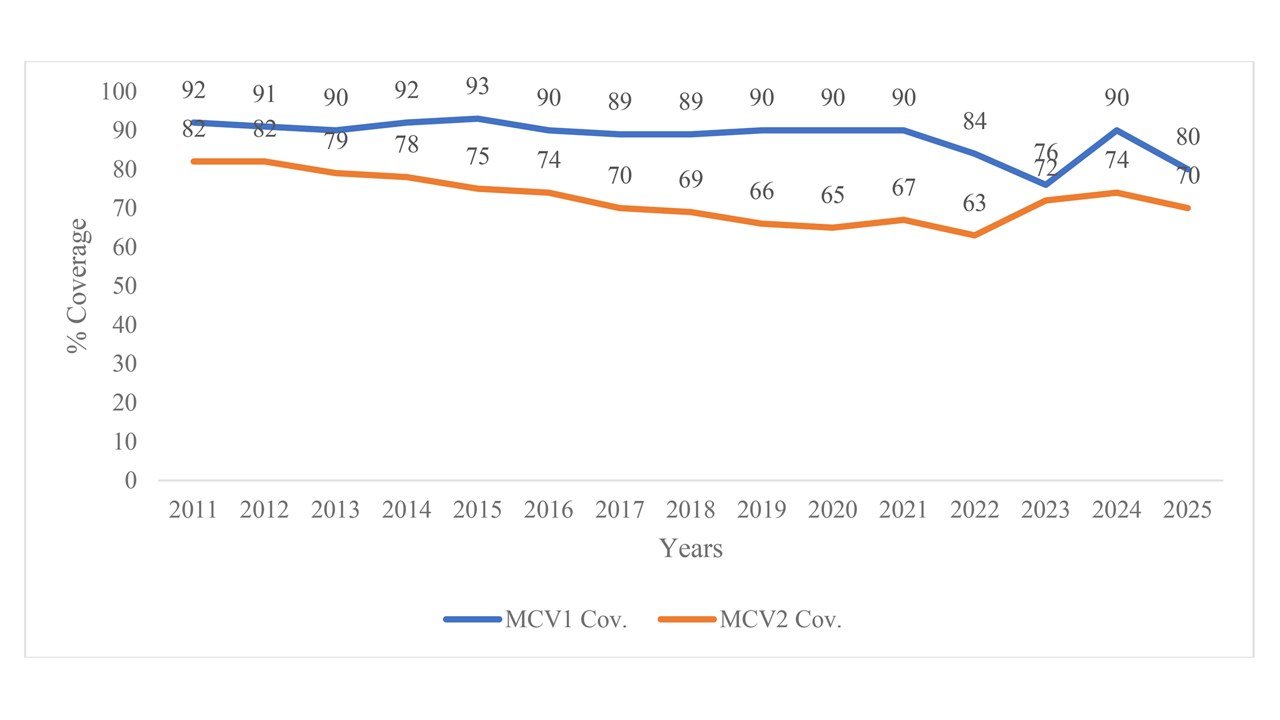
During 2011–2025, MCV1 coverage generally remained ≥90% but failed to reach the 95% elimination target. MCV2 coverage reached 80% in 2011 and 2012 before declining in subsequent years. Lesotho has mostly attained the targets for surveillance performance according to the two principal performance indicators – non-measles febrile rash illness rate and the proportion of districts that report a minimum of one suspected case. From 2011 to 2015, measles incidence stayed below one per 1 million population in Lesotho. However rubella incidence ranged between 33.4 in 2012 to 142.3 in 2014, and declined significantly after MR introduction in 2017.
Lesotho has made significant progress in measles and rubella elimination efforts. To sustain the gains made, the country should work to strengthen vaccination in the second year of life, reinforce demand generation during preventive campaigns, address population denominator inaccuracies that hinder accurate coverage tracking, and systematically document measles and rubella virus genotypes.
1. Introduction
Lesotho is a mountainous landlocked country with an estimated total population of 2,379,237 people as of 2026 [1]. It is a lower-middle-income country with a GDP per capita of 1,001 USD by 2024 [2]. Lesotho has one of the world’s highest HIV infection rates with a 25.6% adult prevalence as of 2022 [3]. The country is divided into 10 districts each managed by a district health management team that oversees implementation of public health activities including immunization.
Immunization is one of the pillars of Lesotho’s national health policy and a primary strategy for improving child survival. Lesotho has an estimated 42,540 annual live births, as of 2025 [1]. Since the launch of the Expanded Program on Immunization (EPI), immunization services have been provided free-of-charge. Of the 315 total functional health facilities, 214 were providing immunization services as of 2023 [2]. The health facility-based service delivery is the predominant service delivery strategy for routine immunization. But non-facility-based strategies (including outreach and mobile sites) remain essential for reaching remote and hard-to-reach communities [2,4].
Reading this evidence
Use the full paper to check the study design, participant selection, comparator and outcome definitions before drawing a practical conclusion. An association does not by itself show cause and effect. A reported performance measure needs its denominator and uncertainty. A finding from a particular facility, sample or time period should retain that scope when it is discussed elsewhere.
This briefing makes the source accessible within the wider public health desk. It does not assess an individual patient or certify a product. When considering relevance to another health system, examine the original authors’ account of context and limitations, then seek local implementation evidence. The related reporting below provides other studies to read alongside this one; it is a topic connection, rather than a claim that their results are directly comparable.
© 2026 Yankuba Singhateh, Tshepiso Mechele Matoko, Mannini Shaabe, Selloane Amelia Maepe, Francis Dumobong Ngmenasong Abobo, Sarah Waithera Wanyoike. Excerpts reproduced under CC BY. Selection, formatting and contextual notes by Health Signal. The researchers are the authors of the source study, not members of Health Signal’s staff.
Explore connected evidence
- Evidence brief: Spatial distribution and associated factors influencing 2024 Measles-Rubella vaccination campaign coverage among children aged 9–59 months in Mainland Tanzania: A multi-level mixed-effect analysis
- Evidence brief: Progress and gaps in childhood immunization among two-year-olds in Ghana (1993–2022): A trend and equity analysis
- Evidence brief: Sociodemographic and geographic determinants of childhood immunization coverage and equity in Ghana: Analysis of the 2022 demographic and health survey

