Published in PLOS One on 2026-09-21, this study is presented as an attributed evidence briefing. The excerpts below are the original researchers’ words, reproduced under their Creative Commons Attribution licence. Health Signal has selected the abstract and, where needed, opening background paragraphs; the complete methods, results, limitations and references remain in the linked paper.
Original authors: Juliana Ofosua Addo, Douglas Aninng Opoku, Julius Kwabena Karikari, Emmanuel Konadu, Mercy Addae, Francis Kwabena Kyei, Mawuse Kanfra, Obed Kwabena Offe Amponsah, Eric Adjei Boadu
Source: PLOS One • DOI 10.1371/journal.pone.0358457
Read the complete primary study ↗ · Creative Commons Attribution licence
From the researchers
Abstract
Previous studies on Fear of Childbirth (FoC) across sub-Saharan Africa have typically reported prevalence separately by parity or treated it as a covariate in multivariable analyses, with little attention given to identifying parity-specific determinants. However, first-time mothers and those with previous birth experiences may require different forms of antenatal support. To address this gap, we assessed the prevalence of FoC and identified parity-specific determinants among antenatal care attendees in Ghana to inform targeted interventions.
A facility-based cross-sectional study was carried out among pregnant women attending antenatal care (ANC) at a primary healthcare facility in Kumasi. Data were collected using an interviewer-administered questionnaire. The primary outcome of the study, FoC, was assessed using the English version of the Wijma Delivery Expectation/Experience Questionnaire (W-DEQ). Additional data included sociodemographic and obstetric characteristics. Stratified multivariable linear regression models were applied to identify parity-specific determinants among the participants.
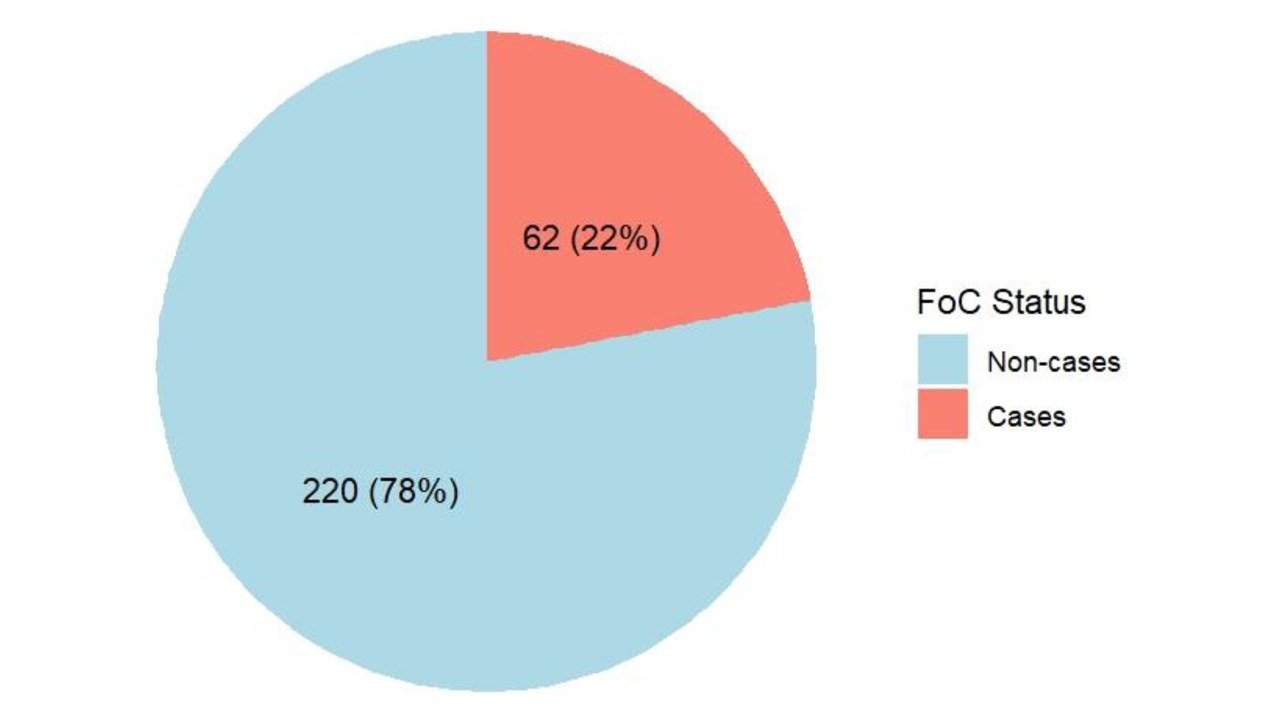
Of the 282 women who participated in the study, 22% had high-to-severe FoC. Nulliparous women (median: 46.0, IQR: 37.0–66.0) reported significantly higher median W-DEQ scores than parous women (median: 39.0, IQR: 32.0–58.5). In a parity-stratified analysis, among nulliparous women, factors such as a history of family abuse (adjusted Β = 16.32, 95% CI: 2.50 to 30.14) and late ANC booking (adjusted Β = 13.13, 95% CI: 1.43 to 24.84) were significantly associated with FoC. Among parous women, factors such as secondary education (adjusted Β = −7.63, 95% CI: −14.88 to −0.37), intimate partner violence (adjusted Β = 10.87, 95% CI: 0.69 to 21.04), unplanned pregnancy (adjusted Β = 8.38, 95% CI: 2.51 to 14.26), and strong family support (adjusted Β = −27.94, 95% CI: −38.77 to −17.11) were significantly associated with FoC.
FoC is common among this cohort of pregnant women, and its determinants differed by parity and across parity-specific factors. The parity-stratified determinants underscore the need for parity-tailored psychosocial care at ANC, incorporating targeted screening and support procedures aligned with parity-associated risk pathways to enhance maternal well-being.
Introduction
Fear of childbirth (FoC) is a well-documented psychological phenomenon affecting both maternal and infant health outcomes worldwide [1]. It involves persistent feelings of anxiety, worry, and psychological distress related to pregnancy, labour, and childbirth. It may manifest through emotional symptoms (e.g., mood swings, somatisation) and cognitive effects, including impaired decision-making [2–4]. FoC is associated with adverse consequences, including increased risk of maternal depressive symptoms, avoidance behaviours such as preference for caesarean section without medical indication, and undesirable birth outcomes [5–9]. A systematic review estimated the prevalence of FoC ranges between 4% and 43%, with an overall pooled prevalence of 14% worldwide [4]. Among pregnant women, FoC is influenced by an interplay of sociodemographic, psychosocial, and obstetric factors, including younger age, lower educational attainment, nulliparity, previous obstetric complications, and lack of social support [6,9,10]. While nulliparous women often report higher FoC due to inexperience and uncertainty, parous women may develop fears related to adverse past birth experiences [4,6].
Reading this evidence
Use the full paper to check the study design, participant selection, comparator and outcome definitions before drawing a practical conclusion. An association does not by itself show cause and effect. A reported performance measure needs its denominator and uncertainty. A finding from a particular facility, sample or time period should retain that scope when it is discussed elsewhere.
This briefing makes the source accessible within the wider public health desk. It does not assess an individual patient or certify a product. When considering relevance to another health system, examine the original authors’ account of context and limitations, then seek local implementation evidence. The related reporting below provides other studies to read alongside this one; it is a topic connection, rather than a claim that their results are directly comparable.
© 2026 Juliana Ofosua Addo, Douglas Aninng Opoku, Julius Kwabena Karikari, Emmanuel Konadu, Mercy Addae, Francis Kwabena Kyei, Mawuse Kanfra, Obed Kwabena Offe Amponsah, Eric Adjei Boadu. Excerpts reproduced under CC BY. Selection, formatting and contextual notes by Health Signal. The researchers are the authors of the source study, not members of Health Signal’s staff.
Explore connected evidence
- Evidence brief: Maternal knowledge of obstetric danger signs and related factors among antenatal care attendees in Hargeisa, Somaliland: A cross-sectional analysis
- Evidence brief: Determinants of knowledge, attitudes and childbirth experiences related to obstetric violence among women who delivered in the public health facilities of Jimma Zone Southwest Ethiopia: A cross sectional study design
- Evidence brief: Prevalence and associated factors of intimate partner violence against reproductive-age women in Africa and Asia regions: Insights from 2022–2024 DHS datasets

