Published in PLOS One on 2026-09-08, this study is presented as an attributed evidence briefing. The excerpts below are the original researchers’ words, reproduced under their Creative Commons Attribution licence. Health Signal has selected the abstract and, where needed, opening background paragraphs; the complete methods, results, limitations and references remain in the linked paper.
Original authors: Heavenlight Estomihi Masuki, Jovin S. Sagale, Celina F. Mhina, Mustafa Yusufali, William Makupa, Milka Mafwiri
Source: PLOS One • DOI 10.1371/journal.pone.0357451
Read the complete primary study ↗ · Creative Commons Attribution licence
From the researchers
Abstract
To determine the anatomical and visual outcomes of macular hole surgery and identify factors associated with surgical success among patients at Kilimanjaro Christian Medical Centre (KCMC) and Comprehensive Community-Based Rehabilitation Hospital (CCBRT), Tanzania.
We conducted a retrospective cohort study between August and December 2023. Data on demographics, pre- and postoperative clinical characteristics, surgical details, and outcomes were extracted from medical records using a structured data collection tool. Analyses were performed using SPSS version 27. The Friedman test was used to compare median pre- and postoperative visual acuity (VA). Generalized estimating equations with logistic regression assessed factors associated with macular hole closure, while gamma regression modelled postoperative logMAR VA, accounting for repeated measures. Statistical significance was set at p < 0.05. Ethical approval was obtained from the Institutional Review Board, and patient data were handled confidentially.
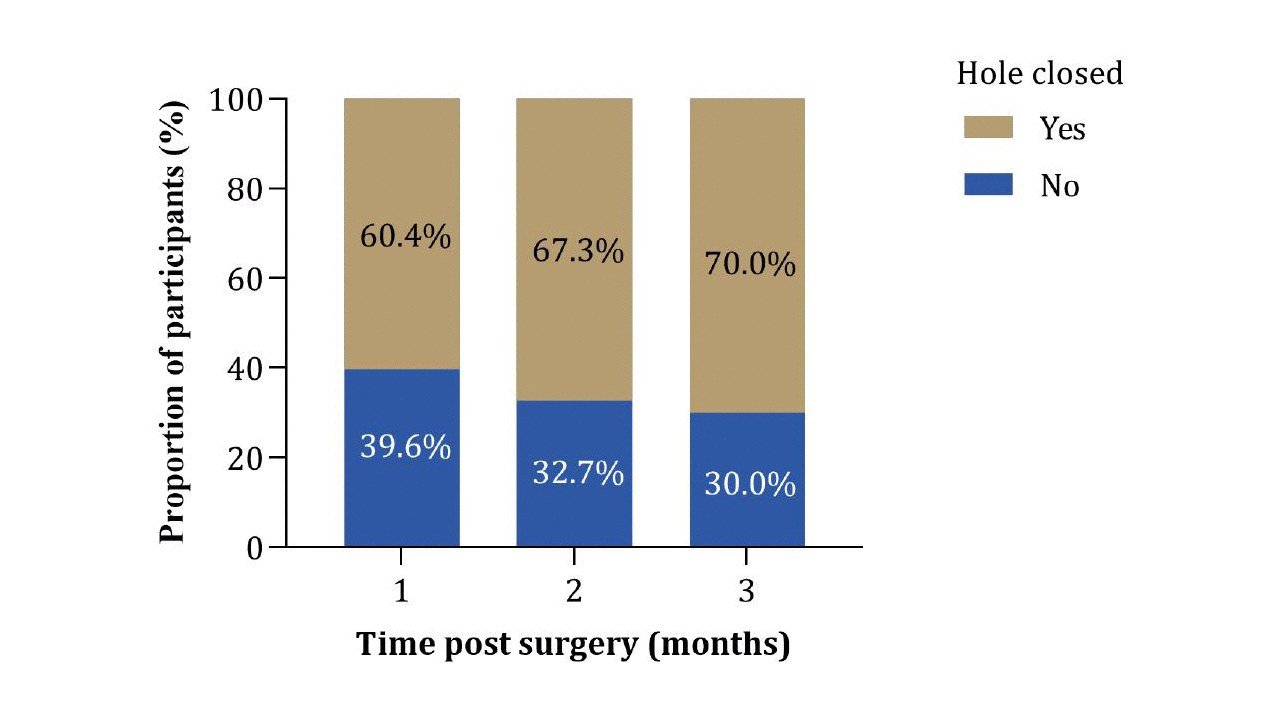
A total of 101 eyes were analysed, of which all had idiopathic macular holes. Preoperatively, the median logMAR VA was 1.2(Snellen 6/96). At three months, median VA improved to 1.00(Snellen 6/60), representing a gain of 0.20 logMAR (approximately two ETDRS lines; p < 0.001). Anatomical closure was achieved in 70% of eyes. Multivariable analysis showed that good preoperative VA increased the odds of macula hole closure (aOR 19.77; 95% CI 1.20–25.3; p = 0.037). The use of the conventional ILM flap technique was associated with an increase in logMAR VA (aβ = 0.05, 95% CI 0.01–0.08, p = 0.012). Anatomical closure correlated with significant visual improvement (p < 0.001). Effect sizes for VA changes were modest, reflecting limited but meaningful functional gain.
Over two-thirds of eyes achieved anatomical closure with modest visual improvement. These findings confirm the effectiveness of macular hole surgery in resource-limited settings. Expanding surgical capacity and applying evidence-based techniques could further improve outcomes. Longer-term follow-up with optical coherence tomography is recommended to optimize treatment strategies and patient counselling.
Introduction
A macular hole (MH) is a vitreoretinal interface disease characterized by a retinal defect in the centre of the macula [1]. Macular holes can occur due to traumatic or idiopathic causes [2]. The macular hole can involve a few layers of the retina (lamellar macular hole) or the entire thickness of the retina (full-thickness macular hole) [3]. If left untreated, macular holes tend to enlarge, leading to loss of the central vision, which increases the risk of falls and accidents, thereby contributing to hospital morbidity [4–6].
Globally, the burden of visual impairment due to macular holes is 0.2–2.2 per 1000 population [4]. It accounts for a significant visual morbidity in the elderly population. Treatment of lamellar macula holes includes observation or ocriplasmin injection. Pars plana vitrectomy, ILM peeling and gas tamponade are widely accepted as the treatment of choice for full thickness macular holes [7]. Surgeries for macular holes were first done three decades ago in developed countries [6]. Studies on MH surgery outcomes report anatomical outcome (hole closure) range of 70% to 100% and a visual improvement of 10 more letters on a Snellen chart [6]. Factors associated with hole closure include the macula hole size, surgical technique and adjunctive procedure [8]. Factors associated with visual acuity included presenting visual acuity, and internal limiting flap technique employed.
Reading this evidence
Use the full paper to check the study design, participant selection, comparator and outcome definitions before drawing a practical conclusion. An association does not by itself show cause and effect. A reported performance measure needs its denominator and uncertainty. A finding from a particular facility, sample or time period should retain that scope when it is discussed elsewhere.
This briefing makes the source accessible within the wider hospital systems desk. It does not assess an individual patient or certify a product. When considering relevance to another health system, examine the original authors’ account of context and limitations, then seek local implementation evidence. The related reporting below provides other studies to read alongside this one; it is a topic connection, rather than a claim that their results are directly comparable.
© 2026 Heavenlight Estomihi Masuki, Jovin S. Sagale, Celina F. Mhina, Mustafa Yusufali, William Makupa, Milka Mafwiri. Excerpts reproduced under CC BY. Selection, formatting and contextual notes by Health Signal. The researchers are the authors of the source study, not members of Health Signal’s staff.
Explore connected evidence
- Evidence brief: Cancer surgical outcome study in Ethiopia: A 7-day multicenter prospective observational cohort study
- Evidence brief: Chronic kidney disease screening and associated factors among people living with HIV on anti-retroviral therapy in Dar Es Salaam, Tanzania: Hospital-based cross-sectional study
- Evidence brief: Management outcomes and factors related to hospital stay for pediatric intussusception in a Tertiary Care Hospital, Northwestern Ethiopia

