Published in PLOS One on 2026-09-09, this study is presented as an attributed evidence briefing. The excerpts below are the original researchers’ words, reproduced under their Creative Commons Attribution licence. Health Signal has selected the abstract and, where needed, opening background paragraphs; the complete methods, results, limitations and references remain in the linked paper.
Original authors: Kathleen O’Connor, Benjamin D. Mallinger, Nicholas A. Bedard, Robin Patel
Source: PLOS One • DOI 10.1371/journal.pone.0356997
Read the complete primary study ↗ · Creative Commons Attribution licence
From the researchers
Abstract
Staphylococcus aureus causes a multiplicity of human diseases acquired in community and healthcare settings alike around the globe. While most studies focus on coding changes to assess genome evolution and study genetic adaptation, interrogation of silent mutations in the form of synonymous codon usage bias is less well-studied. As such, understanding of patterns in codon bias at the gene and genome levels, and how codon bias impacts protein expression in S. aureus remains incomplete.
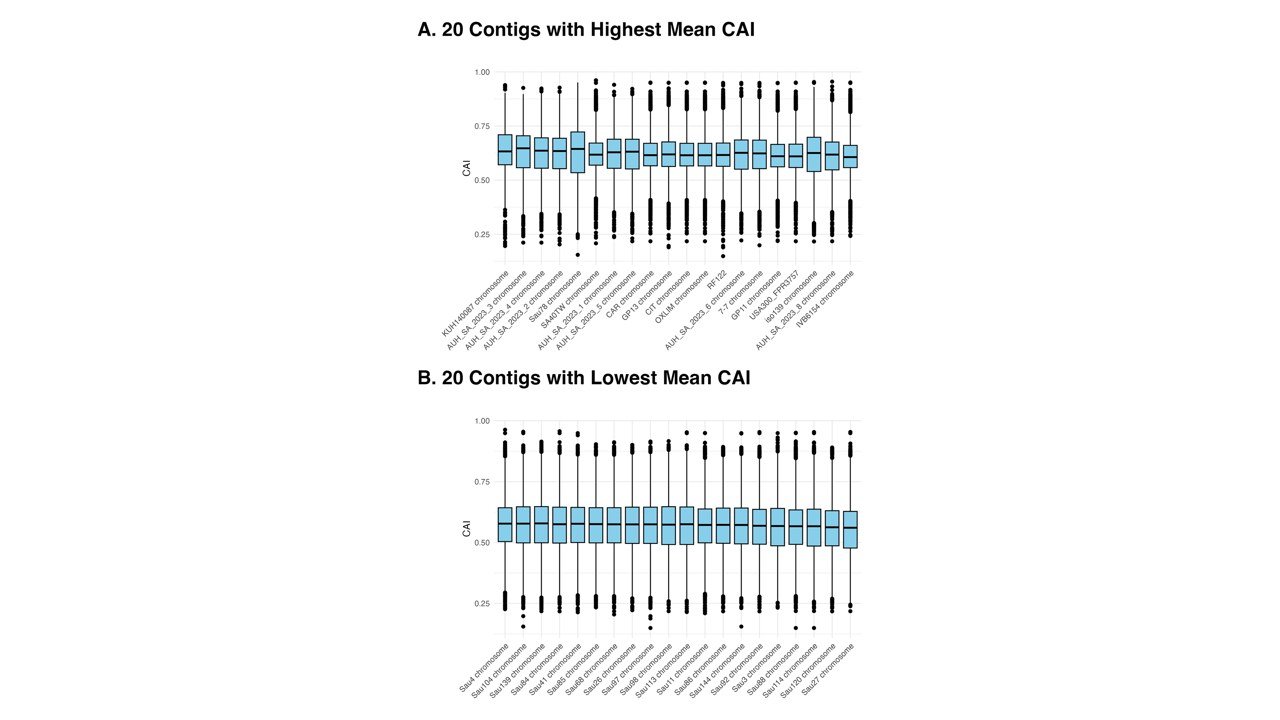
The codon bias of 2,565 protein encoding genes from NCTC 8325 was queried against all publicly available closed S. aureus genomes. Using public BioSample data, genomes were sorted by disease state, submitting institution, and collection site. Codon bias was assessed at the level of gene and genome using the codon adaptation index (CAI), calculated using 30S and 50S ribosomal genes. Gene set enrichment analysis was applied to determine associations between physiological functions, CAI gene scores, and interquartile ranges. CAI scores were also compared to an in vitro S. aureus proteomics database to correlate codon bias and protein expression.
CAI scores varied within and between isolates at the gene and genome levels. Genes with ribosome-associated functions were most enriched among high CAI genes, and had low CAI interquartile ranges (IQR), suggesting selective pressure to maintain high expression of these genes across all S. aureus isolates. Genome sequences submitted by Aga Khan University Hospital, Nairobi, Kenya were most different from others. For the LAC USA 300 strain, CAI and protein expression were moderately positively correlated (cor = 0.534, p < 2.2e-16).
Codon bias in S. aureus was shown to vary between gene, and to be a source of genetic variation between isolates; CAI and in vitro protein expression were positively correlated.
Introduction
In 2019, Staphylococcus aureus was the leading cause of infection-related death in 135 countries, accounting for 1.1 million fatalities [1]. The financial burden of S. aureus-related hospitalizations reaches $16 billion yearly in the United States [2]. As S. aureus adapts, fitness (defined as the ability to produce offspring and in the process pass a genome to future generations) is optimized based on the environment it encounters. Fitness for a given cell requires a specialized “toolbox” of proteins and secondary metabolites. While changes may occur over the course of a lifespan (phenotypic adaptation/“bet hedging”) [3–18], most occur across generations, as mutations accumulate across genomes (genotypic adaptation) [19–35]. Dynamics of genome evolution therefore play a role in an organism’s survival. Genome evolution does not solely occur due to selective environmental pressures; genome changes also accumulate due to random chance, referred to as “genetic drift” [36], often attributed to “bottleneck”-ing events during infection [37–43]. It is likely that S. aureus evolution is driven by both random genetic drift and selective pressure from the various environments it encounters, with sometimes unclear consequences. Bacterial genomic evolution altering protein sequences non-synonymously has been the primary focus of study, potentially obscuring connections between synonymous changes and their impact on bacterial physiology.
Reading this evidence
Use the full paper to check the study design, participant selection, comparator and outcome definitions before drawing a practical conclusion. An association does not by itself show cause and effect. A reported performance measure needs its denominator and uncertainty. A finding from a particular facility, sample or time period should retain that scope when it is discussed elsewhere.
This briefing makes the source accessible within the wider hospital systems desk. It does not assess an individual patient or certify a product. When considering relevance to another health system, examine the original authors’ account of context and limitations, then seek local implementation evidence. The related reporting below provides other studies to read alongside this one; it is a topic connection, rather than a claim that their results are directly comparable.
© 2026 Kathleen O’Connor, Benjamin D. Mallinger, Nicholas A. Bedard, Robin Patel. Excerpts reproduced under CC BY. Selection, formatting and contextual notes by Health Signal. The researchers are the authors of the source study, not members of Health Signal’s staff.
Explore connected evidence
- Evidence brief: Maternal serum vitamin D levels and preeclampsia among Kenyan pregnant women: A matched case-control study
- Evidence brief: “The injection gives freedom” – An exploration of long-acting injectable HIV treatment acceptance among patients seeking care in two Nairobi tertiary hospitals
- Evidence brief: Genomic epidemiology of multidrug-resistant and ESBL-producing Proteus mirabilis in a military referral hospital in Ethiopia