Published in PLOS One on 2026-09-22, this study is presented as an attributed evidence briefing. The excerpts below are the original researchers’ words, reproduced under their Creative Commons Attribution licence. Health Signal has selected the abstract and, where needed, opening background paragraphs; the complete methods, results, limitations and references remain in the linked paper.
Original authors: Kimbley Asaso Omwodo, Joy Njoki Kimani, Kuboi Nicodemus, David Mbugua Kioko, Antoniya Georgieva
Source: PLOS One • DOI 10.1371/journal.pone.0358781
Read the complete primary study ↗ · Creative Commons Attribution licence
From the researchers
Abstract
Preeclampsia accounts for about one in five direct maternal deaths in Kenya. Low vitamin D levels have been linked to its pathophysiology. Despite this, context‑specific data from African populations remain limited. The study aimed to determine the association between maternal serum 25-hydroxyvitamin D [25(OH)D] concentrations (nmol/L) in pregnancy and the risk of preeclampsia in a Kenyan population.
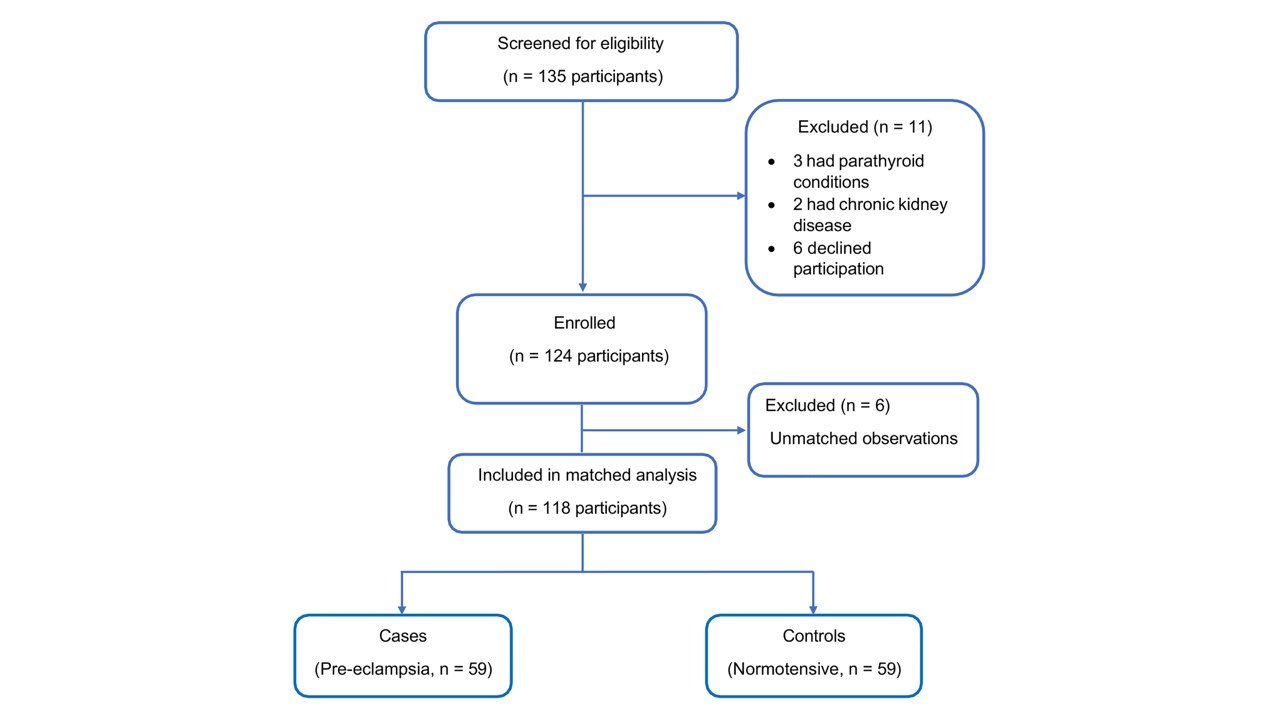
A matched case-control study was conducted at Moi Teaching and Referral Hospital, Kenya. A total of 118 women with confirmed viable intrauterine pregnancies at ≥28 weeks’ gestation were analysed. Fifty-nine women with preeclampsia (cases) and 59 controls were matched by parity, gestation, and age. Serum 25(OH)D was quantified. Vitamin D status was categorised as suboptimal (<50 nmol/L) or sufficient (≥50 nmol/L) status. The association between vitamin D status and preeclampsia was assessed using conditional logistic regression. Odds ratios (ORs) with 95% confidence intervals (CIs) were presented.
Median serum 25(OH)D was significantly lower in preeclampsia cases compared with controls [67.1 nmol/L (interquartile range 47.8–84.0) vs. 77.6 nmol/L (62.4–99.7); P = 0.001]. Suboptimal vitamin D levels (<50 nmol/L) were observed in 32.2% of preeclampsia cases versus 6.8% of controls (P = 0.002). In conditional logistic regression accounting for matching, women with suboptimal vitamin D had higher odds of preeclampsia (OR 8.0; 95% CI: 1.84–34.78; P = 0.006). Each 10 nmol/L decrease in serum 25(OH)D was associated with a 29% increase in preeclampsia odds (OR 1.29; 95% CI: 1.09–1.54; P = 0.004).
In this study, suboptimal maternal serum vitamin D status demonstrated a significant association with preeclampsia. There is potential value in antenatal screening for vitamin D status. Findings support further research into vitamin D supplementation as a preventive intervention for preeclampsia.
Pan African Clinical Trial Registry (PACTR202505516303679).
Introduction
Hypertensive disorders of pregnancy (HDP) refer to a group of medical disorders characterised by high blood pressure occurring during pregnancy. HDP affects up to 10% of pregnancies worldwide [1]. According to the National High Blood Pressure Education Program Working Group on High Blood Pressure in Pregnancy, HDP is classified into four categories: chronic hypertension, preeclampsia (and related disorders: eclampsia and haemolysis, elevated liver enzymes, low platelets [HELLP] syndrome), preeclampsia superimposed on chronic hypertension and gestational hypertension [2].
In Kenya, approximately 1 in 5 direct maternal deaths result from hypertensive disorders, including preeclampsia [3].
Preeclampsia (PE) aetiology can be divided into two distinct phases. The first phase is characterised by defective placentation. The progression into the second phase is marked by decreased vascularisation occurring at the placental site, which initiates a maternal inflammatory response. PE modifies angiogenic as well as antiangiogenic factors, e.g., serum placental growth factor (PIGF), soluble fms-like tyrosine kinase 1 (sFlt-1), and soluble endoglin (sENG) [1].
Reading this evidence
Use the full paper to check the study design, participant selection, comparator and outcome definitions before drawing a practical conclusion. An association does not by itself show cause and effect. A reported performance measure needs its denominator and uncertainty. A finding from a particular facility, sample or time period should retain that scope when it is discussed elsewhere.
This briefing makes the source accessible within the wider hospital systems desk. It does not assess an individual patient or certify a product. When considering relevance to another health system, examine the original authors’ account of context and limitations, then seek local implementation evidence. The related reporting below provides other studies to read alongside this one; it is a topic connection, rather than a claim that their results are directly comparable.
© 2026 Kimbley Asaso Omwodo, Joy Njoki Kimani, Kuboi Nicodemus, David Mbugua Kioko, Antoniya Georgieva. Excerpts reproduced under CC BY. Selection, formatting and contextual notes by Health Signal. The researchers are the authors of the source study, not members of Health Signal’s staff.
Explore connected evidence
- Evidence brief: Association between hypovitaminosis D and uterine leiomyomas among women of reproductive age attending selected hospitals in Uganda: A multicenter cross-sectional study
- Evidence brief: Clinical factors associated with severe maternal outcomes in two South African hospitals: A case-control study
- Evidence brief: Improving maternal outcomes of young mothers through mobile health (mHealth) and community-based interventions: Evidence from a quasi-experimental trial in Kwale County, Coastal Kenya