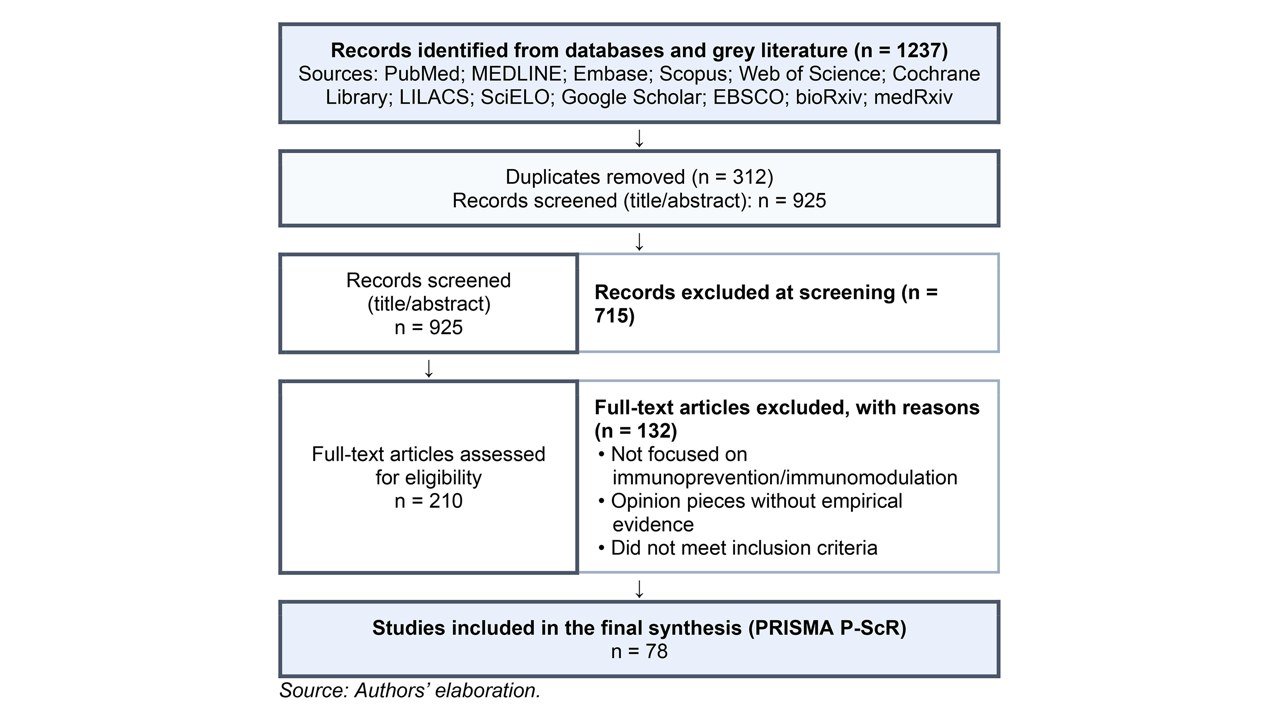
Published in PLOS One on 2026-07-14, this study is presented as an attributed evidence briefing. The excerpts below are the original researchers’ words, reproduced under their Creative Commons Attribution licence. Health Signal has selected the abstract and, where needed, opening background paragraphs; the complete methods, results, limitations and references remain in the linked paper.
Original study title: Immunoprevention and immunomodulation of yellow fever: A scoping review of global and Latin American evidence
Original authors: Clímaco de Jesús Pérez Molina, Flor Elena Chavarro Bermeo, Arlin Martha Bibiana Pérez Hernández
Source: PLOS One • DOI 10.1371/journal.pone.0352755
Read the complete primary study ↗ · Creative Commons Attribution licence
From the researchers
Abstract
Yellow fever (YF) remains a major global public health challenge, with recurrent outbreaks in Africa and the Americas despite the long-standing availability of a highly effective vaccine. In recent years, outbreaks in Brazil and Colombia (2024–2025) have underscored persistent barriers to achieving optimal vaccination coverage and have highlighted the predominantly reactive nature of many public health responses to YF transmission.
To map and synthesize evidence published between 2020 and 2025 on YF immunoprevention and immunomodulation at global, Latin American, and Colombian levels, identifying advances, gaps, and implications for public health policy.
A scoping review was conducted following PRISMA-ScR guidelines. Eligible sources included original research, reviews, and official documents addressing vaccination strategies, safety, and immune responses. Publications in English, Spanish, and Portuguese from January 2020 to September 2025 were retrieved from major databases and grey literature sources. Data were tabulated and descriptively synthesized.
Seventy-eight documents met inclusion criteria. The literature consistently supported the high efficacy of a single 17D vaccine dose, with fractional dosing validated as an emergency strategy in contexts of vaccine shortage. Immunological evidence confirmed strong and durable humoral and cellular responses, consistent with foundational studies conducted prior to 2020. However, important gaps persist, particularly regarding immunogenicity and safety in Latin American populations, older adults, pregnant women, and people living with HIV. In Colombia, universal vaccination campaigns during the 2025 outbreak improved coverage but revealed weaknesses in pharmacovigilance, local research capacity, and sustained prevention strategies.
The 17D vaccine remains the cornerstone of YF control. However, sustaining elimination goals requires not only maintaining ≥95% vaccination coverage but also strengthening pharmacovigilance systems, generating locally relevant immunological evidence, and transitioning from reactive outbreak responses to more proactive, context-sensitive vaccination strategies.
Introduction
Yellow fever (YF) is an acute hemorrhagic arboviral disease caused by a Flavivirus transmitted by mosquitoes of the genera Haemagogus, Sabethes, and Aedes, maintaining both sylvatic and urban transmission cycles with critical epidemiological implications [1]. Clinically, YF is characterized by sudden-onset fever, jaundice, hemorrhage, and multiorgan failure in severe forms, with case fatality rates reaching up to 60% in complicated cases [2]. Despite the availability of a highly effective vaccine for more than eight decades, YF continues to be regarded as a re-emerging disease and a persistent global health challenge due to ongoing transmission in endemic areas, suboptimal vaccination coverage in rural settings, and population movements that facilitate viral introduction into previously YF-free regions [3].
Globally, the World Health Organization (WHO) estimates 84,000–170,000 severe cases and up to 60,000 deaths annually, concentrated mainly in sub-Saharan Africa and the Amazon Basin [4]. Uncontrolled urbanization, deforestation, expansion of Aedes aegypti populations, and limited capacity of health systems to sustain optimal vaccination coverage have contributed to the reemergence of outbreaks in countries that had reported no autochthonous cases for decades [5]. Moreover, the impact of climate change has altered vector distribution patterns, expanding geographic risk areas [6].
Reading this evidence
Use the full paper to check the study design, participant selection, comparator and outcome definitions before drawing a practical conclusion. An association does not by itself show cause and effect. A reported performance measure needs its denominator and uncertainty. A finding from a particular facility, sample or time period should retain that scope when it is discussed elsewhere.
This briefing makes the source accessible within the wider financing & policy desk. It does not assess an individual patient or certify a product. When considering relevance to another health system, examine the original authors’ account of context and limitations, then seek local implementation evidence. The related reporting below provides other studies to read alongside this one; it is a topic connection, rather than a claim that their results are directly comparable.
© 2026 Clímaco de Jesús Pérez Molina, Flor Elena Chavarro Bermeo, Arlin Martha Bibiana Pérez Hernández. Excerpts reproduced under CC BY. Selection, formatting and contextual notes by Health Signal. The researchers are the authors of the source study, not members of Health Signal’s staff.
Explore connected evidence
- Evidence brief: Strategies to improve outcomes of obstetric emergencies in sub-Saharan Africa: A scoping review
- Evidence brief: Impact of demographic factors and HIV status on Hepatitis B vaccination adherence and completion rate among high-risk populations in Lagos State, Nigeria
- Evidence brief: Challenges, opportunities and best practices in routine childhood vaccination services delivery in urban slums and pastoralist regions of Ethiopia: An exploratory qualitative study in marginalized settings